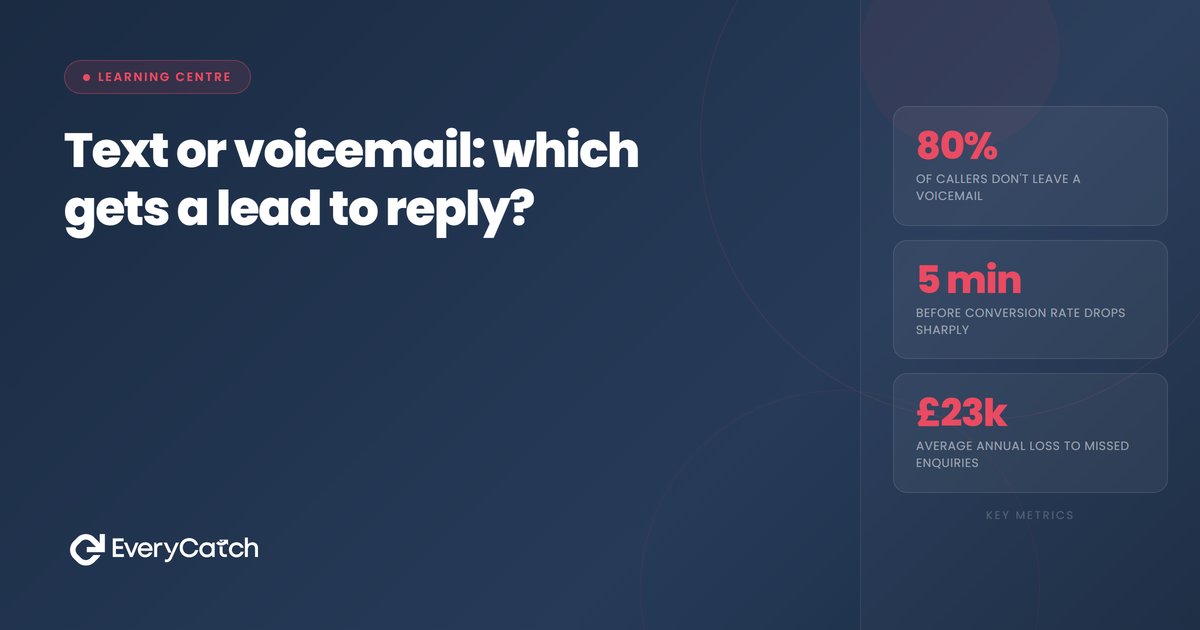
- A text back beats a voicemail on a missed enquiry because it gets read within minutes and can be answered in one line from anywhere
- Voicemail is the only option when the caller rang from a landline, and the stronger option on funeral, legal, medical and large-build enquiries where tone carries weight
- A text leaves a usable record carrying your name, your number and a booking link, while a voicemail leaves nothing to tap and nothing to forward
- A text can go out automatically the second a call rings out, whereas a voicemail needs a person who has already noticed the missed call
- On bigger jobs, text inside two minutes and then call, in that order, so your number is recognised when it rings back
Text or voicemail: the short answer
Text back. For a missed call from a new enquiry, a text is the stronger choice nearly every time, because it gets read within minutes and the caller can answer it without having to ring you again. A voicemail asks them to listen to it, note your number down, and make a second call. Plenty of people never get past the first step.
That isn't a blanket rule, and the useful part of this comparison is the cases where it breaks. Voicemail holds up on bigger and more sensitive jobs, and it's the only route open if the number that rang was a landline. There's also a third answer that beats either on its own, which is sending the text immediately and following it with a call later.
Whichever way you go, the gap between the missed call and your reply does more damage than the channel you picked, which is the whole argument in why leads go cold in the first five minutes.
The four deciding factors
Four things do the deciding for a missed enquiry, and they are worth naming before either option is assessed.
Whether the message gets seen at all comes first. A well-judged reply nobody opens is worth as much as no reply.
How much effort your message demands comes second. Every extra step between your message and their reply loses people, and you're asking that of someone already dialling the next number on their list.
Whether the channel works for that number comes third. Office switchboards and home landlines still account for a real share of inbound calls in some trades, and a text sent to one never arrives.
How much the tone of first contact matters comes fourth. A blocked drain and a £40,000 extension are not the same conversation.
Where texting back wins
Texting wins on visibility first. A text lands on the lock screen with your business name attached and gets read without the recipient agreeing to anything. Voicemail sits behind an icon they have to choose to open, two or three taps deep on a lot of handsets.
It wins again on effort. A text can be answered in one line from a meeting room, a building site or a train carriage, none of them places to return a call. Someone holding an unheard voicemail has to find a quiet five minutes instead, and that's how a warm enquiry becomes tomorrow's problem. It's the same behaviour behind why SMS gets opened at a far higher rate than email.
Then there's what the message leaves behind. A text sits in the caller's phone carrying your name, your number and whatever you asked them, and you can put a booking link or a price band straight into it. A voicemail leaves nothing to tap and nothing to forward to a partner before deciding.
The real advantage is that a text doesn't need you present. Automated first contact within minutes of every enquiry can fire the second a call rings out, while you're up a ladder or under someone's sink. A voicemail needs a person who already knows the call was missed, and that's the step that quietly stops happening on a busy Friday.
Where leaving a voicemail still wins
Voicemail isn't finished, and writing it off costs real work in three situations.
Landlines are the clearest of them. If an office number or a home landline rang you, a text has nowhere to arrive, so a voicemail or a straight callback is all you have. The landline share keeps shrinking as the phone fades as a primary enquiry channel, but in trades selling to offices, schools and care homes it's still the number that rings.
High-value and emotionally heavy jobs are the second situation. A family arranging a funeral, a client with a probate matter, a homeowner under a collapsed ceiling, all want evidence that a competent human has picked this up. Thirty seconds of a steady voice does that. A text can read as brisk, or worse, as automated, at precisely the moment the caller needs reassurance.
The third is when the caller has left a voicemail of their own. Someone who spoke for ninety seconds about a complicated job has shown you how they'd rather communicate, and one line of text back is a mismatch they'll register.
One honest qualifier. Voicemail transcription on iPhones and current Android handsets means a good share of voicemails now arrive as readable text anyway, which narrows the visibility gap. Transcription still garbles trade terms, postcodes and prices often enough that it hasn't closed it.
How many calls are you missing in a week?
Working out where the gap is takes about fifteen minutes, and the answer is usually bigger than owners expect.
Book a free discovery callText or voicemail compared on each criterion
Set against those four factors, plus two practical ones, the pattern is more lopsided than the debate suggests.
| Factor | Texting back | Leaving a voicemail |
|---|---|---|
| Gets seen | Read on the lock screen, usually within minutes | Needs a deliberate decision to open and listen |
| Effort to respond | One line, from anywhere, no privacy required | Needs a quiet moment and a return call |
| Works for the number | Mobiles only, nothing reaches a landline | Works on any number that rang you |
| Tone and reassurance | Flat by default, so the wording has to carry it | Carries warmth, pace and competence directly |
| What it leaves behind | Written record, booking link, your number saved | Nothing to tap, nothing to forward on |
| Can run without you | Yes, triggered automatically on a missed call | No, somebody has to notice and record it |
Texting takes four of the six rows outright and loses two clearly. The sensible reading is a text as the standing default, with voicemail kept for the cases where it genuinely wins.
Which to use, by the kind of work you do
The recommendation splits by job type far more than by business size.
Emergency and reactive trades, so plumbing, locksmiths, electricians and emergency glazing, should text first without exception. The caller is working down a list of three numbers and whoever answers first tends to get the job. A voicemail arrives after that decision has been taken.
Scheduled domestic work belongs on text too. Gardeners, cleaners, decorators and salons handle enquiries that aren't urgent but are casual, and a text matches how the caller already arranges this kind of booking.
High-ticket project work is where the hybrid earns its keep. Building firms, kitchen fitters and architects should text straight away, then ring back inside the hour and leave a voicemail if nobody picks up.
Professional and sensitive services should lead with the voice. Solicitors, funeral directors, private clinics and veterinary practices can send a short text confirming who called, then make the call. The text handles the acknowledgement, the call handles the substance.
Doing both, in the right order
The strongest version of this uses both channels. Text inside two minutes, then follow with a call and a voicemail twenty to thirty minutes later if nothing has come back.
Order matters more than it looks. Text first and the caller knows who you are before your number shows up again, so the callback gets answered rather than screened. Call first and your number is unknown, the call gets ignored, the voicemail with it, and the text afterwards reads like a sales message from a stranger.
Keep the text short and specific about the missed call. Something like "Hi Sarah, Dave here from Dave's Plumbing, sorry I missed your call. What's the job and which postcode are you in? Happy to ring back in ten minutes."
If the voicemail does get left, it should reference the text rather than repeat it. Thirty seconds is plenty, and saying the number twice at a readable pace does more good than anything else in it.

From the EveryCatch team
EveryCatch was built for service businesses where the person answering the phone is also the person doing the work. Missed-call texts, follow-up and booking run automatically, so an unanswered call still gets a reply within minutes.