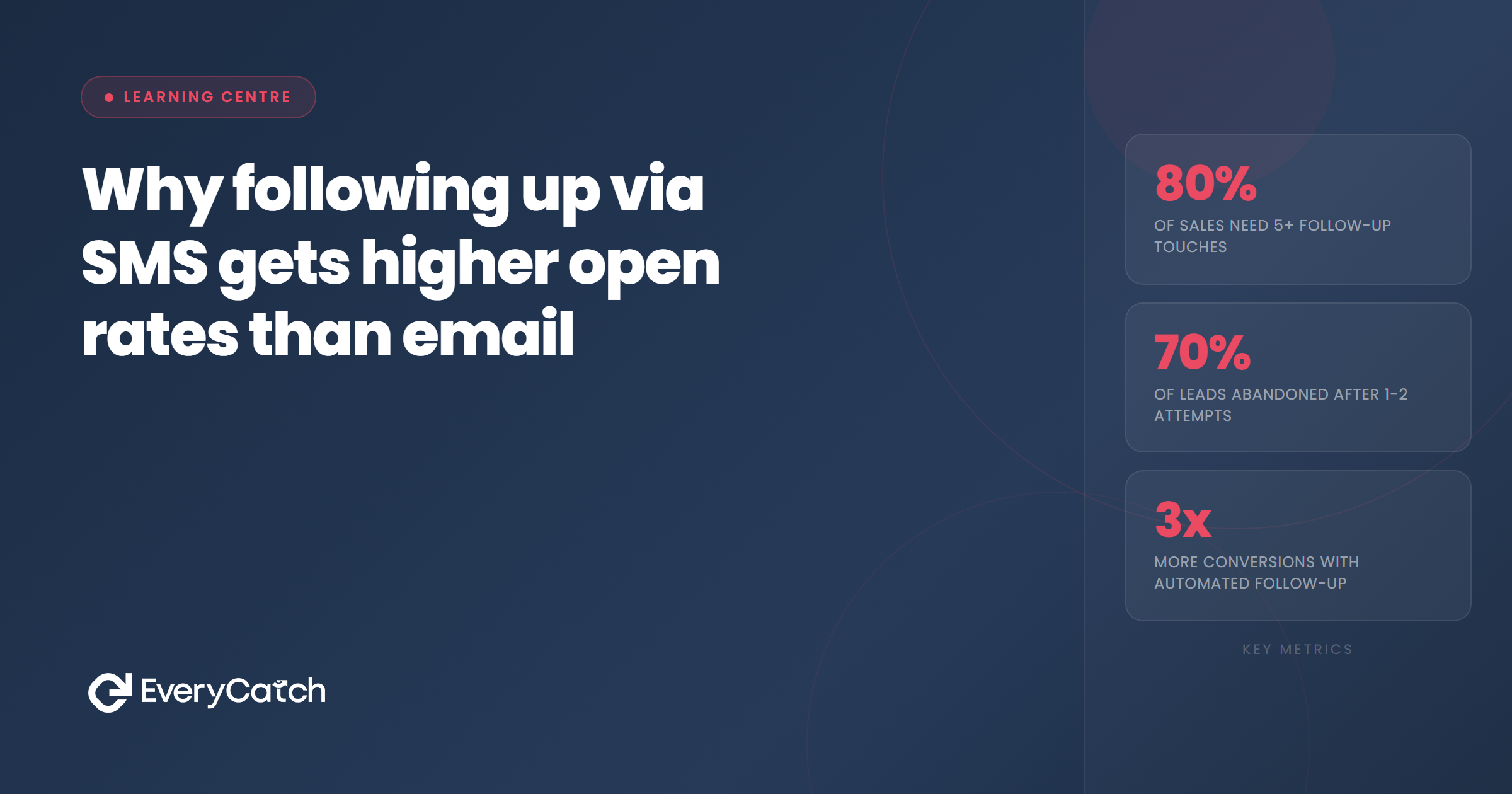
- SMS messages achieve 98% open rates within minutes, while emails average 20% and often sit unread for hours
- Text messages bypass spam filters entirely, guaranteeing delivery to your prospect's main inbox
- People check their phones 96 times per day on average, creating multiple opportunities for engagement
- SMS works best for time-sensitive follow-ups, while email suits detailed information and longer-form content
- Combining both channels in a sequence produces the highest overall conversion rates
When you send an email, you're competing with 121 other messages that arrived in your prospect's inbox today. When you send a text, you're one of maybe six. That fundamental difference explains why SMS gets opened, read, and acted on at rates email can never match.
The statistics tell a clear story. Email open rates hover around 20% for most industries. SMS open rates sit at 98%. Email response rates average 6%. SMS response rates reach 45%. These aren't marginal improvements. They represent a completely different level of engagement.
For service businesses trying to convert warm leads before they cool off, this difference matters enormously. A plumber who texts within five minutes has a dramatically better chance of booking the job than one who emails and waits. The medium you choose shapes whether your follow-up succeeds or disappears into the void.
The open rate difference
The 98% open rate for SMS sounds too good to be true, but the mechanism behind it is simple. When a text message arrives, your phone lights up, vibrates, plays a sound, and displays a preview of the message on your lock screen. You don't need to unlock your device, open an app, or navigate to an inbox. The message is right there, demanding attention.
Email requires multiple steps. You need to notice the notification, open your email app, find the message among dozens of others, and decide whether the subject line merits your time. Each step creates friction, and friction kills open rates.
The average person reads 90% of text messages within three minutes of receiving them. The same metric for email stretches to 90 minutes. That three-minute window versus 90-minute gap represents the difference between catching someone while they're still thinking about your service and reaching them after they've moved on to other priorities.
Industry data shows that SMS open rates remain consistently high across all age groups, income levels, and geographic regions. Email open rates vary wildly depending on sender reputation, subject lines, time of day, and whether your domain has been flagged by spam filters. Text messages work reliably. Email requires constant optimisation just to maintain baseline performance.
Why people respond faster to texts
Speed matters because leads decay quickly. A prospect who fills in your contact form at 2pm is actively looking for your service right now. By 5pm, they've received three quotes from competitors. By tomorrow, they've made a decision. The business that responds fastest usually wins.
Text messages create urgency that emails don't. When your phone buzzes with a text, you check it immediately. You might let emails pile up for hours, but texts feel like they require instant attention. This psychological difference translates directly into response behaviour.
The brevity of SMS reinforces this urgency. A text message arrives, gets read in seconds, and prompts an immediate decision. Reply now or ignore it. Email invites procrastination. People read emails, flag them for later, and then forget they exist. Text messages force a yes-or-no response in the moment.
Research shows that 90% of people respond to a text message within 30 minutes. For emails, 90% of responses arrive within 48 hours. This isn't a small timing difference. It's the gap between converting a lead while they're hot and watching them choose a competitor who moved faster.
How people treat texts versus email
People have fundamentally different relationships with their text inbox versus their email inbox. Email inboxes are chaotic war zones filled with newsletters, promotional messages, automated notifications, and actual important correspondence. Text message inboxes contain real conversations with real people.
This distinction shapes how seriously people take messages from each channel. An email from an unknown business gets the same mental treatment as a clothing sale notification or a LinkedIn message. A text from an unknown number gets treated like a potential appointment reminder or time-sensitive update.
The average person checks their phone 96 times per day, according to recent studies. Each check creates an opportunity for your message to be seen. Email checking happens far less frequently, with most people reviewing their inbox three to five times daily. More touchpoints mean more chances to catch someone's attention.
Text messages also benefit from smaller inbox sizes. Most people have between zero and 20 unread texts at any given time. Unread email counts routinely reach hundreds or thousands. Standing out in a queue of six messages is infinitely easier than competing with 347 unread emails.
Wondering how many leads go cold while you're sending emails?
See how SMS follow-up systems capture more responses in less time.
Book a free discovery callSMS bypasses the spam folder
Email deliverability is a constant battle. Your messages compete with spam filters, domain reputation systems, and increasingly aggressive inbox sorting algorithms. Even legitimate business emails frequently land in spam folders or promotional tabs where they never get seen.
Text messages have no spam folder. When you send an SMS to someone's mobile number, it arrives in their main message thread. There's no filtering system deciding whether your message deserves to be seen. No algorithm sorting it into a "promotions" category that never gets checked. The message simply arrives.
This guaranteed delivery matters enormously for time-sensitive follow-ups. When a potential customer requests a quote, you need certainty that your response reaches them. Email provides no such certainty. Your carefully crafted follow-up might be sitting in a spam folder right now, never to be read.
Mobile network regulations do restrict SMS marketing in ways that email marketing isn't restricted. You need explicit consent to text someone for marketing purposes. But for service businesses doing legitimate follow-up with people who have specifically requested contact, these restrictions pose no obstacle. Your messages get through because they're expected and wanted.
When to use SMS versus email
The high open rates of SMS don't mean you should abandon email entirely. Each channel has appropriate use cases, and the smartest follow-up strategies use both.
Text messages excel at immediate, time-sensitive communications. Appointment confirmations, quick updates, urgent responses to enquiries, and short follow-ups asking simple questions all work brilliantly via SMS. The medium forces brevity, which keeps messages focused and actionable.
Email handles detailed information better. Quotes with multiple line items, lengthy explanations of services, attached documents, and comprehensive project proposals all belong in emails. Text messages have character limits. Email doesn't.
The most effective approach combines both. A typical sequence might start with a text message within minutes of receiving an enquiry, confirming you've received their request and will follow up shortly. An email follows with detailed information, pricing, and next steps. Then another text a day later checks whether they received the email and asks if they have questions.
This multi-channel approach plays to the strengths of each medium. SMS ensures your initial response gets seen immediately, establishing that you're responsive and attentive. Email provides the detail and documentation prospects need to make decisions. A second text breaks through inbox clutter to re-engage prospects who might have missed or forgotten about your email.
Timing also influences channel choice. Texts work well during business hours when immediate responses are appropriate. Late evening or early morning texts can feel intrusive. Email accepts a wider sending window because people read emails on their own schedule.
The key is understanding that SMS and email aren't competitors. They're complementary tools that solve different problems in your follow-up process. Use texts when speed and certainty of delivery matter most. Use email when depth and detail matter most. Use both when you want the highest possible conversion rates.

From the EveryCatch team
We help service businesses respond faster to every lead with automated SMS and email sequences that feel personal. Our systems text prospects within seconds, then follow up systematically until they respond or book.