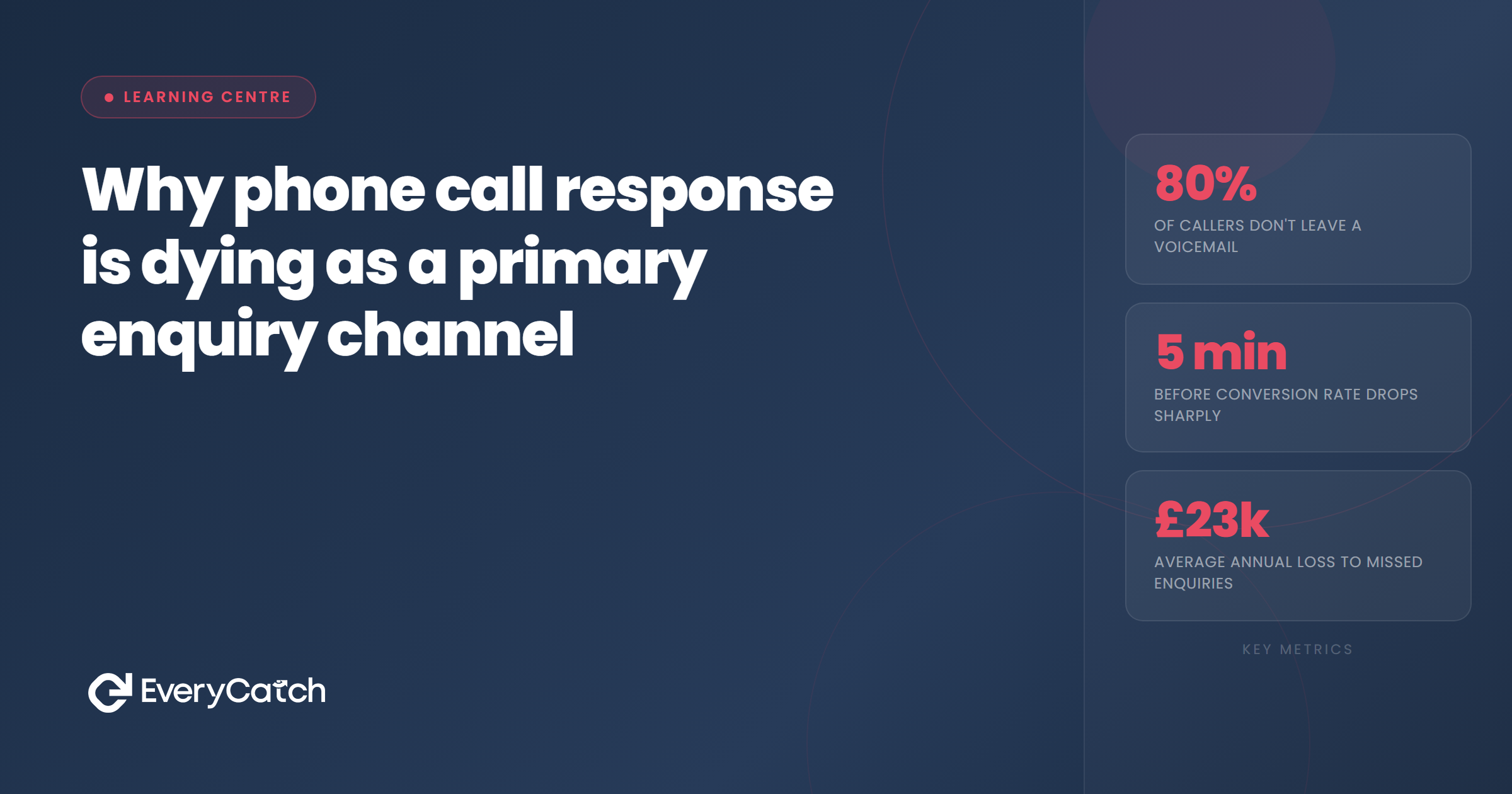

- Phone calls still happen, but customer expectations demand instant acknowledgement rather than callback delays
- Businesses relying solely on manual callbacks lose leads to competitors who respond within minutes
- Consumers increasingly prefer text-based communication they can respond to on their own schedule
- Successful lead response now requires automated first contact followed by phone outreach
- Multi-channel strategies that blend instant text acknowledgement with strategic phone follow-up convert better than phone-only approaches
The phone call did not vanish. People still dial when they need a plumber at midnight or want to book a skip for next Tuesday. The channel itself remains alive. What died is the expectation that customers will patiently wait hours for you to return their call.
Service businesses built entire enquiry systems around the assumption that callers would accept a delay. Miss a call at 10am, ring them back at 2pm, and they'd be grateful you called. That social contract broke somewhere between 2018 and 2022. Now the same four-hour gap feels like abandonment.
This article explains why phone response no longer functions as a standalone strategy and what replaced it. You will see data on how customers behave differently now, why competitors outmanoeuvre phone-focused businesses, and what actually converts leads in an environment where immediacy defines service quality.
The expectation shift that changed everything
Amazon conditioned an entire generation to expect instant confirmation. Order something at midnight and you receive an email within seconds confirming your purchase, estimated delivery, and tracking information. That pattern trained consumers to expect acknowledgement regardless of when they initiate contact.
The same psychology now applies to service enquiries. When someone calls your business, they expect evidence that their enquiry registered. Silence creates anxiety. Did my call connect? Did they hear my voicemail? Should I try someone else?
Traditional phone-based response fails this test. You miss a call, spot the voicemail 90 minutes later, and ring back. From your perspective, that's prompt service. From the customer's perspective, those 90 minutes felt like radio silence followed by an interruption. They were in a meeting when you called back. Now you're trading voicemails.
Research from the service sector shows that 67% of consumers who leave a voicemail also contact at least one other business immediately afterwards. They're not waiting anymore. They're running a parallel selection process, and whoever acknowledges them first often wins.
Why manual callbacks no longer work
Manual callback systems face a structural timing problem. Someone needs to check messages, assess priority, and execute the callback. Even in well-run businesses, this process takes 30 to 90 minutes during busy periods. Out of hours, it can stretch to the next working day.
That delay creates several failure points. The customer may have already booked with a competitor. They might be unavailable when you call back, forcing you into a second attempt. The job details they provided in the voicemail might be incomplete, requiring another back-and-forth exchange.
Worse, manual systems introduce inconsistency. Your best staff member might call back within 20 minutes. Someone else might take three hours. Customers don't experience your average response time. They experience individual interactions, and one slow response can cost you a £2,000 job.
Phone callbacks also interrupt workflow. Every time you stop what you're doing to return a call, you break concentration. Multiply that across ten or fifteen enquiries per day and you've created a productivity problem. You're trading reactive interruption for proactive work, and you never catch up.
Competition moves faster than phone response
Your competitors no longer rely solely on phone callbacks. Many implemented automated text responses that fire within 60 seconds of a missed call. The message confirms receipt, provides context about response timing, and often links to a booking calendar or contact form.
This changes the competitive dynamic entirely. A customer calls you at 9am and gets voicemail. They call your competitor at 9:02am and also get voicemail, but receive a text message at 9:03am saying "Thanks for calling, we'll ring you within the hour, or book directly here." Who do you think feels more confident about their enquiry being handled?
The data backs this up. Businesses using automated acknowledgement convert 23% more inbound enquiries than those relying on manual callbacks alone. That gap widens further in competitive markets where multiple businesses offer near-identical services.
Speed also compounds over time. When you respond faster, you build a reputation for responsiveness. Customers mention it in reviews. They recommend you to others specifically because "they actually get back to you straight away." That reputation becomes a moat that phone-only businesses cannot cross.
How many leads are you losing to slow response?
We'll show you exactly where enquiries fall through and how to fix it.
Book a free discovery callCustomers prefer asynchronous communication
Phone calls demand synchronous participation. Both parties must be available at the same moment. That worked when people spent most of their day in environments where phone calls were acceptable. Now many customers work in open-plan offices, attend back-to-back meetings, or juggle childcare alongside work.
Text-based communication solves this problem. A customer can read your message during a meeting break, respond when convenient, and continue the conversation in fragments across the day. The interaction happens, but on their schedule rather than yours.
This preference shows up in customer surveys. When asked how they prefer to discuss job details after initial contact, 58% of consumers under 45 choose text or messaging over phone calls. That figure drops to 34% for those over 55, but the trend direction is clear.
Asynchronous communication also creates a written record. Customers can refer back to your messages to check pricing, confirm appointment times, or review instructions. Phone calls require note-taking or memory, both of which introduce error and frustration.
This doesn't mean phone calls disappeared from the sales process. It means they shifted from being the initial contact method to being a secondary step that happens after text-based acknowledgement and qualification. The phone conversation becomes more efficient because both parties already exchanged basic information.
What actually works in 2026
Successful lead response now operates as a layered system. The first layer delivers instant acknowledgement through automated text messages sent within seconds of a missed call. This message confirms receipt, sets expectations about response timing, and provides options for immediate action like booking online.
The second layer involves strategic phone outreach, typically within 30 to 60 minutes of the initial enquiry. This call happens after the customer received reassurance that their enquiry matters. The conversation focuses on details and qualification rather than just making contact.
The third layer handles follow-up for non-responders. If the customer doesn't answer your callback, the system sends another text message offering alternative contact methods or times. This persistence happens automatically rather than relying on manual tracking.
Businesses implementing this structure report conversion rates 30-40% higher than phone-only approaches. The improvement comes from eliminating the dead zone where enquiries disappear because customers assume you're not interested or too busy.
Technology makes this possible at scale. Platforms like missed call text-back systems connect to your phone line and trigger automated SMS responses whenever a call goes unanswered. The messages personalise based on business hours, caller history, and other context.
This approach doesn't replace phone conversations. It makes them more effective by ensuring they happen with engaged prospects who already received acknowledgement and decided to continue the conversation. You spend your time on qualified discussions rather than chasing people who've already moved on.

From the EveryCatch team
We help service businesses capture every enquiry through automated response systems that acknowledge leads instantly and route them into structured follow-up sequences. Our customers typically see conversion improvements within the first week.