- There is no single right number — response speed benchmarks vary by channel and service type
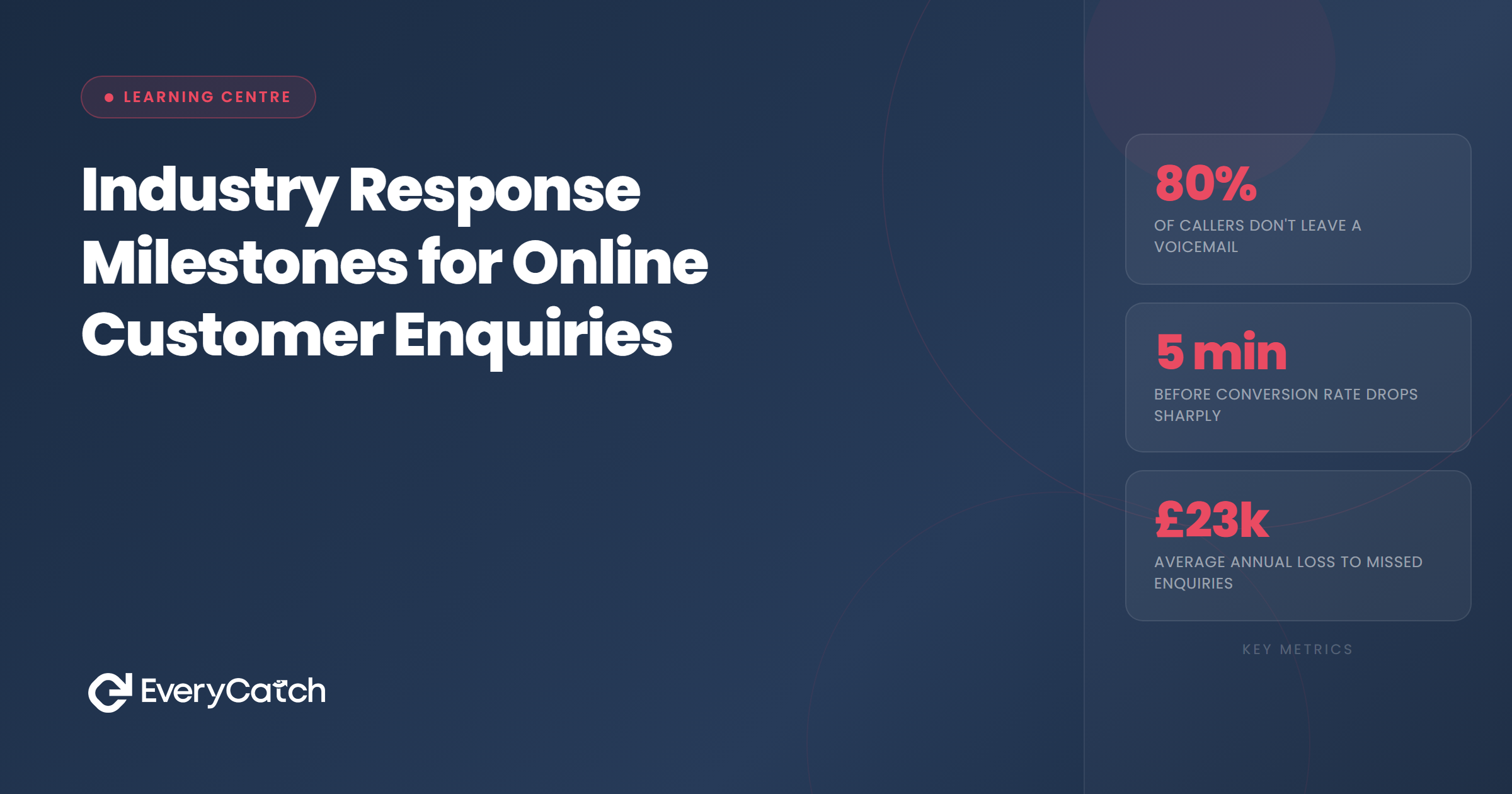
- For web forms, WhatsApp, and social messages, under five minutes puts you ahead of most competitors
- Emergency and urgent services face a higher bar than planned, considered purchases
- Speed alone is not enough; the quality of the first response shapes whether the conversation progresses
- Out-of-hours enquiries are often the highest-intent ones — and the most commonly ignored
The question sounds straightforward. It is not, because the right answer depends on several things at once: the channel the enquiry came through, the nature of the service, what the competition looks like, and whether it is a Tuesday afternoon or a Saturday evening.
What is clear is that the old standard of "we'll get back to you within one business day" is well below the expectation most customers now have. That standard was set in a world of fax machines and postal quotes. It is not the world your customers are operating in.
There is no universal number
If you search for response time benchmarks, you will find a range of figures — five minutes, one hour, 24 hours. They are not all wrong. They reflect different contexts.
An emergency plumber operating in a competitive urban market faces a completely different situation from a bespoke furniture maker with a three-month lead time. The plumber's prospective customer is standing next to a burst pipe and will go with whoever calls back first. The furniture customer has no urgency and will probably wait a few days before following up with any business they contact.
The general principle applies across both: the sooner you respond meaningfully, the better your position. But "soon" means something different in each case. Failing to call back an emergency enquiry within 20 minutes is probably a lost job. Failing to respond to a bespoke joinery enquiry within 20 minutes is unlikely to cost you anything.
The practical question for most service businesses is not "what is the ideal response time?" but "what response time consistently puts us ahead of the businesses our customers are also contacting?"
What the research shows
The most widely cited finding on lead response time comes from sales research published over a decade ago and replicated in various forms since: businesses that respond to leads within five minutes are significantly more likely to make contact and qualify a prospect than businesses that respond after 30 minutes or longer.
The research was originally conducted in B2B sales contexts. Service business dynamics are somewhat different — you are not chasing a corporate decision-maker through layers of gatekeepers — but the underlying principle holds. When someone enquires, they are in an active decision-making state. They are thinking about their need, comparing options, and ready to engage. Getting in front of them during that window matters.
The competitor dimension makes this more concrete. If a prospective customer contacted three local builders and you are the only one who responded within five minutes, you are having a live conversation while the other two have not even acknowledged the enquiry yet. That is an advantage that is difficult to recover once it is lost.
See why speed of response determines who wins the job for a deeper look at what the first contact actually does to a competitive situation.
How the channel changes the expectation
Different channels carry different implicit expectations. Responding to each at the same speed misses this.
Phone calls are the most urgent. A missed call is immediately obvious to both parties. If you cannot answer, a callback within 15 minutes during business hours is a reasonable target. An SMS acknowledging the missed call and giving an approximate callback time buys goodwill and stops the prospect from immediately trying your competitors.
WhatsApp and social media DMs sit at the fast end of the expectation scale. People message on these platforms with the expectation of a relatively quick reply — not instant like a live chat, but considerably faster than email. Under five minutes is competitive. Under 60 seconds stands out.
Web contact forms are where most service businesses have the biggest gap. People submit a form and then return to what they were doing. The mental model they have is "I've sent a message, I'll hear back at some point." But the reality is that they are probably also filling in forms on your competitors' sites. An automated acknowledgement within seconds followed by a human or AI response within a few minutes keeps you in the conversation at the moment it matters most.
Email enquiries carry a lower urgency expectation than messaging channels. Within two hours during business hours is acceptable. Within an hour is better. Any enquiry left until the following morning is a risk, because the prospect has had time to hear from — and potentially commit to — someone else.
What a good first response actually involves
Responding quickly with the wrong thing is only marginally better than not responding at all. A generic "thanks, we'll get back to you soon" sent within 30 seconds is a response in terms of timing. It is not a response in terms of engagement.
A first response that moves the conversation forward will do at least two things: acknowledge what the person actually told you about their need, and ask one specific question that progresses things. It demonstrates you have read the enquiry, not just received it.
This is where the fear about automated responses often comes from. Business owners worry that an automated reply will feel hollow. A badly configured autoresponder will. But a properly set up AI response that references the prospect's specific situation, answers their obvious questions, and asks something relevant does not feel impersonal — it feels attentive. Why automated response does not mean impersonal response covers this in detail.
The speed benchmark is a condition that needs to be met. The quality of the response is what determines what happens next.
Want to know your actual response time?
Most businesses think they are faster than they are. Book a discovery call and we will walk through your real enquiry flow — including what happens at 7pm on a Friday.
Book a free discovery callThe out-of-hours question
All of the benchmarks above are implicitly about business hours. But enquiries do not respect business hours.
A significant share of service business enquiries arrive in the evening, at weekends, and over bank holidays. These tend to be high-intent. Someone looking for a local tradesperson at 9pm on a Sunday is not browsing idly — they have a real need and they want it sorted. They may also be searching because the problem just became apparent and they want to get things in motion.
The question for most small service businesses is not whether to staff 24/7 — that is generally impractical and uneconomic. The question is: what does the person who enquires at 9pm on Sunday experience?
At minimum, an automated acknowledgement that confirms receipt and sets an expectation ("We've got your message — we'll be in touch first thing Monday") is far better than silence. A step up from that is an AI system that can hold the initial conversation, answer standard questions about your services, and even book a call or site visit. The prospect leaves the interaction feeling heard rather than ignored, and you start Monday with a warm, progressed lead rather than a cold form submission.
How to set up 24/7 lead response for a small business outlines the practical options at different levels of complexity and cost.
The right response speed benchmark for your business is the one that keeps you ahead of whoever else your prospects are contacting. For most service businesses, that means faster than you are currently managing — and available at times when you currently are not.