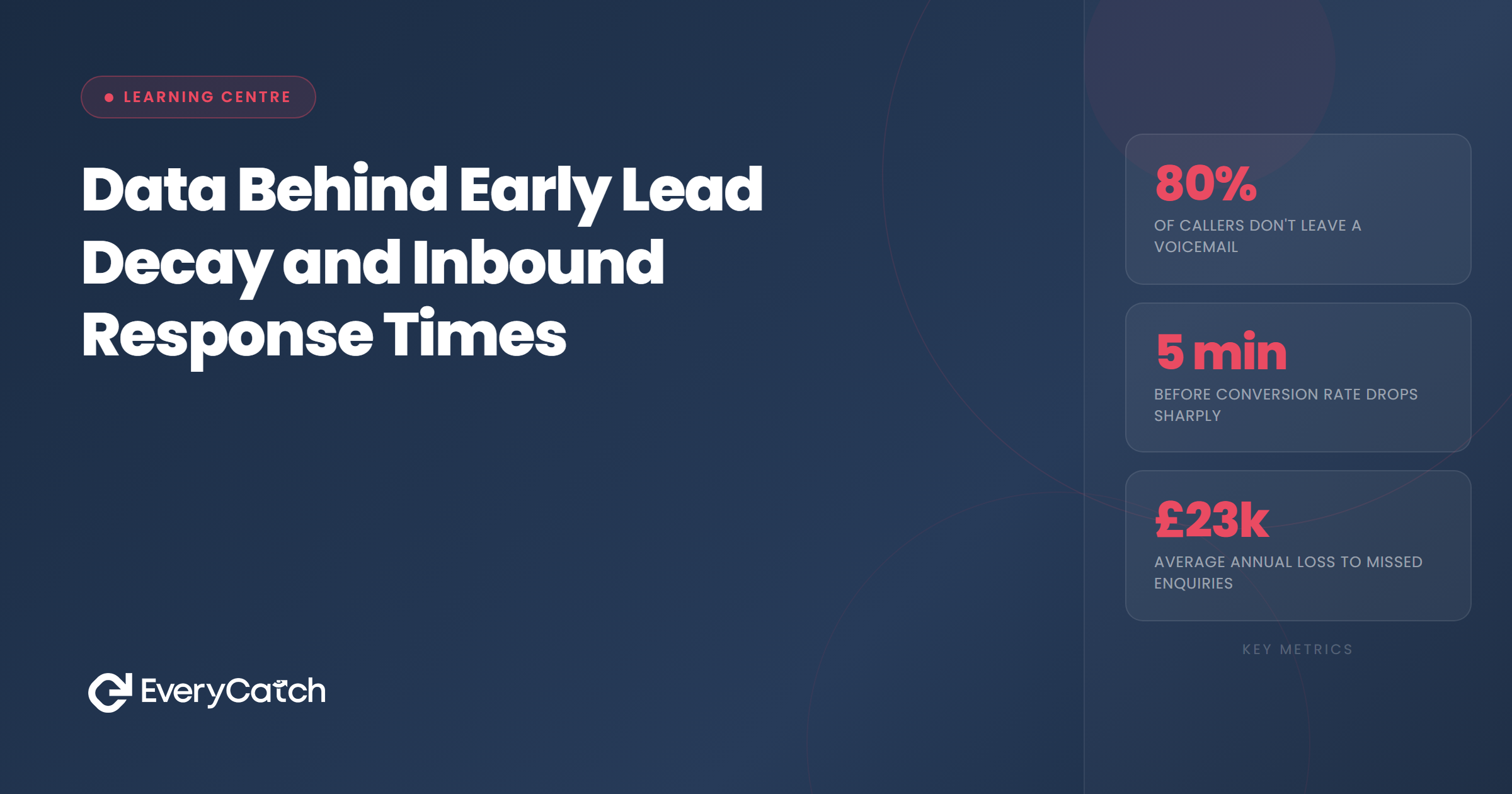

- Most people who enquire about a service contact more than one business at the same time
- The first meaningful response carries a significant advantage — the prospect is still in decision-making mode
- Leads cool quickly; after an hour or two, you are competing against someone who already started a conversation
- Lost leads in this window disappear silently — no feedback, no explanation
- The fix is not more headcount; it is a reliable first-response system that operates whenever enquiries arrive
When someone sends an enquiry to your business, they are rarely sending it only to you.
This is the uncomfortable part. You might see a contact form submission come in at 6.45pm, make a mental note to reply after dinner, and get back to them at 8.30pm with a perfectly good message. The reply you get is polite but brief: "Thanks, I've sorted it." You never know who sorted it for them, or when, or how close you were to winning that job.
That is the standard pattern. People with a service need contact several local businesses, then go with whoever engages them properly and first. Most service business owners believe they respond reasonably quickly. The data, when they actually measure it, usually tells a different story.
Most prospects contact multiple businesses at the same time
This is well-established behaviour, not a theory. When someone needs a plumber, a personal trainer, an accountant, or a kitchen fitter, they do not typically research one business in detail, decide they want that business, and then get in touch. They search, they find a few that look credible, and they send enquiries to two, three, or four of them. Then they wait to see who responds.
Whoever starts a real conversation first is ahead. Not just ahead in the race to respond, but ahead in building the relationship. That first exchange, if it is relevant and attentive, sets the tone for everything that follows. It signals that the business is organised, responsive, and probably reliable on the job too.
Your competitors may not be faster than you in any meaningful operational sense. They may not do better work or charge fairer prices. But if they respond to an enquiry 90 minutes before you do, they have already had a conversation with your potential customer that you have not yet started.
Why the first few minutes carry more weight than later ones
When someone submits an enquiry, they are in the decision-making mindset. They have identified a need, done some initial research, and taken the step of getting in touch. Their attention is on this. They are thinking about the problem, the options, and who can help them.
That state does not last. Ten minutes later they are back to whatever they were doing. An hour later the mental energy around this particular decision has dissipated. Two hours later, if someone else has already replied and started a proper conversation, the prospect may have mentally moved on. When your response eventually arrives, it is being compared not against silence, but against an existing dialogue.
This is not absolute. Some enquiries are patient. Some jobs are complex enough that people expect a slower turnaround before they hear from anyone. But for most standard service business enquiries, especially those arriving via web forms, WhatsApp, social media messages, or Google, the first few minutes are disproportionately important.
How fast should a service business respond to an enquiry covers the specifics by channel and industry type.
What actually happens after an enquiry is sent
Consider a realistic scenario. Someone needs a boiler service and fills in contact forms on three local heating engineers' websites at 7.15pm on a Wednesday.
Business A has an automated first-response system. Within two minutes, the prospect receives a message that acknowledges their request, confirms what they need, and asks one relevant question about their boiler type. It is not a generic acknowledgement — it is specific to what they wrote.
Business B has the owner pick up a phone notification at 9pm and fire off a quick response.
Business C has an admin person who picks it up at 9am Thursday morning.
Business A is nearly two hours ahead of Business B and fourteen hours ahead of Business C. More than that, Business A is the only one that showed up while the prospect was still actively thinking about it. By the time Business B responds, the prospect has probably already replied to Business A and started narrowing things down.
Business C is almost certainly too late. Not because the work cannot be won, but because they are starting from a significant deficit of attention and trust.
The invisibility problem
The most damaging aspect of this is that you cannot see it happening.
Lost leads in this window do not announce themselves. The prospect does not send you a message explaining that they went with someone faster. They simply do not reply to your eventual response, or they send a brief "thanks, all sorted" and move on. You log it as a dead enquiry. You have no idea whether the job went to someone else in the first twenty minutes, or whether the prospect simply changed their mind.
This means the scale of the problem is almost always underestimated. You see the enquiries you converted. You do not see the full shape of what was possible — including the jobs you were well-placed to win, had you just been a little faster.
The only way to get a clearer picture is to measure your actual response times and compare them against your conversion rate. Why your business is losing leads before you even know about it goes deeper on how to audit this properly.
Not sure how your response times compare?
Book a discovery call. We will walk through your current enquiry flow, map where the gaps are, and give you an honest picture of what you are likely losing.
Book a free discovery callThe solution is a system, not more staff
When business owners recognise this problem, the first instinct is often to hire someone to handle enquiries. That can work. It can also be expensive, unreliable out of hours, and unavailable when a member of staff calls in sick or goes on holiday.
The practical solution for most service businesses is a first-response system that does not depend on a human being available at exactly the right moment. This does not need to be complicated. At its simplest, it is an automated first reply that acknowledges the enquiry, demonstrates that you have read what the person actually wrote, and moves the conversation one step forward.
For businesses that want something more capable, an AI-configured response system can hold an intelligent conversation, answer business-specific questions, and even book appointments without any human involvement in those early stages. How to respond to enquiries instantly without hiring more staff outlines the options at different levels of complexity.
The goal is the same at every level: make sure that when someone enquires, they hear from you while they are still paying attention. EveryCatch Speed-to-Lead is built around exactly this principle, responding to new enquiries across every channel in under 60 seconds.
The five minutes after an enquiry arrives are not the only thing that determines whether you win the job. Pricing, reputation, availability, and follow-up all matter. But the first few minutes are where the competitive landscape is set, quietly and invisibly, before most business owners know the race has begun.