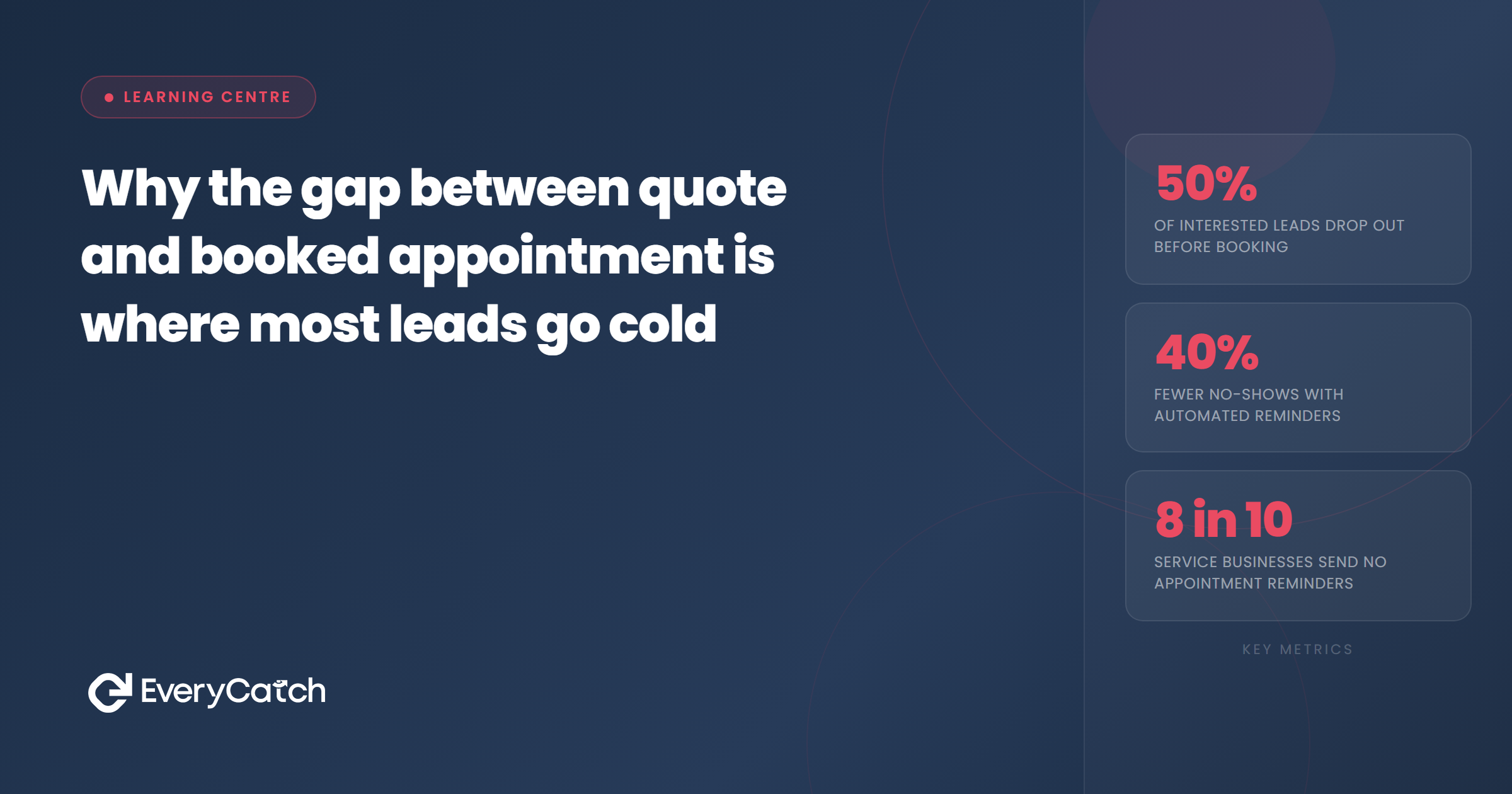
- The gap between sending a quote and the prospect booking an appointment is the highest-attrition point in most service business sales journeys.
- Most leads lost in this gap are not lost to a decision — they are lost to inertia, competing priorities, and a lack of a clear prompt to take the next step.
- Businesses miss this dropout because they track quote-sent and appointment-booked separately, without measuring the conversion rate between the two.
- Closing the gap requires a specific next step embedded in the quote itself — not a follow-up several days later.
- An automated prompt sent 24–48 hours after a quote with no response recovers a meaningful proportion of leads who were simply waiting to be nudged.
The invisible dropout point in the sales journey
Every service business has a sales funnel, even if it is not written down anywhere. A lead comes in, a conversation happens, a quote or proposal is sent, and then — in the best case — an appointment or contract follows. The steps are clear. The gap between them is not.
Between the quote being sent and the appointment being booked is a period of silence where the prospect is, in theory, considering. In practice, a significant proportion of those prospects are not actively considering anything. They received the quote, got pulled into something else, and have not thought about it since. They are not gone — they are just not moving. And because no one has given them a reason to move, they stay where they are until someone else fills the space.
That someone else is usually a competitor who followed up faster or more consistently. The lead does not switch because the competing quote was better — often it was not. The lead switches because the competing business kept the conversation warm and made the next step easy. The original business did not.
What actually happens in the gap
The prospect receives the quote and intends to read it properly when they have a spare hour. The spare hour does not arrive as planned. The next day they are in meetings. The day after, something urgent comes up. By day three, the quote is three screens down in the inbox and the emotional momentum that made them enquire in the first place has dissipated.
At this point, the prospect is not hostile to the service. They are not comparing competitors. They are simply idle — waiting for something to reignite the process. What usually reignites it is either a direct prompt (a follow-up from the business) or a change in their own circumstances (the problem gets worse, a deadline approaches, a colleague mentions the same need). The businesses that follow up have some control over the first trigger. They have no control over the second.
This dynamic explains why a short, well-timed follow-up after a quote often converts at a much higher rate than businesses expect. The prospect was not unconvinced — they were just waiting for someone to restart the conversation.
Want to close the gap between quote and booked appointment?
EveryCatch builds the follow-up process so your quotes don't disappear into silence.
Book a free discovery callWhy most businesses do not see this gap in their data
The quote-to-appointment gap is invisible to most businesses because of how they measure performance. They know how many quotes they send, and they know how many appointments or jobs follow. But they do not usually calculate the conversion rate between the two, and they do not track how long the gap is for the quotes that do convert versus the ones that do not.
If ten quotes are sent and four convert, the business sees a 40% win rate. This seems acceptable. But if most of those four conversions happened within 48 hours — and the remaining six never converted because no follow-up was sent after day three — the story is different. The win rate is not 40%. The win rate on quotes that received timely follow-up is much higher, and the win rate on quotes left without follow-up is significantly lower.
Measuring conversion rate by follow-up behaviour is not standard practice for most small service businesses, but it is the measurement that reveals where the real improvement opportunity sits.
What actually closes the gap
Two things reliably close the quote-to-appointment gap: embedding the next step in the quote itself, and sending a follow-up prompt within 48 hours if no response arrives.
Embedding the next step. A quote that ends with "please let me know if you have any questions" creates no particular pressure to act. A quote that ends with "to confirm the work, simply reply to this email or use this link to book your appointment slot" tells the prospect exactly what to do and makes doing it easy. The difference is not in the quality of the quote — it is in whether the quote actively invites the next step or simply waits for the prospect to initiate it.
The 48-hour follow-up. A short message sent 48 hours after the quote, specifically acknowledging the quote and asking whether there are any questions or whether the prospect would like to go ahead, recovers a predictable proportion of leads who were simply waiting for a prompt. This message does not need to be long or clever. "I wanted to check whether you had a chance to look over the quote I sent on Tuesday — happy to answer any questions or book you in if you are ready to proceed" is sufficient.
The system that prevents leads from falling into the gap
Manual follow-up is better than no follow-up, but it depends on discipline that is difficult to sustain across a team or across a high volume of quotes. The more reliable solution is a system — a process that fires automatically when a quote is sent and no response arrives within a defined window.
The elements are straightforward: a quote template that includes a clear next step and booking link, a CRM or workflow tool that tracks when the quote was sent and whether a response came in, and an automated message that fires to quotes without responses at the 48-hour mark. For businesses doing ten or more quotes per month, this system typically pays back its setup cost in the first few recoveries.
The underlying principle is that the gap between quote and appointment is not a prospect behaviour problem — it is a process gap. Prospects do not intend to go quiet; they just do not have a clear, easy path back to the next step. A system that creates that path, reliably, for every quote sent, closes the gap without depending on someone remembering to follow up.

From the EveryCatch team
EveryCatch builds the follow-up systems that close the gap between quote and appointment — so every quote gets the follow-up it deserves without anyone having to remember to send it.