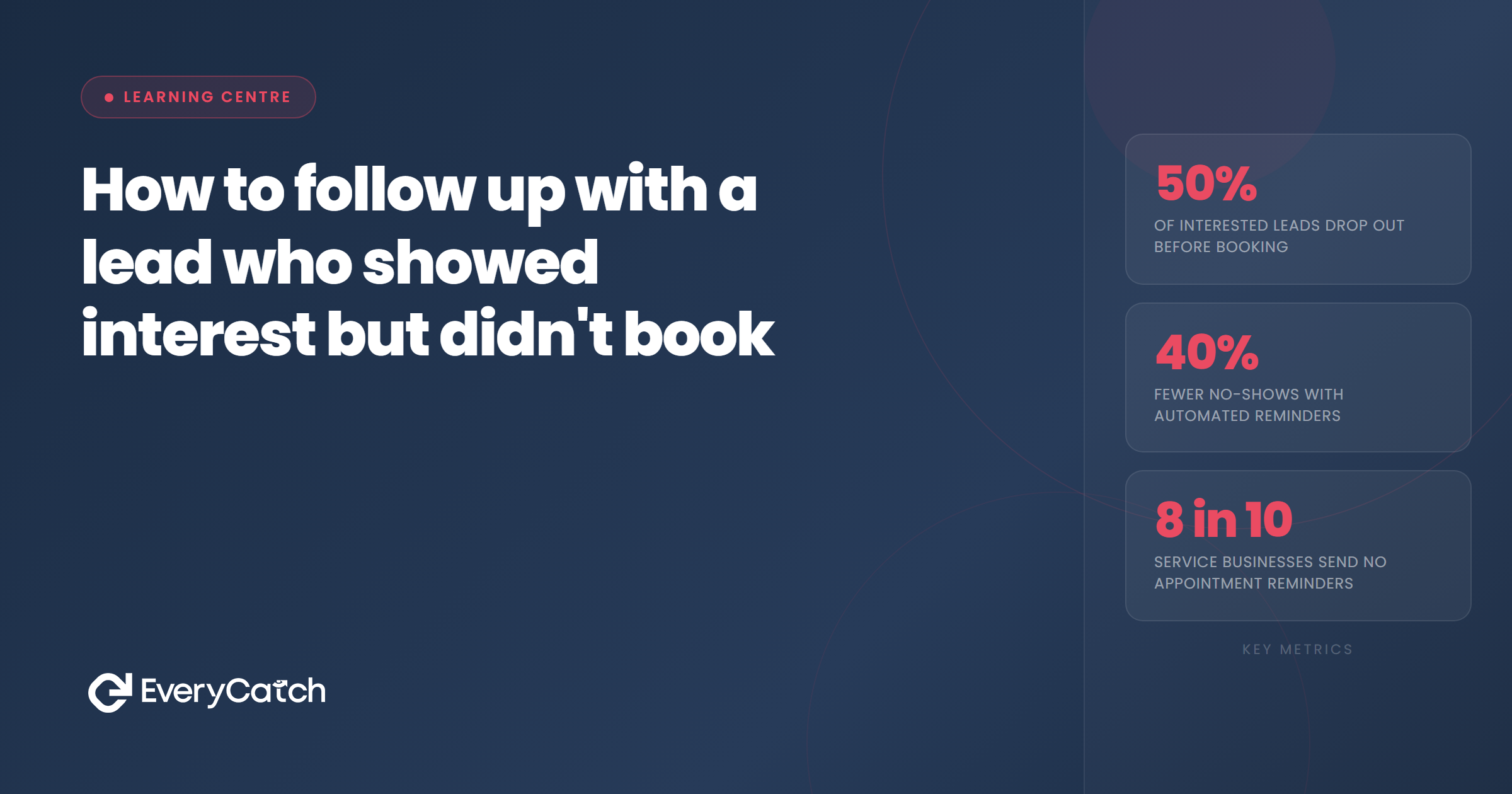
- Most leads that show interest but do not book are stalled by timing or distraction, not disinterest — one well-placed follow-up often resolves it.
- The first follow-up should arrive within 24–48 hours of the interaction that showed interest.
- The message should be short, specific to the interaction, and focused on making it easy to take the next step — not on persuading.
- A second touchpoint seven to ten days later covers the leads who were genuinely busy, not just slow.
- After two follow-ups with no response, moving the lead to a longer-cycle nurture sequence is more productive than continuing direct outreach.
Why leads stall without booking — and what it usually means
A lead who reads your content, fills in a contact form, or starts a booking process and then goes quiet is rarely a lead who has decided against you. In most cases, they are a lead who got interrupted. Something else came up — a work deadline, a family matter, another supplier they were also considering — and the moment passed. The intention is still there, but the momentum is not.
This distinction matters because it changes the nature of the follow-up. A lead who has decided against you needs to be released without burning the relationship. A lead who is stalled needs one thing: an easy, low-pressure way back to the next step. The mistake most businesses make is treating stalled leads as if persuasion is needed, when what is usually needed is simply a prompt.
Step 1: Send the first follow-up within 24–48 hours
The timing of the first follow-up is the most important variable in whether it works. A follow-up sent within 24 hours of the triggering interaction — a form submission, a page visit with an email capture, a quote request — arrives while the prospect still remembers why they were interested. A follow-up sent a week later arrives after the moment has passed and the prospect may not even immediately place your business.
For leads who started a booking process but did not complete it, 24 hours is the right window. For leads who made an enquiry but did not take the next step, 48 hours is acceptable. Beyond that, the connection between the follow-up and the original interest starts to weaken, and the prospect is more likely to receive the message as a cold contact than as a continuation of a conversation they started.
If you are doing this manually, a note in your CRM or a reminder to yourself is sufficient. If you are doing any volume of enquiries, an automated follow-up triggered by the relevant action — a form submission that did not lead to a booking, a quote sent without a response — is more reliable than manual discipline.
Want automated follow-up that recovers stalled leads?
EveryCatch builds the follow-up sequences so nothing falls through the gaps.
Book a free discovery callStep 2: Write a message that helps, not one that chases
The difference between a follow-up that works and one that annoys comes down to intent. A message that focuses on "we noticed you didn't complete your booking" reads as surveillance. A message that focuses on "I wanted to make sure you had everything you needed" reads as service.
The effective follow-up message for a stalled lead has three elements:
- A specific reference to the interaction that triggered it — not a generic "you visited our website" but "you asked about our monthly plan on Tuesday"
- A single clear next step — one link, one action, not a list of options or a request to "get in touch when ready"
- A low-pressure close — "happy to answer any questions before you decide" or "here is the link if you would like to book when it suits you"
Keep the message short. Three to five sentences is the right length for a first follow-up. A long message requires effort to read, and a stalled lead is by definition someone who does not currently have mental bandwidth to spare for your process.
Step 3: Add a second touchpoint seven to ten days later
A proportion of leads who do not respond to the first follow-up are genuinely busy rather than uninterested. The first message arrived at the wrong moment — a difficult week at work, a week away — and was skimmed and set aside. A second touchpoint seven to ten days later reaches this group.
The second message should be different in angle from the first. Where the first message was a direct prompt ("here is the link to book"), the second message can add value before asking for anything: a piece of relevant content, an answer to a question the prospect might have at this stage, or a brief note about something that changed since the first message. "We have a new time slot available on [date] if that works better" is a legitimate second touchpoint that does not feel like a repeat of the first.
The second message should be just as short as the first — brevity is not a courtesy, it is a signal that this message was worth reading rather than deleting.
Step 4: Know when direct outreach has run its course
Two direct follow-ups with no response is the limit for most service business contexts. A third direct message, regardless of how it is framed, starts to feel like pressure — and pressure pushes stalled leads further away rather than bringing them back.
After two unanswered follow-ups, the right move is to shift the lead to a longer-cycle nurture sequence: a monthly content email, a relevant article, a low-frequency touchpoint that keeps your business visible without creating the expectation of an immediate response. Some leads in this category will convert months later, when their timing changes. A nurture sequence keeps the door open without cluttering it.
The final optional step is a close-loop message: "I don't want to keep sending messages you don't find useful — if you decide to come back to this in future, here is the link. Happy to help when the time is right." This message consistently gets responses from leads who are stalled rather than disinterested — the lack of pressure creates space for a genuine reply.

From the EveryCatch team
EveryCatch helps service businesses build automated follow-up sequences that recover stalled leads without manual tracking. The sequences described in this article can be set up once and run automatically for every enquiry that does not convert immediately.