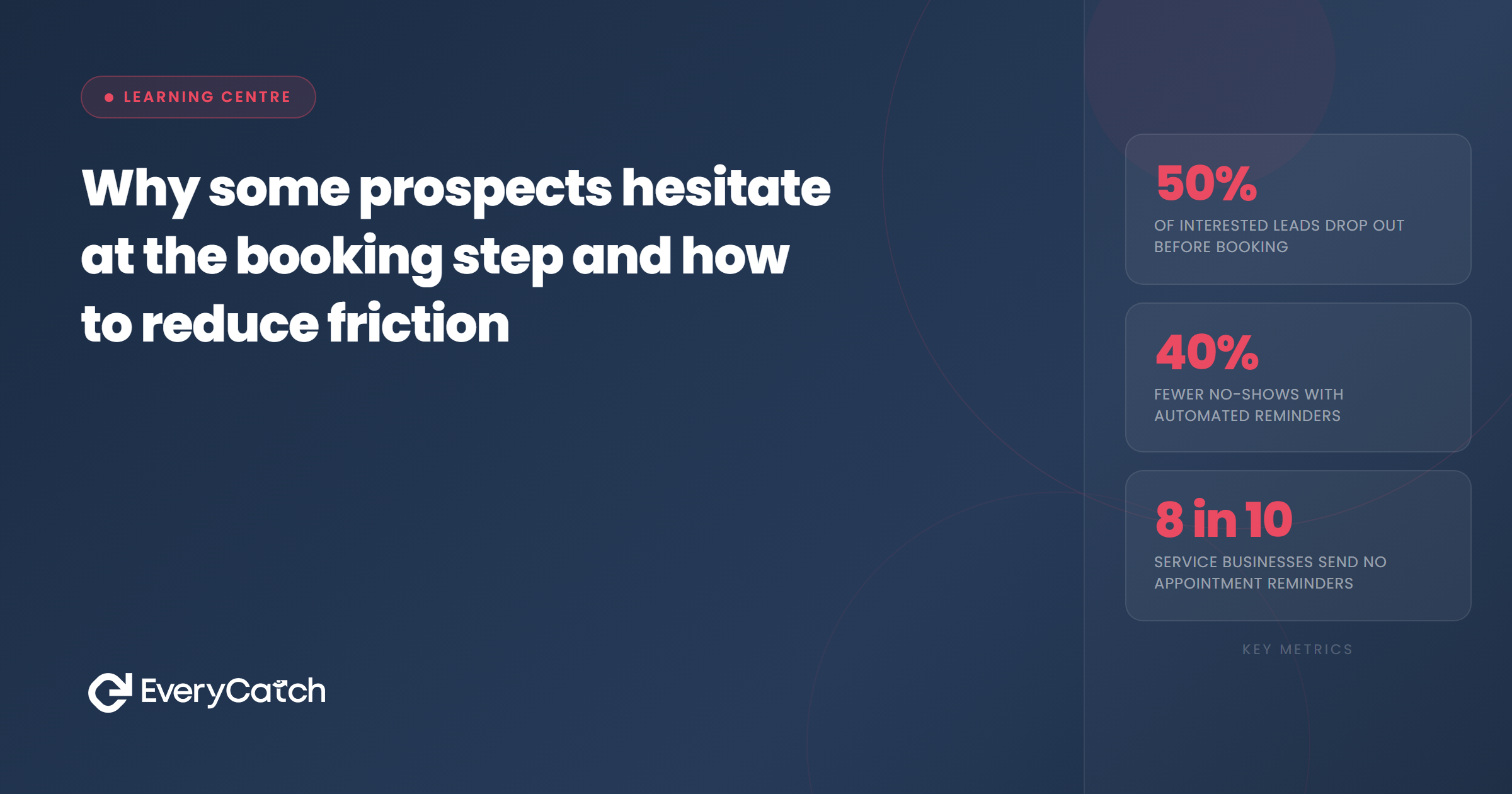
- Hesitation at the booking step is almost always about uncertainty, not disinterest — the prospect is looking for reassurance, not a reason to leave.
- The most common causes are: unanswered questions about what happens next, doubt about whether now is the right time, and uncertainty about commitment level.
- Trust signals on the booking page — reviews, names, faces, clear next-steps — directly address each of these concerns.
- Reducing the apparent commitment level (short calls, no obligation framing, cancellation clarity) converts hesitant prospects into booked ones.
- Booking page drop-off data shows you where hesitation occurs — and makes it diagnosable rather than assumed.
The hesitation moment — what is actually happening
A prospect who reaches your booking page has already made several positive decisions. They read something that interested them, they followed a link, they looked at your service offering, and they clicked through to book. By any measure, this person is interested. The hesitation that sometimes occurs at the booking step is not a reversal of those decisions — it is a pause.
In that pause, the prospect is answering a question for themselves: "Am I ready to do this right now?" The outcome depends heavily on what they find on the page in front of them. If the page reinforces confidence, they book. If the page creates uncertainty — through a long form, missing information, unclear next steps, or an absence of social proof — some will close the tab and tell themselves they'll come back later.
Most of them do not come back. Not because the service was wrong for them, but because the moment passed and the next thing filled its place.
What specifically creates doubt at the booking stage
Understanding the causes of hesitation makes it fixable. The most common ones are not mysterious:
Uncertainty about what happens after booking. If the prospect cannot see a clear description of what the next step looks like, they fill that gap with assumptions — and assumptions can go in either direction. "Will someone call me straight away? Do I have to do something? Is this going to turn into a sales call?" A clear "here is what happens next" section on the booking page removes this completely.
No visible evidence that other people have been through this. A booking page with no testimonials, no reviews, and no names or faces asks the prospect to trust a business they cannot yet verify. For a service business selling something intangible, social proof is not a nice addition — it is doing active conversion work at the exact moment the prospect needs to decide.
The form feels like more commitment than they intended. A booking form with many fields, a requirement to provide detailed information, or the appearance of a binding commitment creates more anxiety than the prospect expected. They came to book a call, not sign a contract.
The page asks for something they are not ready to give. This might be a phone number (if they prefer to communicate in writing), a deposit (if they did not know one was required), or information about a specific requirement (if they are not sure of the answer yet). Any unexpected request creates a friction point.
Is your booking page losing prospects it should be converting?
EveryCatch can help identify where drop-off happens and what to do about it.
Book a free discovery callTrust signals that work on booking pages
Trust signals are not decoration. On a booking page, each one is doing a specific job in the prospect's decision-making process. These are the ones that reliably move the needle:
Reviews with names and photos. Anonymous reviews carry less weight than named ones. A review from "Sarah, Birmingham" reads differently to a review from "A satisfied customer." Including a photo — even a simple initial avatar — adds human context that a text-only review does not have.
A clear description of the next step. "After you book, you will receive a confirmation by email. Andrew will then call you within one business day." This removes the uncertainty about what happens next and makes the post-booking experience feel predictable and safe.
A face and a name from the team. Service businesses sell trust as much as they sell a service. A photo of the person who will be in touch, or who will turn up at the site, makes the booking feel less abstract. The prospect is booking a call with a person, not submitting a form into a void.
Explicit low-commitment framing. "No obligation, no pushy sales call" or "This is a fifteen-minute call to see if we are a good fit" are phrases that directly address the fear of being cornered into something. They work because they are answering the question the prospect is already asking.
Reducing commitment anxiety without reducing your standards
Some businesses worry that reducing the apparent commitment level makes them look less serious. The opposite is true. A business confident enough to say "come and have a quick chat, no pressure" signals that it wins on the quality of what it delivers — not on locking prospects into a process before they are ready.
The practical changes are small. Renaming a "Book an appointment" button to "Book a free fifteen-minute call" makes the step feel smaller. Showing a clear cancellation policy — "You can reschedule or cancel with 24 hours' notice" — removes the fear of being locked in. Adding a line below the submit button that says "We'll confirm your booking within one hour" addresses the anxiety about what happens after clicking.
None of these changes compromise your business or your process. They make the booking step feel proportionate to where the prospect is in their decision-making — which is exactly where it needs to feel.
What your own booking data tells you
Most booking tools track page views and form completions. The gap between these two numbers is your hesitation rate — the proportion of people who reached the booking page but did not complete the form. For most businesses, this gap is larger than expected.
If you have step-level form analytics, you can go further: identify which specific field triggers the most drop-off. This turns hesitation from a vague problem into a specific one. "We lose a large proportion of prospects at the 'how did you hear about us' field" is actionable. "Some prospects seem to hesitate" is not.
Even without detailed analytics, a simple test is available to any business: remove a field, run the form for thirty days, and compare completions. The results are almost always informative and frequently surprising.

From the EveryCatch team
EveryCatch works with service businesses to identify and fix the specific friction points in their booking process. In most cases, the changes that move the needle are small — wording, field count, trust signals — rather than platform changes.