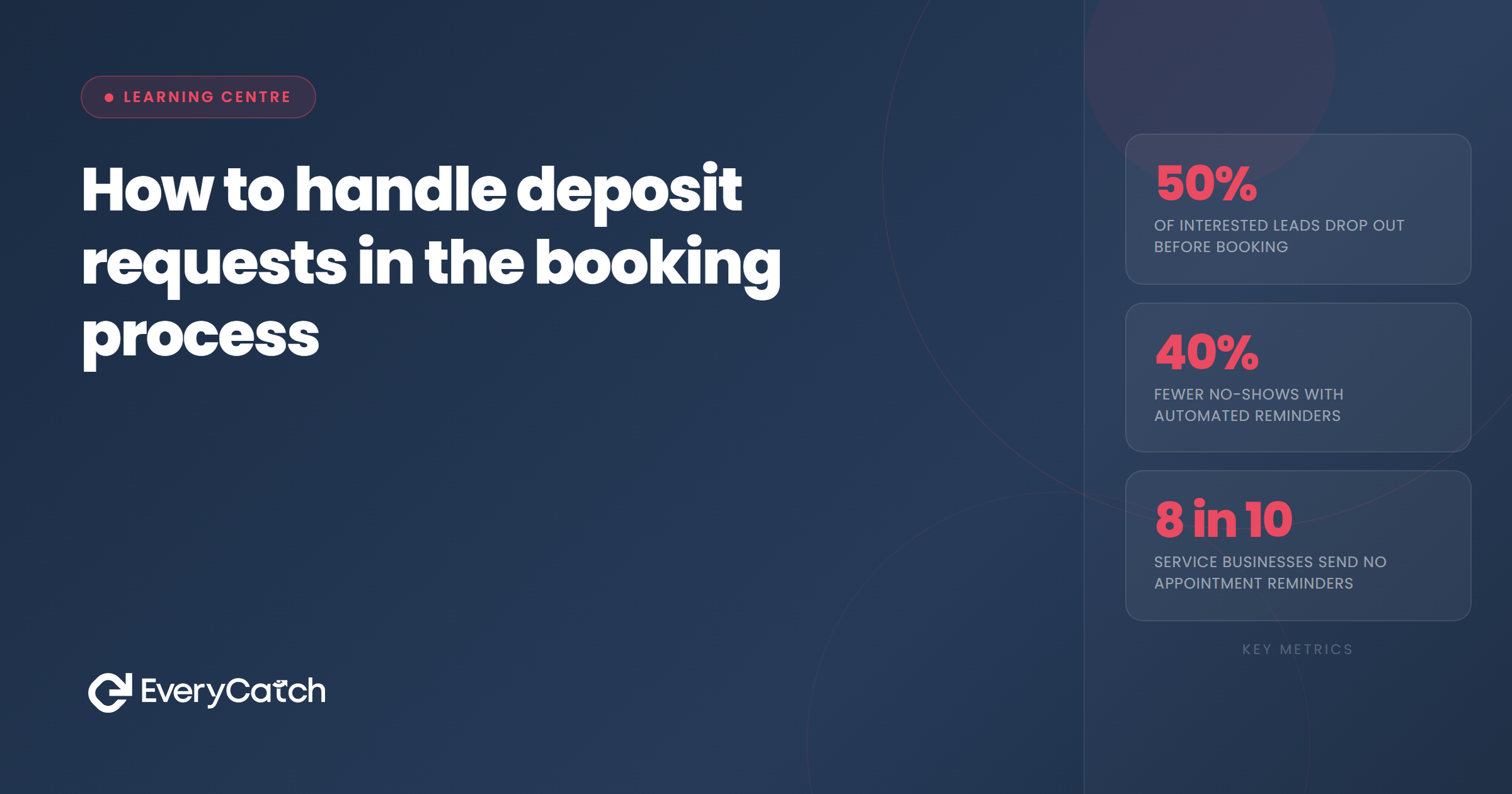

- A deposit reduces no-shows and cancellations because it creates genuine commitment, not just intention.
- Not every booking needs a deposit — the right trigger points are high time investment, material costs, or a pattern of no-shows in specific service types.
- How a deposit is framed determines whether prospects push back on it or accept it without comment.
- The deposit should appear after the booking is confirmed, not as a barrier on the booking form itself.
- A clear, consistent refund policy removes the most common objection before it is raised.
Why deposits scare service businesses — and what that reluctance costs
Most service businesses that do not take deposits are not refusing on principle. They are worried about what will happen if they ask. The fear is that a proportion of prospects will say no, and that those prospects will go to a competitor who does not ask for a deposit.
This fear is understandable but rarely accurate. The prospects most likely to object to a deposit are also the prospects most likely to cancel without notice or not show up. The ones who are genuinely serious about the appointment — the ones who will turn into good customers — are not put off by a reasonable deposit request. In many cases, a deposit request is reassuring: it signals that this business takes its appointments seriously and expects the same from the people it works with.
The real cost of not taking deposits is not measured in bookings won. It is measured in no-shows, last-minute cancellations, and gaps in the schedule that could have been filled. For a service business where revenue depends on time utilisation, those gaps add up to a significant amount each year.
Step 1: Decide which bookings need a deposit
Not every booking requires a deposit, and applying deposits selectively is often more effective than applying them universally. The criteria for requiring a deposit are straightforward: the booking carries a meaningful time or cost commitment that is not recoverable if the appointment is missed.
Deposits make clear sense when:
- The appointment requires a team member to travel to a site
- Materials or equipment are ordered or prepared in advance
- The slot is long enough that a no-show cannot be filled at short notice
- The service type has a historical pattern of no-shows or late cancellations
- The appointment is at a premium time (Saturday morning, first slot after a holiday)
Initial discovery calls or short consultations — where the cost of a no-show is limited to thirty minutes — may not warrant a deposit. The decision should be based on the actual cost of losing that slot, not on a blanket policy.
Want help building a booking process that protects your time?
EveryCatch can set up deposit requests as part of your automated booking flow.
Book a free discovery callStep 2: Frame the deposit correctly
The wording around a deposit request determines how it is received. A deposit described as a "booking fee" or "securing payment" positions it as an administrative step. A deposit described as "ensuring we have everything ready for your appointment" positions it as part of the service. The second framing lands better because it focuses on the prospect's benefit rather than the business's protection.
The amount also matters. A deposit should be meaningful enough to create genuine commitment but not so large that it becomes a barrier. For most service businesses, a deposit in the range of 20–30% of the expected job value, or a flat fee that reflects the time commitment of the slot, is appropriate. Very high deposits — 50% or more of the total — are common in some industries (event services, bespoke manufacturing) but should be positioned carefully.
State clearly, in the booking confirmation, what the deposit covers: how it applies to the final invoice, under what circumstances it is refundable, and what the cancellation window is. Clarity here removes ambiguity and reduces the likelihood of disputes later.
Step 3: Position the deposit correctly in the booking flow
The deposit request should not appear on the booking form itself. A form that requires payment before the booking is confirmed creates a barrier at the most sensitive point in the prospect's decision — before they have committed to proceeding. Many will close the tab rather than enter card details at that stage.
The more effective sequence is: form submission, booking confirmation message, then deposit request. Once the booking is confirmed and the prospect has received a confirmation message with the appointment details, the deposit request arrives as the natural next step to secure the slot. The prospect is now committed in intention — the deposit converts that intention into a financial commitment.
The deposit request message should be short, specific, and include the payment link prominently. Include the appointment date, time, and what the deposit amount is. Make the payment step as simple as possible — one click to a hosted payment page, not a multi-step checkout.
Step 4: Handle the common objections before they arise
Most deposit objections come from one of two places: the prospect does not understand what the deposit is for, or they are worried about what happens if they need to cancel. Both can be addressed in the deposit request message itself, before the prospect has a chance to ask.
On purpose: state plainly that the deposit secures the appointment slot and is applied directly to the final invoice. This makes clear that they are not paying extra — they are paying in advance.
On cancellation: state your cancellation policy clearly and honestly. If cancellations made more than 48 hours in advance are fully refunded, say so. If cancellations within 24 hours forfeit the deposit, say that too. A clear policy is more reassuring than a vague one, even when the policy is not entirely in the prospect's favour. Prospects understand that late cancellations have a cost — they just want to know the rules upfront.
Prospects who still push back after clear framing and a clear policy are usually the ones most likely to cancel without notice. That information is useful to have.

From the EveryCatch team
EveryCatch helps service businesses protect their time with booking processes that include deposit requests, automated confirmation messages, and clear cancellation policies — all set up and running without manual management.