
- The visible cost of a no-show is the revenue from the missed appointment. The full cost includes fixed overheads, preparation costs, administrative time, and opportunity cost.
- A business with a 15% no-show rate is typically losing far more than 15% of potential revenue when all costs are accounted for.
- No-shows that are not recovered become permanently lost revenue, while cancellations with notice can usually be recovered.
- Repeat no-shows from the same customer signal a relationship problem worth addressing separately from the system problem.
- The economics of no-show prevention almost always justify the cost of a proper reminder and confirmation system.
The visible cost everyone counts
When a customer does not show up for an appointment, the most immediate cost is clear: the revenue that would have been generated from that slot does not arrive. For a business charging £80 per session and running eight appointments per day, a no-show is an £80 hole in the day's revenue. That number is easy to identify and easy to be frustrated by.
But most businesses stop there. They count the missed appointment value, feel the irritation, and move on. The actual economic impact of a no-show is considerably larger than that single figure, and the full picture changes how seriously the problem deserves to be taken.
For many service businesses, the fixed costs of running the business continue regardless of whether every appointment slot is filled. Premises costs, equipment costs, staff costs where applicable, and utility costs are all paid whether the business is at 100% capacity or 70%. A no-show does not reduce these costs. It simply removes the revenue that was meant to cover them for that slot. The marginal cost of a no-show, when fixed costs are considered, is higher than the appointment value alone.
The hidden costs that do not appear in the ledger
Beyond fixed costs, a no-show carries several costs that never appear in a profit and loss account but are nonetheless real.
The first is preparation cost. Many service businesses carry out preparation before an appointment: reviewing client notes, setting up equipment, preparing materials, travelling to a location. That preparation time is spent and cannot be recovered when the customer does not arrive. A mobile service business that has driven 20 minutes to a job site has already incurred travel cost and time before the appointment begins.
The second is administrative cost. Someone typically chases a no-show customer to understand what happened, attempt to rebook, and update records. This is staff time that has a cost, and it is time spent recovering from a problem rather than generating new revenue.
Want to reduce no-shows for your business?
EveryCatch builds reminder and confirmation systems that measurably reduce no-show rates for service businesses without adding manual work.
Book a free discovery callThe third is opportunity cost. A slot that is reserved for a customer who does not show up is a slot that could not be offered to another customer. If the booking system showed that slot as unavailable, other enquiries that arrived during that window were turned away or deferred. The no-show cost includes not just the revenue from the missed appointment but the revenue from any customer who was displaced because that slot appeared occupied.
The fourth, and often largest, is the relationship cost with the customer. A no-show is usually not the end of the relationship, but it does introduce friction. The business owner is now dealing with an awkward situation, the customer is aware they let someone down, and the next interaction carries that history. Some customers do not rebook after a no-show, either from embarrassment or because the barrier to re-engaging has increased. When a no-show ends the customer relationship entirely, the cost becomes not just one appointment but the lifetime value of that customer's future business.
How no-shows compound over time
A single no-show is a disruption. A consistent no-show rate is a structural revenue problem.
A business running 40 appointments per week with a 15% no-show rate is losing six appointments per week to no-shows. Over a working year of 48 weeks, that is 288 appointments. At £80 per appointment, that is £23,040 in direct missed revenue before any of the hidden costs are factored in. If the real cost per no-show, including preparation, administration, and opportunity cost, is closer to £120, the annual figure rises to £34,560.
Few service businesses think about their no-show rate in annual terms. They experience individual no-shows as individual irritations and do not aggregate the data to see the scale of the problem. When the annualised cost is made visible, the case for investing in prevention becomes considerably stronger.
No-shows also have a secondary effect on the business's scheduling discipline. A business with a high no-show rate often starts leaving buffer slots deliberately, anticipating that some percentage of bookings will not materialise. This self-imposed capacity reduction compounds the revenue loss by reducing the number of appointments that can theoretically be taken even in a good week.
What to do with this information
The starting point is measuring the actual no-show rate, not estimating it. If the booking system does not track this automatically, manually reviewing the past four to eight weeks of appointments and counting the no-shows produces a usable baseline. Once the rate is known, calculating the annualised cost using the full picture, including preparation time, staff cost, and opportunity cost, produces a number that makes prevention feel like a worthwhile investment rather than an administrative nicety.
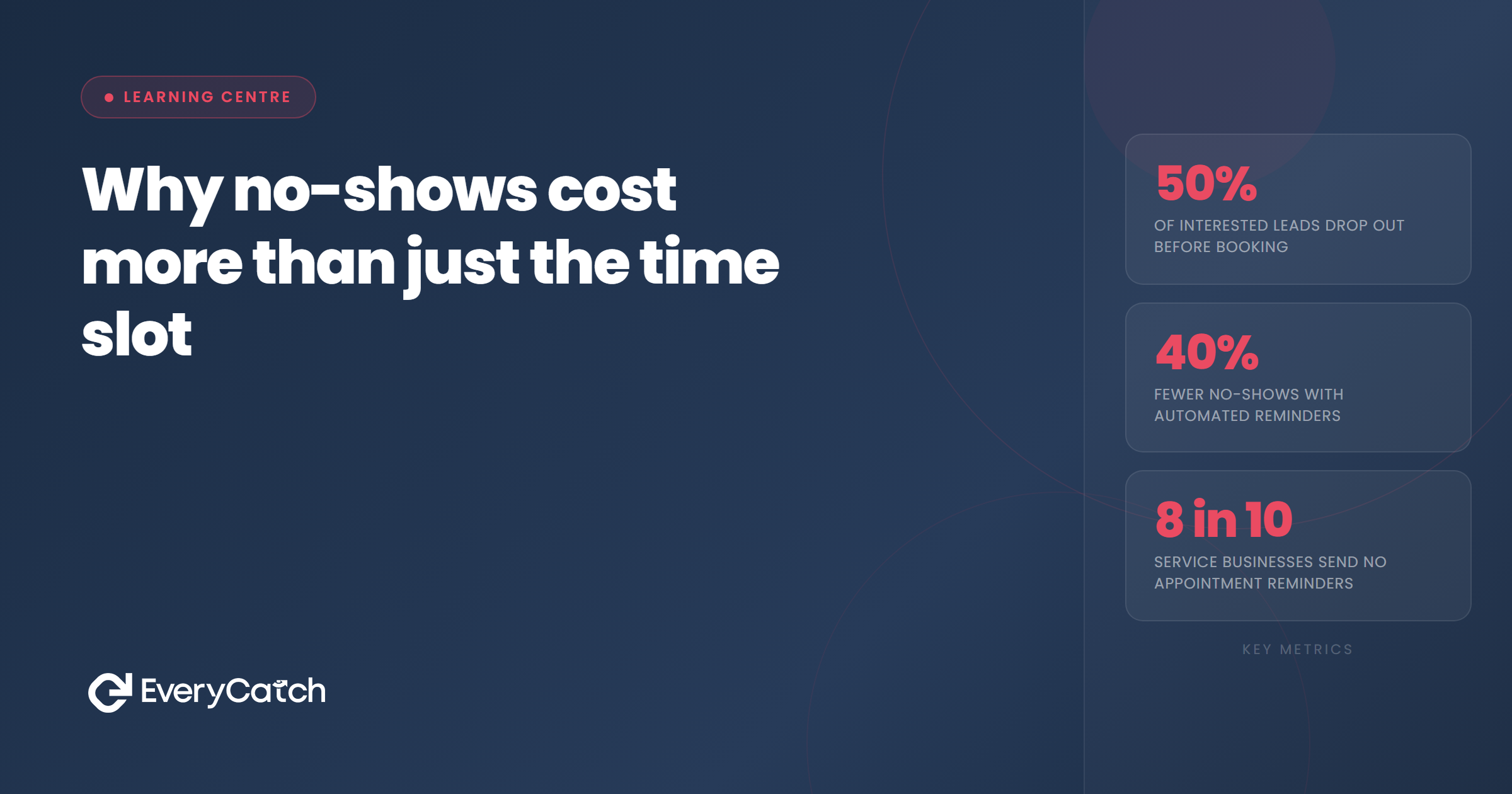
The most cost-effective prevention measure is a reminder sequence: a confirmation immediately after booking, a reminder the day before, and a same-day nudge for appointments booked in advance. Most businesses that implement a proper three-touchpoint reminder system see a 30 to 50 per cent reduction in no-show rates within the first few weeks. Against the annualised cost calculated above, the return on a reminder system is almost always positive within the first month.
Deposits also play a role. A customer who has paid something towards an appointment has a financial reason not to walk away. Even a small deposit, £10 to £20 for many service types, substantially changes the calculus for the customer when the day approaches. Businesses that cannot implement deposits might instead take card details at booking with a stated cancellation policy, which creates a similar commitment effect without requiring payment upfront.

From the EveryCatch team
EveryCatch helps service businesses measure and reduce their no-show rate using reminder sequences, deposit systems, and booking confirmation flows that are built once and run automatically.