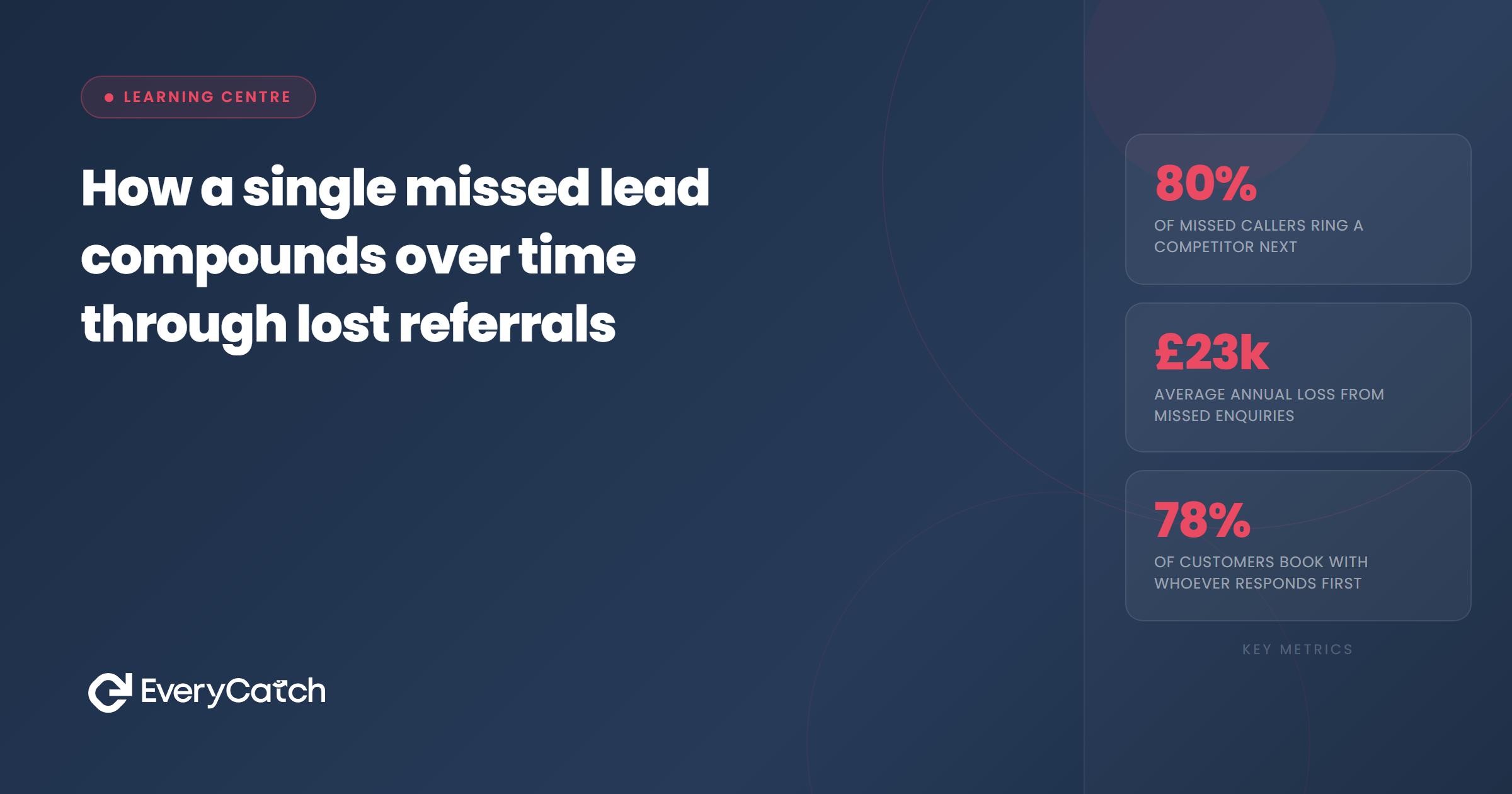

- A missed lead does not cost you one job. It costs you the customer's lifetime value plus every referral they would have generated.
- Happy customers in service trades typically refer between two and five new customers over several years, and each referral can refer onwards.
- One missed £400 enquiry can plausibly represent £8,000 to £15,000 in lost revenue over five years once repeat work and referral chains are counted.
- The loss stays invisible because referrals that never happen leave no record. Your books look fine while your competitor's pipeline grows.
- The compounding only starts if the lead escapes in the first place, so capturing every call, form and message is the highest-value fix available.
Most owners price a missed lead at the value of the job they lost. A plumber who misses a £400 boiler repair call writes off £400 and moves on. That figure is wrong, and it is wrong by an order of magnitude. The real cost of a missed lead unfolds over years, through channels you cannot see, and the mechanism that drives it is the referral.
This article walks through exactly how the compounding works, puts real numbers against it, and explains why the damage never shows up anywhere you would think to look.
The first job is only the entry fee
When a new customer hires you, they rarely hire you once. Service businesses live on repeat work. The boiler repair customer needs an annual service. The customer who booked a gutter clean needs it again next autumn. The client who used your accountancy firm for one tax return comes back every year, often with more work attached each time.
So the first calculation to fix is lifetime value. If your average job is £400 and a typical customer uses you three more times over five years, that missed call was never worth £400. It was worth £1,600 before a single referral enters the picture. We cover this first layer in more detail in the real cost of a missed lead beyond the single job.
But lifetime value is still the smaller half of the story. The larger half is what that customer would have done for you socially.
The referral maths nobody runs
Word of mouth remains the dominant growth engine for local service businesses. Ask any established trade where their best work comes from and the answer is nearly always the same. Someone recommended them. Research on referral behaviour consistently finds that a satisfied service customer will recommend the business to friends, family and neighbours when the topic comes up, and in trades it comes up constantly. Someone's boiler breaks, someone's garden needs landscaping, and the first question they ask is always the same. Do you know anyone good?
A reasonable, conservative assumption is that a happy customer produces two to five referred customers over a five-year relationship. Some produce none. Others become unofficial ambassadors who send you a steady trickle of work for a decade. The average sits comfortably in that two-to-five band.
Here is where the compounding begins. Each of those referred customers has their own lifetime value. Each of them also refers. The referral chain does not stop at one generation. A single satisfied customer in year one can be the root of a small tree of customers by year five, none of whom would have found you otherwise.
Miss the original lead and you do not lose one branch. You lose the whole tree.
A worked example over five years
Take that £400 boiler repair call that rang out while you were under a floor. Run the numbers conservatively.
- The original customer would have spent £1,600 with you over five years through repeat work and annual servicing.
- They would have referred three people during that time. Each referred customer carries a similar lifetime value, adding £4,800.
- Of those three, assume just one refers two further customers. That second generation adds another £3,200.
The running total is £9,600, and that model deliberately cuts the chain off early. Extend the window to ten years, or assume slightly more generous referral behaviour, and one missed £400 call plausibly represents £15,000 or more in revenue that went somewhere else. It did not vanish. The customer hired a competitor, was presumably satisfied, and started growing that competitor's referral tree instead of yours. Every missed lead is a double loss in that sense, because the compounding still happens. It just happens for someone else.
How many referral trees have you already lost?
A short call will show you where enquiries are slipping through and what they are really costing you over time.
Book a free discovery callWhy the loss stays invisible
The reason this problem persists is that compounded losses leave no evidence. A missed call might appear in your phone log if you check. The four repeat jobs, three referrals and two second-generation referrals that never happened appear nowhere. There is no report, no notification and no line in your accounts labelled revenue that would have existed.
Your books can look perfectly healthy while this erosion runs in the background. Turnover is steady, the diary is reasonably full, and nothing feels broken. What you cannot see is the counterfactual, the version of your business where those trees were growing. Owners who eventually fix their lead capture often describe the following twelve months as inexplicably busier, and the explanation is simple. They stopped donating referral networks to their competitors.
There is a second invisibility problem worth naming. Because referrals arrive months or years after the original job, the connection between a missed call today and a quiet January in two years' time is impossible to feel intuitively. Human beings are poor at pricing delayed, probabilistic losses, which is exactly what a lost referral chain is. If you want to estimate what this is costing your specific business, our guide on calculating what missed leads cost your business walks through the sums step by step.
How to stop the compounding at source
The encouraging part of all this is that the compounding works in both directions. Every lead you capture that you would previously have missed starts its own tree in your favour. The fix is not complicated, but it does need to be systematic rather than a matter of trying harder.
Start with the phone, because missed calls are the biggest leak for most service businesses. A caller who reaches voicemail rarely leaves a message and usually rings the next name on the list within minutes. An instant text back, sent automatically the moment a call goes unanswered, holds most of those callers in place until you can respond properly. It is the single highest-return change available, which is why it is the first thing EveryCatch switches on for new customers through missed call text back.
Then close the other gaps. Website forms need a fast acknowledgement rather than a silence that stretches into the evening. Enquiries that go quiet need structured follow-up over days and weeks, because a lead that does not book immediately is delayed, not dead. And once the job is done, a prompt review request turns each happy customer into visible proof for the next stranger who searches your trade, which accelerates the referral effect rather than leaving it to chance.
None of this requires you to answer every call personally or spend evenings chasing enquiries. It requires a system that treats every single lead as what it actually is, the root of something that compounds. Once you see a £400 call as a potential £15,000 relationship, letting it ring out stops being a minor annoyance and starts being the most expensive habit in your business.

From the EveryCatch team
EveryCatch helps service businesses capture and convert every enquiry with automatic responses, follow-up sequences and review generation. We write these guides to show owners exactly what missed leads cost and how to stop the loss.