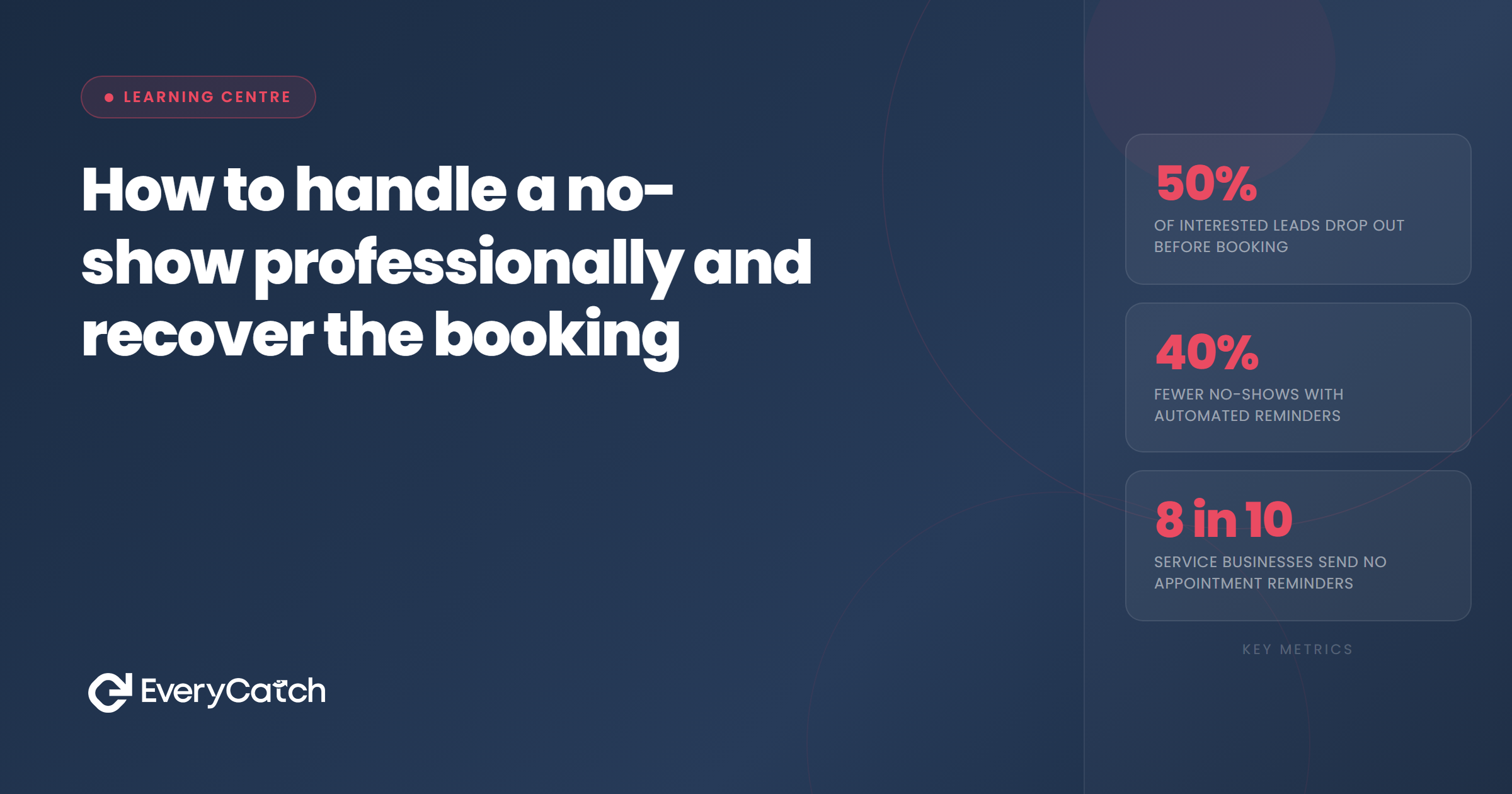
- Send a recovery message within 30 to 60 minutes of the missed appointment, while the no-show is still fresh for the customer.
- The tone should be calm, non-accusatory and focused on making it easy to rebook, not on expressing disappointment.
- A second follow-up 24 hours later, if there has been no reply, recovers a further proportion of customers.
- Most no-show customers are embarrassed rather than disinterested; a warm, practical message gives them a face-saving way back in.
- Automating the recovery message means it happens every time, without requiring the business owner to manage the emotion of the moment.
What to do in the first hour after a no-show
When a customer does not show, the instinct can be to wait and see whether they get in touch, or to take it personally and move on. Neither of those positions serves the business. The customer who just no-showed is usually in one of two states: they forgot entirely and will feel a wave of embarrassment when they realise, or something came up and they did not know how to handle the contact.
In both cases, they are reachable. And they are most reachable in the window immediately following the missed appointment, when the fact of missing it is front of mind. Leave it too long and the embarrassment or awkwardness solidifies into avoidance. Reach them in the first hour and you are far more likely to get a reply.
The practical step is simple: within thirty to sixty minutes of the appointment start time, send a message. Not a call, not a stern email, a short and warm text message that acknowledges you missed them, assumes good intent, and makes it easy to rebook. Nothing more.
The tone in that first message is what determines the outcome. A message that sounds annoyed or disappointed, even subtly, puts the customer on the defensive. They feel judged and are less likely to reply. A message that sounds like it came from a business that genuinely wants to help them and understands that things happen is one that customers reply to. The difference in response rate between these two tones is significant.
The message that recovers most bookings
The recovery message has three components, each doing a specific job. It acknowledges the missed appointment without making it the centrepiece of the message. It opens a door without pushing the customer through it. And it makes the next step obvious and frictionless.
A message along these lines tends to work well: "Hi [Name], we had you booked in today at [time] for [service]. We missed you. No worries at all. If you'd like to rebook, just click here [link] or reply to this message and we'll sort something out. Hope you're well."
That message is warm, short, assumes no bad intent, removes the awkwardness, and gives the customer a clear next step. It does not ask for an explanation. It does not charge a fee in the message itself. It does not express disappointment. It just makes it easy to come back.
For higher-value appointments, a follow-up call within the first two hours can supplement the message. Not instead of the text, in addition to it. A brief voicemail that covers the same ground as the text, friendly and practical, reaches the customer through a different channel and increases the chance of a response. Some customers prefer to respond to a voicemail rather than a text; offering both means the net is wider.
When to follow up again, and when to stop
Want no-show recovery automated for your business?
EveryCatch builds automated recovery sequences that send the right message at the right time after every missed appointment, without requiring the business owner to manage it manually.
Book a free discovery callIf there has been no reply to the first message, a second follow-up sent 24 hours later recovers a further proportion of customers who would otherwise disappear. By this point, the immediate embarrassment of the missed appointment has had time to settle, and many customers are now thinking about rebooking but have not taken the step yet. A gentle second message gives them the prompt they were waiting for.
The second message should be shorter than the first and should not repeat the full context. Something like: "Hi [Name], just following up from yesterday. Happy to get you rebooked whenever suits, just let us know." The brevity signals that the business is not making a big deal of the situation, which makes it easier for the customer to respond.
Two messages is the right limit for a standard no-show. A third follow-up, unless there is a specific reason such as a deposit or a pre-committed slot that needs to be formally released, reads as pressure and can damage the relationship rather than repair it. After two messages, the customer has had ample opportunity to respond. If they have not, they either need more time or they are genuinely not coming back. Either way, further contact is unlikely to help.
Where a no-show fee applies and the customer has agreed to this at booking, this can be addressed in the second message or in a separate follow-up. The same tone applies: practical and non-accusatory. The goal is to handle the admin without burning the relationship, which is possible if the message is handled carefully.
Turning no-show recovery into a system
The challenge with handling no-shows manually is that it requires the business owner or a staff member to act at a specific time, in a specific tone, when they may be frustrated or busy. That combination produces inconsistent results. Sometimes the recovery message goes out promptly and warmly. Sometimes it goes out late, or not at all, or with an edge that makes the customer less likely to respond.
Automating the recovery process removes the inconsistency. When an appointment is not checked in or confirmed as attended, the system sends the first recovery message automatically at a set interval after the start time. If there is no reply after 24 hours, the second message fires. Neither message requires a human to write or send it in the moment. Both go out in the same tone, every time, regardless of how busy or frustrated the day has been.
The messages still need to be written well, which is a one-time task. But once written and configured, the recovery sequence runs in the background as a standard part of the booking process. Customers who no-show receive the same professionally handled follow-up every time, and the business recovers a proportion of them that would otherwise be lost.

From the EveryCatch team
EveryCatch builds no-show recovery systems that send the right message at the right moment, recovering customers who would otherwise disappear and protecting the business's time and revenue without any manual effort.