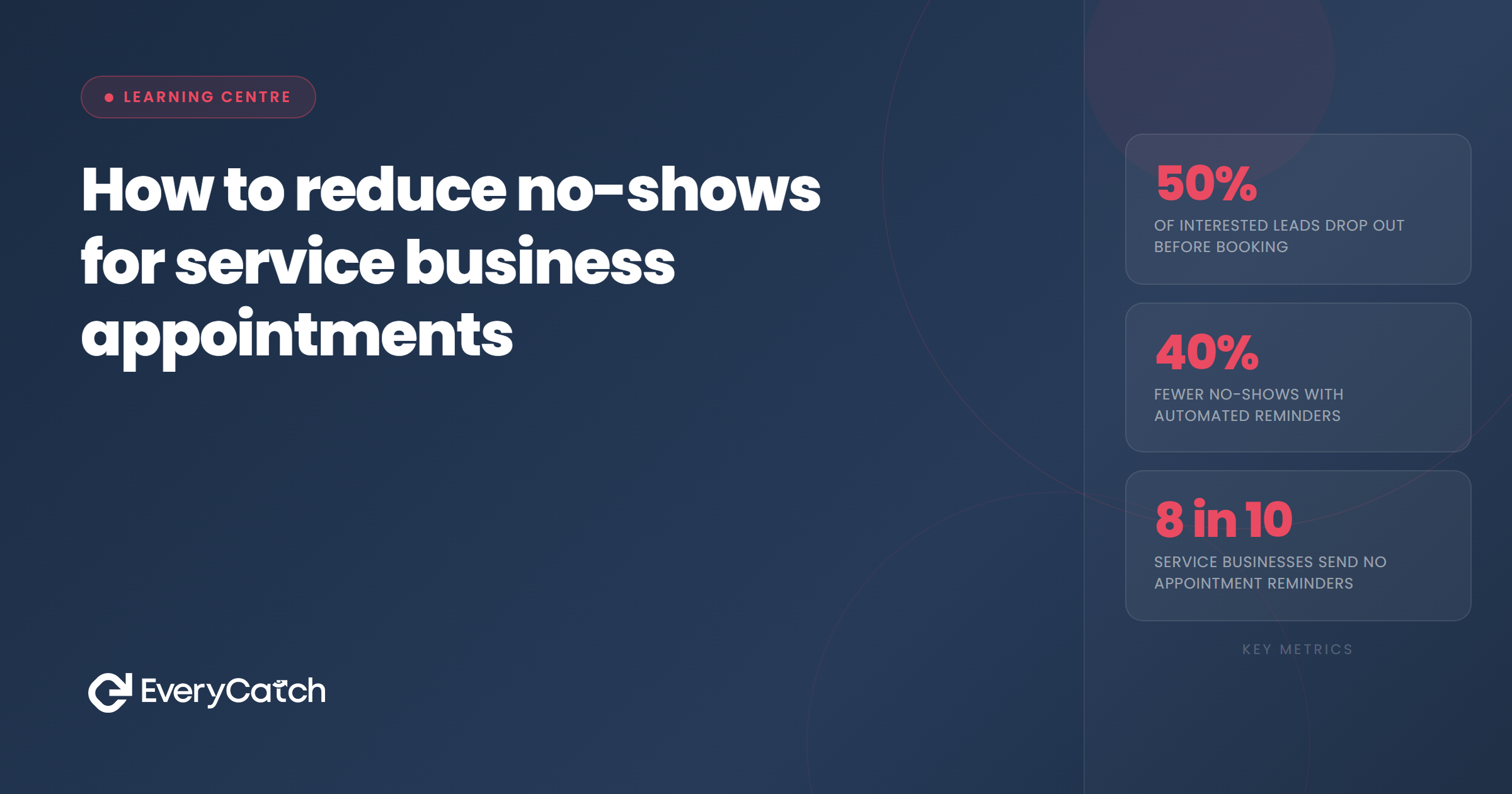

- Most no-shows happen because the customer forgot, not because they decided not to come.
- A reminder sequence of three touchpoints, at booking, the day before and the morning of the appointment, outperforms any single reminder by a wide margin.
- Asking the customer to confirm attendance creates a soft commitment that increases follow-through.
- A deposit or pre-payment requirement reduces no-shows sharply but should be used where it fits the service type and customer relationship.
- No-show recovery, a follow-up message after the missed appointment, brings back a significant proportion of customers who would otherwise disappear.
Why no-shows happen
The instinct when a customer does not show is to assume they changed their mind. In most cases, that is not what happened. The majority of no-shows in service businesses come down to one of three things: the customer forgot, something else came up and they did not know how to rearrange easily, or they lost confidence somewhere between booking and appointment day without telling anyone.
Forgetfulness is by far the most common. People book appointments days or weeks in advance, and life gets in the way. Without a reminder, the appointment competes against everything else in the customer's head and often loses. This is not a reflection on how much they value your service; it is how human memory works under a full schedule.
The second category, something came up, is also largely preventable. If rescheduling feels easy, customers reschedule. If it feels awkward or uncertain, they avoid the contact altogether and simply do not show. Making rescheduling straightforward is itself a no-show reduction strategy.
The third category, lost confidence, is the hardest to address because it is often silent. A customer who had second thoughts about whether they made the right choice, about the price, about whether they will feel judged, about whether the business can actually help them, will sometimes no-show rather than cancel. Better pre-appointment communication that reassures and sets clear expectations can reduce this significantly.
Timing and format of reminders
A single reminder sent the day before an appointment is better than nothing. A sequence of three, timed correctly, is meaningfully better than one. The difference lies in how memory and commitment work together over time.
The first reminder should go out immediately after booking. Not days later, immediately. This is the confirmation message, and it does two things: it tells the customer the booking worked, and it anchors the appointment in their awareness at the moment it is most salient to them. A confirmation that arrives promptly signals a professional operation and starts building the expectation of turning up.
The second reminder belongs the day before the appointment. This is the most important touchpoint in terms of preventing no-shows. It prompts the customer to check their diary, prepare anything they need to bring, and reinforces the social commitment to turn up. Including a simple reply option, "reply YES to confirm" or a link to reschedule, adds a confirmation layer that improves attendance further.
The third reminder, on the morning of the appointment, is the final nudge. It keeps the appointment present in the customer's mind when the day is already in motion and competing demands are at their highest. It should be brief: the time, the location, and any practical information they need.
Format matters too. SMS consistently outperforms email for reminders because it is read faster and more reliably. Email works better for longer confirmations with detailed information. A combination of both, using each for what it does best, tends to produce the lowest no-show rates.
Confirmation friction
Want a no-show reduction system built for your business?
EveryCatch sets up automated reminder and confirmation sequences that run without manual input and consistently reduce missed appointments.
Book a free discovery callAdding a small action requirement to the reminder process increases follow-through. Asking the customer to reply to confirm, or to click a link, creates a micro-commitment that makes them less likely to skip the appointment without notice. Psychologically, the act of confirming reinforces the decision to attend.
This does not need to be onerous. A single-word reply or a one-tap button is enough to create the commitment effect. What matters is that the customer takes an active step, rather than simply receiving information passively.
For higher-value appointments, or in businesses where no-shows carry a significant cost, a deposit or pre-payment requirement is the most reliable tool available. When a customer has paid something in advance, the cost of not showing up becomes tangible. No-show rates in businesses using pre-payment are consistently lower, and the customers who do cancel tend to do so earlier, giving more time to fill the slot.
The trade-off is friction at the booking stage. Some customers will not book if a deposit is required upfront, particularly for routine services where they have no prior relationship with the business. The right approach depends on the average appointment value, the no-show rate currently, and how established the customer relationship tends to be. Both options can coexist: a deposit for new customers, no deposit for returning ones, for example.
What to send on the day of the appointment
The day-of message is not about adding another touchpoint for its own sake. Its job is to keep the appointment present in the customer's awareness during the part of the day when everything is most likely to clash.
The most effective day-of messages are short. The time of the appointment, the address or location, any parking or access information, and a number to call if they are running late. Nothing else. A message that is too long gets skim-read, which defeats the purpose.
Timing this message to arrive one to two hours before the appointment tends to work better than sending it first thing in the morning. A message at 7 am for a 3 pm appointment is read, acknowledged, and then forgotten as the day fills up. A message at 1 pm for a 3 pm appointment is much harder to ignore.
Some businesses include a personal element in the day-of message, something that makes it feel like it came from a person rather than an automated system. This does not require manual sending; it can be built into the automation. A message that uses the customer's first name and references the specific service they booked feels different from a generic appointment reminder, and that difference in tone translates into a higher show rate.

From the EveryCatch team
EveryCatch builds reminder and confirmation systems for service businesses that run automatically and keep no-show rates consistently low, without requiring manual follow-up from the owner or their team.