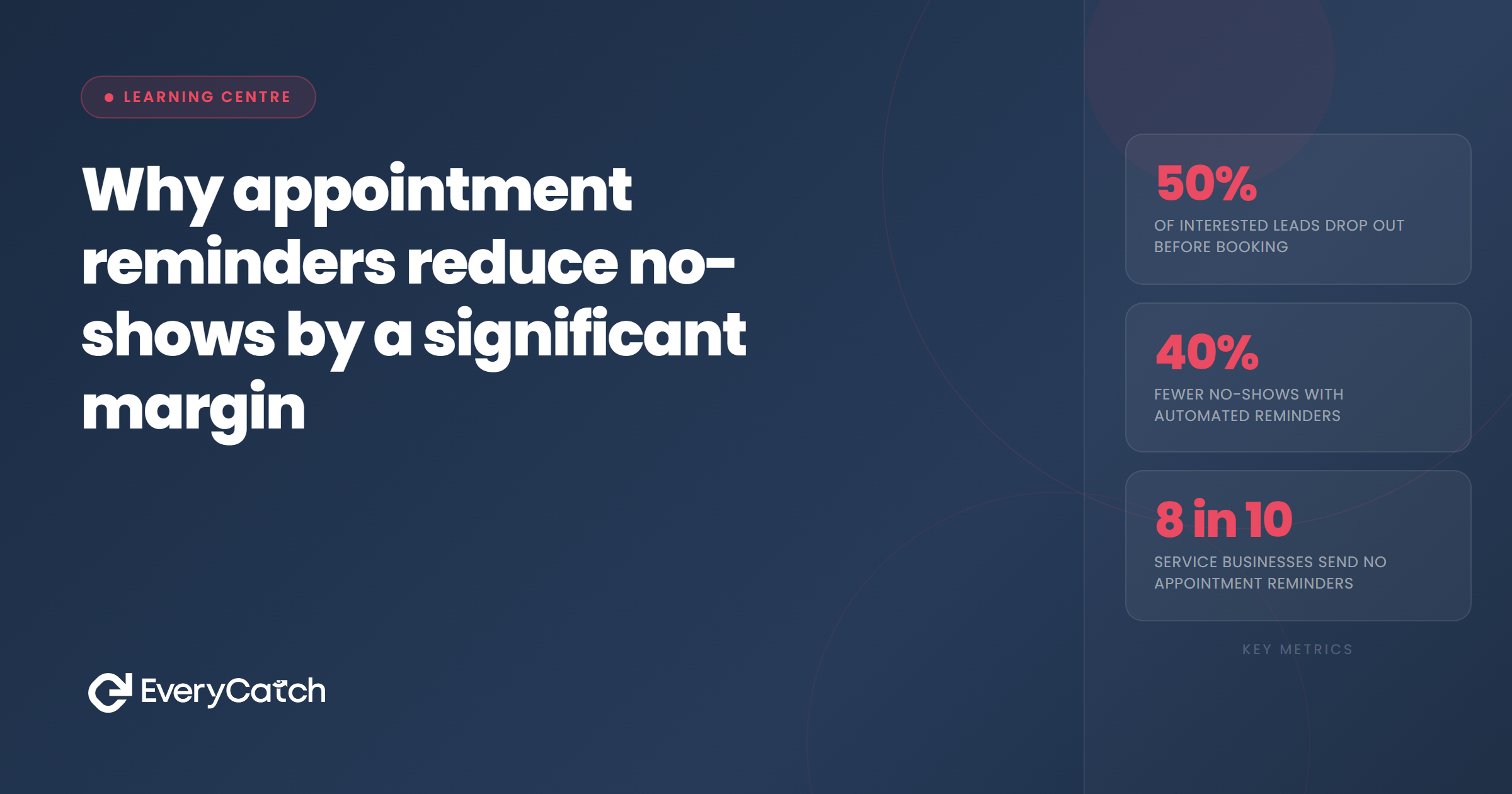
- Reminders address forgetfulness, which causes the majority of no-shows in service businesses.
- Each reminder reinforces the psychological commitment the customer made when they booked.
- A three-message sequence outperforms a single reminder by a considerable margin because it works at different stages of the customer's attention.
- SMS reminders are read faster and more reliably than email, but email works better for longer confirmation detail.
- A reminder that asks for a reply confirmation creates an active commitment that increases attendance further.
The evidence behind reminder effectiveness
The relationship between reminders and attendance is well established across healthcare, professional services and consumer businesses alike. Studies across different sectors consistently show that reminder systems reduce no-show rates by 30 to 50 per cent compared with no reminders at all. In some service categories, the reduction is higher.
What drives those numbers is not complicated. Most people who miss appointments without telling anyone are not acting with bad intent. They forgot, or the appointment slipped to the back of their awareness while other things took priority. A reminder reintroduces the appointment to active thought at a moment when the customer can still do something about it: rearrange, prepare, or simply remember to turn up.
The businesses that send no reminders are, in effect, relying entirely on the customer's memory. Given that appointments are often booked days or weeks in advance, and that those customers are managing jobs, families, travel and a dozen other commitments simultaneously, relying on memory alone is an expensive assumption.
The cost of a no-show goes beyond the lost appointment slot. There is the blocked time that could have been offered to another customer, the materials or preparation that may have been committed, and the administrative effort of chasing, rescheduling or writing off the booking. Against that backdrop, the cost of sending an automated reminder is negligible.
How reminders work psychologically
When a customer books an appointment, they make a commitment. At that moment, the intention to attend is strong. What erodes it is not usually a change of mind but a change of context: the days pass, other things fill the calendar, and the appointment moves from "something coming up soon" to "something I meant to sort out."
A reminder interrupts that drift. It pulls the appointment back into the customer's active awareness and, crucially, does so while there is still time to act on it. The customer is reminded of a commitment they already made, which activates a different part of their decision-making than if they were being asked to commit fresh. Reinforcing an existing commitment tends to produce stronger follow-through than initiating a new one.
This is compounded by what behavioural researchers call the commitment and consistency principle. People tend to act in ways that are consistent with decisions they have already made. A reminder does not need to persuade; it just needs to reconnect the customer with a decision they already took. That makes it one of the most efficient nudges available.
When a reminder includes a confirmation step, asking the customer to reply or click to confirm, the effect strengthens further. The customer takes an active step, which reinforces the commitment a second time. They are now not just remembering that they booked; they have actively restated their intention to attend. That small additional action makes a measurable difference to show rates.
Why a sequence beats a single message
Want a reminder sequence built for your business?
EveryCatch sets up automated reminder systems timed to your specific booking patterns, so every appointment is protected without any manual effort.
Book a free discovery callA single reminder sent the day before an appointment is better than nothing. A three-message sequence is substantially better than one. The reason is that different messages reach the customer at different points in their attention cycle, and each one does a different job.
The first message, sent immediately after booking, is the confirmation. Its job is to anchor the appointment in the customer's awareness while the commitment is fresh and the details are clear. It also signals that the business is organised and responsive, which builds confidence from the start.
The second message, sent the day before, is the preparation nudge. The customer is close enough to the appointment that it feels real and near-term. They check their diary, prepare anything they need to bring, and their intention to attend solidifies. This is the most impactful touchpoint in the sequence for pure attendance rate.
The third message, sent on the morning of the appointment, is the activation nudge. The day is already in motion, other demands are competing, and the reminder places the appointment at the front of the customer's mind during the window when it can still influence what happens. A customer who sees this message while making their morning coffee and thinking about the day is much more likely to plan around the appointment than one who has not been reminded since the day before.
The cumulative effect of these three touchpoints is greater than the sum of their individual impacts, because they work at different stages of the psychological process between booking and attendance. Each one catches a different category of customer: the one who might have forgotten completely, the one who was planning to rearrange, and the one who simply needed the appointment brought back into focus on a busy day.
What to include in a reminder that gets read
A reminder that is not read does nothing. The format, length and timing all affect whether it reaches the customer's attention before it is swiped away or skipped over.
SMS works better than email for short reminders, because it is read faster, read more reliably, and read in the same moment it arrives rather than hours later when an inbox is opened. Open rates for SMS appointment reminders consistently outperform email by a wide margin. For short, time-sensitive nudges, SMS is the right channel.
Email has its place in the sequence, but for different purposes. A detailed booking confirmation with all the information the customer needs, directions, what to bring, what to expect from the service, is better suited to email, where length is expected and content can be referenced later. The day-before and morning reminders should be short and sent by SMS.
Every reminder should include the customer's name, the appointment date and time, and the business name. If the appointment location is not somewhere the customer visits regularly, the address should be included. A link to rearrange should appear in every message, without comment; offering a no-friction exit actually reduces last-minute no-shows because customers who need to change can do so before the appointment rather than simply not turning up.
Tone matters in reminders too. A message that feels warm and personal performs better than one that reads like a system notification. The customer does not need to know it was sent automatically; they just need to feel that the business knows who they are and is looking forward to seeing them.

From the EveryCatch team
EveryCatch builds reminder sequences for service businesses that run automatically for every booking, reduce no-shows consistently, and require no ongoing manual effort to maintain.