- Every additional field on a booking form reduces the probability that a prospect completes it.
- Most of the information businesses ask for at the booking stage is not actually needed until the appointment itself.
- The information you request upfront signals how you will treat a prospect's time and attention in the future.
- Three to five required fields is the right limit for most service business booking forms.
- Anything not needed before the appointment can be collected by automated message after the booking is confirmed.
Where leads stop — and why the booking form is often the reason
A prospect clicks through to your booking page. They are ready to take the next step. Then they see the form. Name, phone number, email address, company name, job title, location, how they heard about you, what service they are looking for, any additional information, preferred appointment time, preferred appointment date — and a required field marked with an asterisk on every single one.
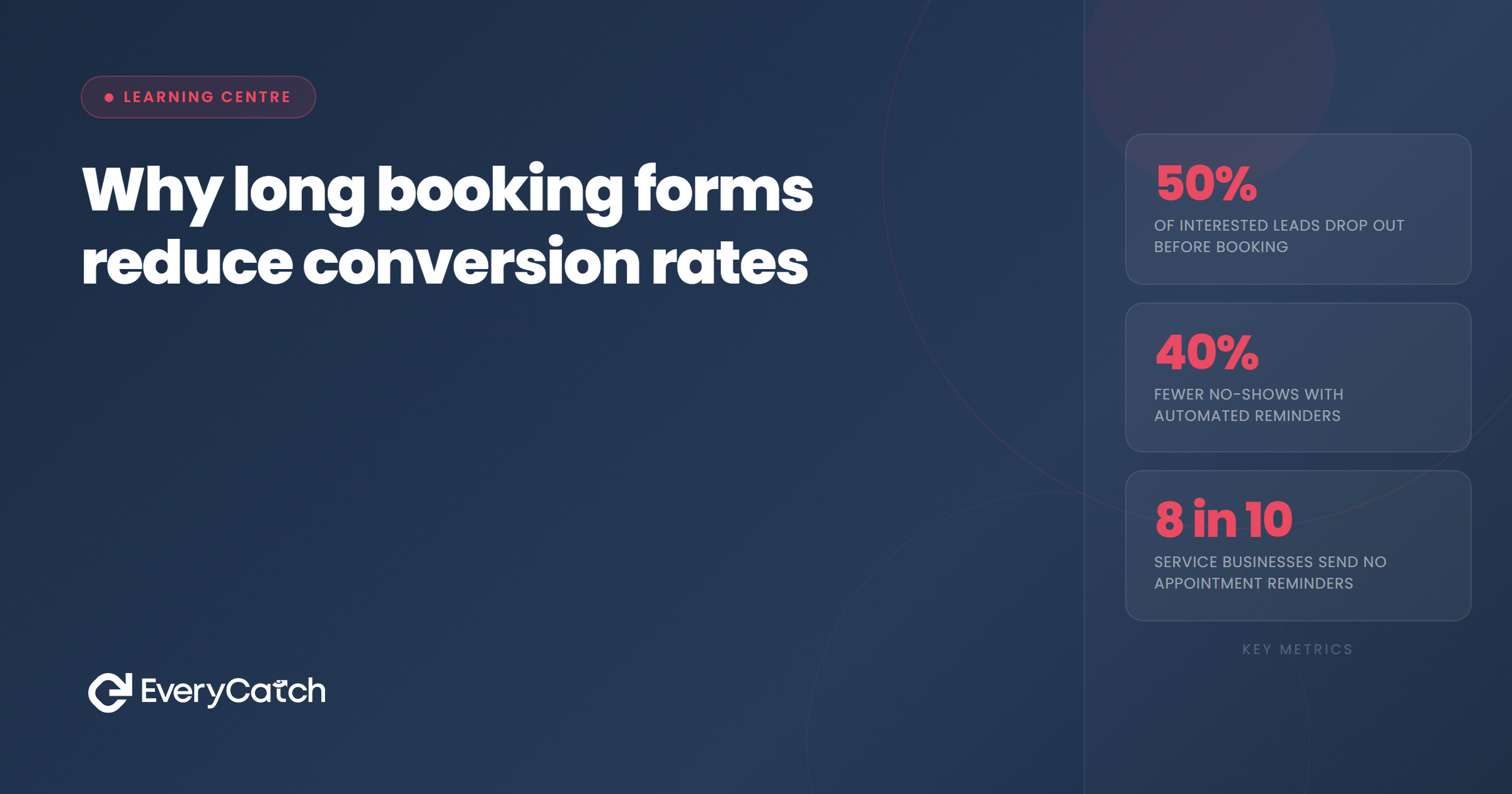
A significant portion of those prospects close the tab. Not because they changed their mind about your service. Because the form asked for more than the moment warranted, and the friction was enough to break the momentum. This is a booking drop-off, and it is one of the most common and preventable causes of lost enquiries.
Most service businesses have no visibility over this. They do not see that thirty people reached the booking page last month and seventeen of them left without completing the form. They see eight bookings and assume the other twenty-two were not interested enough to follow through.
What happens in the prospect's head when they see a long form
Each field on a form is a small decision. Name and phone number are straightforward — the prospect expects to give those. But the more fields appear, the more the prospect starts to weigh whether the effort is worth it.
Questions that feel unnecessary create a specific type of friction. "Why do they need my job title for a boiler service?" or "I am not sure I want to give my home address before I have even spoken to anyone." These are not objections to your business — they are objections to the form. They erode the trust that your initial communications worked to build, and they arrive at precisely the moment when the prospect should be feeling most confident about taking the next step.
There is also the cognitive load of a long form on a mobile screen. A form with twelve fields that looks manageable on a desktop feels like a chore on a phone. Given that a large proportion of enquiries now originate on mobile, form length has a disproportionate impact on the audience most likely to be making a spontaneous, in-the-moment decision.
Is your booking process costing you leads?
Find out how EveryCatch simplifies the journey from enquiry to confirmed appointment.
Book a free discovery callWhat you think you need versus what you actually need
The typical argument for a long form is that the business needs all of that information to prepare for the appointment. This is worth examining honestly. What information do you genuinely need before the slot is confirmed? And what information do you need before the appointment takes place?
The answer to the first question is almost always just four things: a name, a contact number, a broad indication of the service required, and a preferred date or time window. That is enough to confirm the booking and send a confirmation message. Everything else — the detailed job description, the address, the specific requirements, the additional questions — is needed for the appointment, not for the booking.
The distinction matters because the point in the process at which you ask for information changes how the prospect receives the request. Before booking, an information request can feel like a barrier. After booking, when the prospect has already committed and is now preparing for the meeting, the same request feels like a natural part of the process. Moving most of your form fields into a post-booking message does not lose you any information — it just collects it at the right time.
What asking too much tells a prospect about your business
The booking form is part of the brand experience. It is often one of the first direct interactions a prospect has with your systems, and it signals how you will treat their time going forward.
A form that asks for twelve fields before a prospect has spoken to anyone signals: "We are going to need a lot from you." It suggests administrative complexity, a business that prioritises its own processes over the prospect's experience, or simply a lack of attention to what booking actually requires. None of those associations help you win the job.
The contrast is a booking form that takes ninety seconds to complete. That experience signals something different: "This business is organised and respects your time." It is a small interaction but it sets a tone. The businesses that understand this invest in making the booking step fast and frictionless, not exhaustive.
How shorter forms change your conversion numbers
The data from booking platforms and conversion research is consistent on this point: fewer fields produce more completions. The drop-off rate per additional field varies by context, but the direction is always the same. Each new required field reduces the proportion of people who complete the form.
For most service businesses, the practical test is straightforward. Count the required fields on your current booking form. If the number is above five, consider removing everything that is not needed to confirm the slot. Run the reduced form for thirty days and compare the booking completion rate against the previous period. The improvement is typically visible within weeks, not months.
The information you remove from the form does not disappear from your process. It moves to a post-booking message, a pre-appointment call, or the appointment itself. The prospect still provides it, just at a point when they are already committed and the context makes the request feel natural rather than premature.

From the EveryCatch team
EveryCatch helps service businesses design booking processes that convert more enquiries without sacrificing the information needed to run good appointments. The focus is on the right question at the right time, not fewer questions overall.