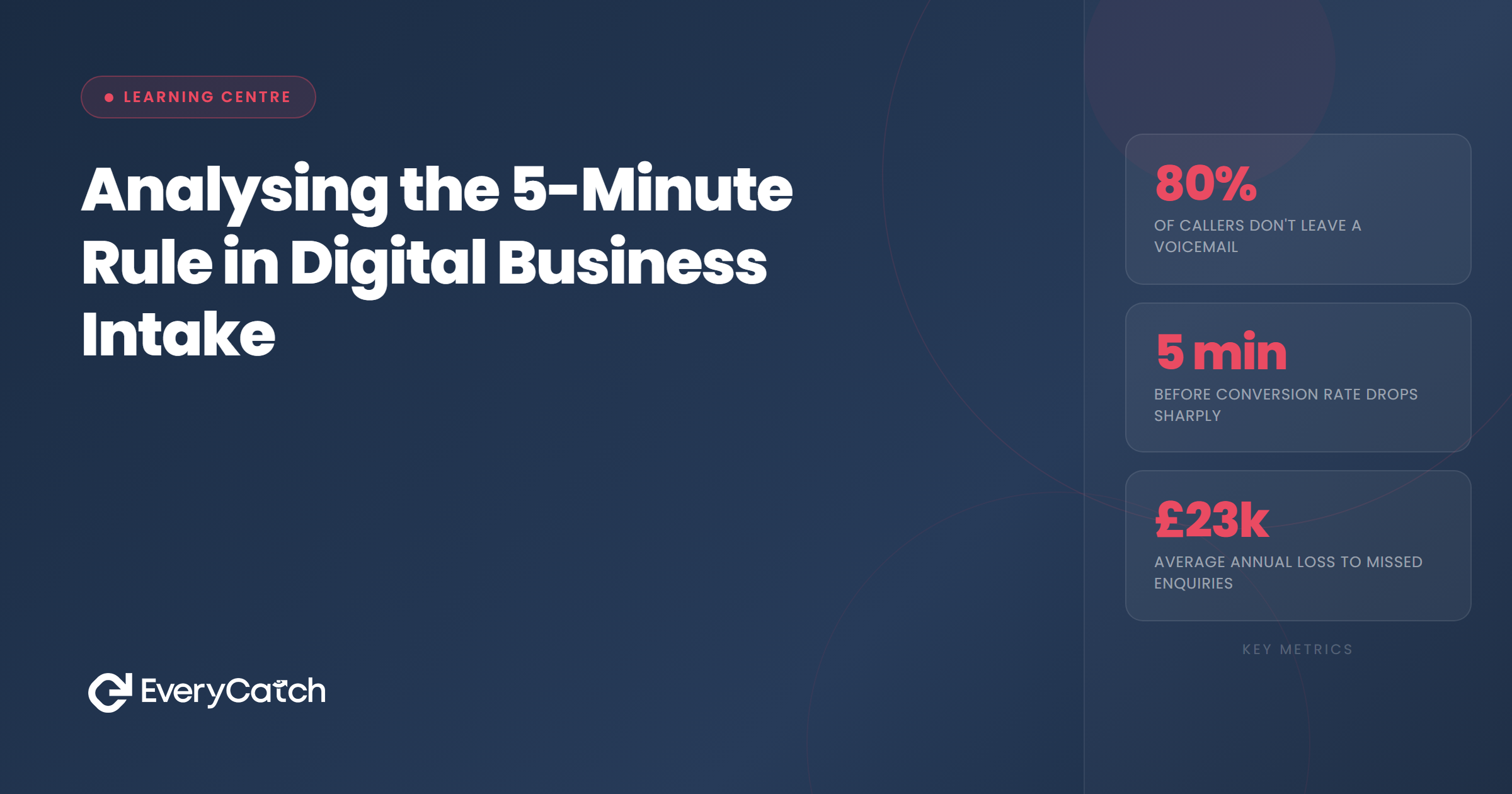

- The five-minute benchmark comes from sales research on lead contact rates — faster response means significantly higher likelihood of reaching the prospect
- For service businesses, the mechanism is competitive: you are not the only business the prospect has contacted
- The first response shapes the relational frame — the prospect's view of who is attentive and responsive
- Emergency and urgent services face an even shorter effective window
- The goal is a fast, relevant response — speed alone without quality does not hold the advantage
The "five-minute rule" has been circulating in sales and marketing circles for over a decade. It refers, broadly, to research showing that the odds of making meaningful contact with a prospective customer drop off sharply after the first five minutes following an enquiry.
Service business owners sometimes hear this and assume it is a B2B sales stat with no bearing on their situation. It is worth understanding where it actually comes from, because the underlying dynamic is more relevant to local service businesses than it might first appear.
Where the five-minute idea comes from
The most cited piece of research comes from a joint study between MIT and InsideSales.com, published in the Harvard Business Review. The finding was that businesses responding to sales leads within five minutes were significantly more likely to qualify those leads than businesses responding after 30 minutes. After an hour, the odds dropped substantially further.
The original research was primarily focused on B2B web leads — businesses submitting forms on other companies' websites to express interest in a product or service. But the underlying dynamic is not exclusive to that context. It is about the prospect's attention and the competitive situation both parties are in.
When someone submits an enquiry, they are thinking about it. They are ready to talk. They have not yet been claimed by anyone. Every minute that passes without a response is a minute they might be engaging with someone else, or a minute their focus shifts back to daily life and the urgency fades. Both of those things work against you.
Why the first contact shapes the relationship
The competitive dimension is what makes this especially relevant for service businesses. When someone contacts three local plumbers, three fitness coaches, or three web designers at roughly the same time, the first one to respond is not just ahead in a race — they are establishing a relational frame.
That first exchange sets initial impressions about how organised, responsive, and professional the business is. If it is relevant — if the response actually engages with what the prospect wrote rather than being a generic acknowledgement — it also begins to demonstrate competence. The prospect has not chosen yet, but they have begun to form a view.
By the time the second and third responses arrive, the prospect is comparing them against an interaction that already has some substance. The businesses that responded later are starting from behind in the relationship, not just behind in timing.
This is why the quality of the first response matters alongside the speed. An instant but generic reply buys you a small timing advantage, then wastes it if there is nothing useful in the message. What to say when you respond to a new enquiry covers how to structure a first response that actually moves the conversation forward.
It varies by industry and urgency
The effective time window is not identical across every type of service. Emergency trades face the most compressed version of this situation. Someone searching for a locksmith at 11pm or a plumber for a burst pipe has an acute need and is actively deciding within minutes. The five-minute window might effectively be a two-minute window. Being third to respond could easily mean the job is already gone.
At the other end of the spectrum, a solicitor handling a property transaction, an architect designing a home extension, or a management consultant engaged on a strategic project all operate in a context where considered decisions are expected to take longer. A prospect in those situations would not necessarily expect an instant reply, and the competitive pressure from a faster competitor is somewhat less acute.
For most of the service businesses that form the core of the UK economy — trades, health and fitness, personal and professional services, cleaning, landscaping, tutoring — the effective window is somewhere between these extremes. Fast response carries a meaningful advantage. The five-minute benchmark is a useful target, not a rigid law.
Want to respond to every enquiry within 60 seconds?
Book a discovery call. We will walk through how EveryCatch's Speed-to-Lead works and what it would mean for your enquiry-to-booking rate.
Book a free discovery callWhat this means practically for a service business
Taken together, it means a few things worth being clear about.
First, the businesses winning disproportionate shares of enquiries in competitive local markets are likely the ones that respond fastest. They may not be the best at the job. They may not have the best prices. They are simply the first to be in conversation, and that gives them a structural advantage in the decision.
Second, the gap is usually not difficult to close. Speed-to-lead is genuinely one of the more achievable advantages a small service business can build, because most competitors are not doing it well. Many do not even know their actual average response time. What service businesses get wrong about lead response covers the assumptions that keep response times high.
Third, the fix does not have to involve hiring. An automated or AI-powered first response can handle the initial contact — acknowledging the enquiry, asking a relevant question, beginning to qualify the need — within seconds of an enquiry arriving. The human then steps in once the conversation has been started and the prospect is warm. How to respond to enquiries instantly without hiring more staff outlines what that looks like.
The real question is not whether to respond fast
Every service business owner who thinks about this problem agrees in principle that faster response is better. The question that actually determines the outcome is: how do you respond within five minutes reliably, consistently, and at all hours — without it requiring constant personal attention?
For a business owner who is on tools, in meetings, or asleep at 11pm, personal vigilance over incoming enquiries is not a reliable system. The businesses that genuinely close the speed gap are the ones that have stopped relying on a person noticing, and built a system that operates on their behalf regardless of when enquiries arrive.
EveryCatch's Speed-to-Lead is configured around exactly this — responding to incoming enquiries across SMS, WhatsApp, web chat, and social within 60 seconds, 24 hours a day, including nights, weekends, and bank holidays. The five-minute rule stops being a challenge the moment the response time is no longer dependent on human availability.