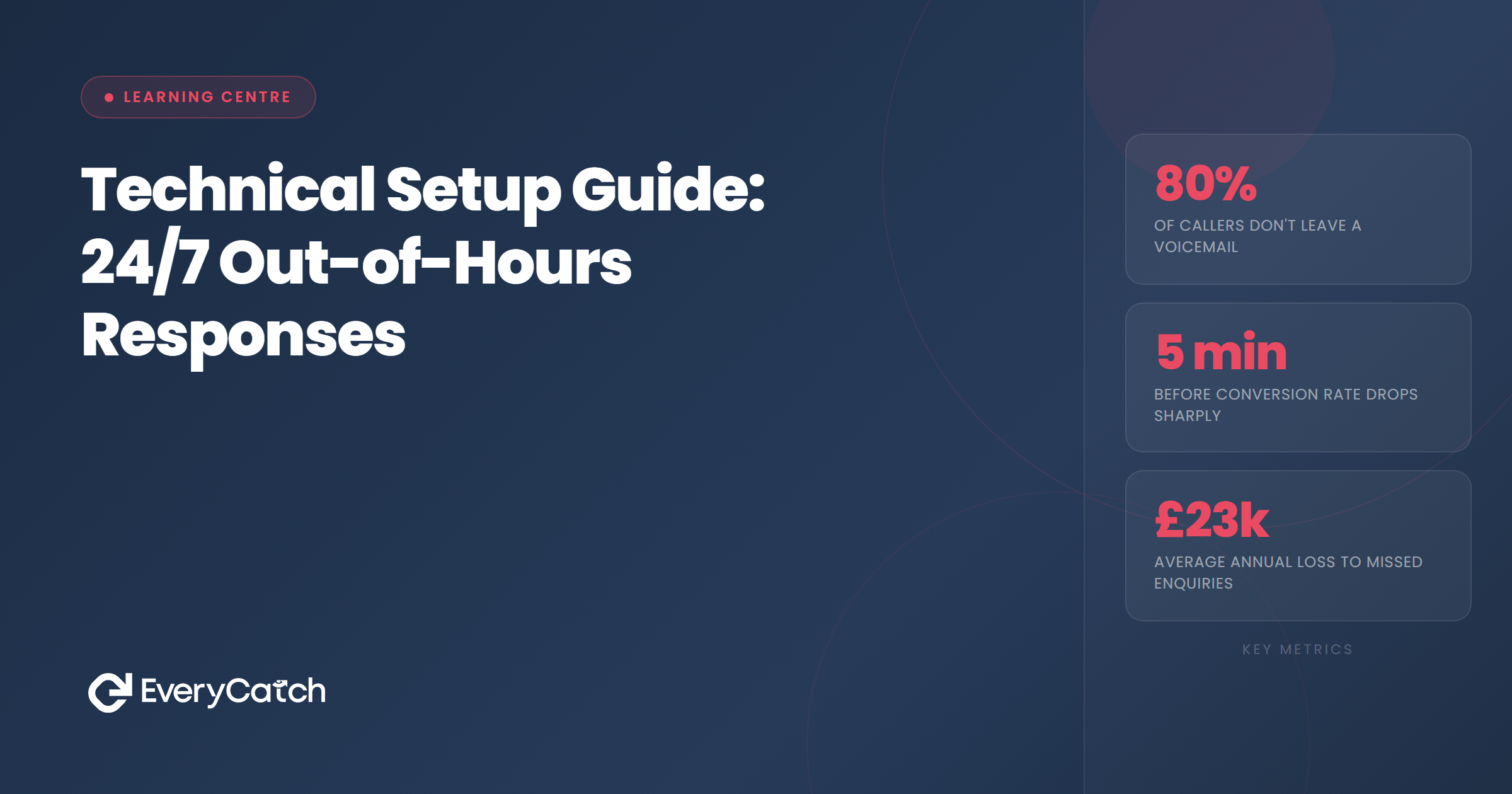

- 24/7 lead response means every enquiry is acknowledged and engaged regardless of when it arrives — not that someone is staffed around the clock
- Out-of-hours enquiries tend to be high-intent; covering them well has a disproportionate effect on conversion
- The simplest version is an automated acknowledgement that confirms receipt and sets expectations
- A more capable version uses AI to hold a real conversation, answer questions, and progress the enquiry without human involvement
- The business owner's working hours do not need to expand — the system operates on their behalf
The phrase "24/7 response" makes some small business owners switch off immediately. They hear it as a requirement to be personally available at all hours, and decide that is neither feasible nor desirable.
The more useful framing is: what does the person who enquires at 9.30pm on a Sunday experience? For most service businesses, the honest answer is silence until Monday morning. This article is about changing that — without extending your working hours.
What 24/7 response actually means for a small business
Staffing around the clock is not the goal. The goal is that no enquiry goes unanswered simply because it arrived outside business hours.
This distinction matters. A prospect who enquires at 10pm on a Friday does not necessarily need a full conversation right now. But they do need to know their message arrived and will be handled. And if they are ready to have a conversation — to answer qualifying questions, to discuss availability, to be guided toward a booking — a system that can handle that without requiring a person to be awake is better still.
Out-of-hours enquiries represent a meaningful share of total enquiry volume for most service businesses. Evenings and weekends are when people have time to think about the non-urgent things they need to sort: finding a new accountant, booking a garden makeover, arranging a home survey. These are not emergency enquiries, but they are real ones, and the prospect is often contacting several businesses simultaneously.
Businesses that cover this period compete for those jobs. Businesses that do not are invisible during it.
The channels that need covering
Not every channel carries the same out-of-hours risk. Phone calls are largely self-limiting — people are less likely to call a business at 10pm, and a missed call is obvious and usually prompts a callback in the morning. The bigger gaps tend to be in the digital channels.
Web contact forms receive a significant share of out-of-hours enquiries. They are convenient for prospects, who can fill them in while sitting on the sofa. Without an automated response, these sit in an inbox until someone checks it the next day.
WhatsApp is increasingly used for business enquiries, particularly in trades and local services. People message in the evening because calling feels intrusive but messaging seems fine. The expectation of response is less urgent than for a phone call, but it still requires acknowledgement to prevent the prospect from moving on.
Social media DMs arrive at all hours. Prospects who find a business via Instagram or Facebook may message directly rather than visiting the website. Without monitoring or automation on these channels, evening and weekend messages can sit unread for days.
Live chat widgets, if offered on the website, create the highest expectation of immediate response. A chat widget that sits idle outside business hours without any indication of this is actively damaging — it suggests no one is paying attention to any aspect of the business.
The simplest version: out-of-hours acknowledgement
The floor-level option for 24/7 coverage is an automated acknowledgement that fires whenever an enquiry arrives outside business hours. It confirms receipt, sets an expectation for the next response, and prevents the prospect from feeling ignored.
A good out-of-hours acknowledgement does three things: it names the business (not just "we"), it says something specific about when the team will follow up, and it gives the prospect a clear next step if their need is urgent. Something like: "Thanks for getting in touch with [Business]. We're not around right now, but we'll pick this up first thing tomorrow morning. If it's urgent, call [number] and leave a message." That is better than a generic "thanks for your message" — and far better than silence.
This is the minimum viable version. It keeps you from losing the prospect before you have even had a chance to engage.
Want to know what your out-of-hours enquiries currently experience?
Book a discovery call and we will map your current enquiry flow — including what happens when a prospect contacts you at 9pm on a Sunday.
Book a free discovery callA more capable version: AI that can hold the conversation
The step up from an acknowledgement is an AI that can actually respond to the content of the enquiry, at any time of day or night. The prospect does not receive a placeholder — they receive a reply that engages with what they wrote, answers their obvious questions, and progresses toward a booking.
This is more involved to set up. The AI needs to be equipped with knowledge about the business: what services are offered, what areas are covered, how the process works, what questions prospects typically ask, and what information is needed to progress toward a quote or a booking. That knowledge base needs to be accurate, because the AI will use it to answer real questions.
When it is set up properly, the result is that a prospect who enquires at 11pm on a Saturday is in a real conversation within 60 seconds. By the time the business owner starts their day on Monday, some of those prospects may already have appointments booked. Others will be warm leads at a more advanced stage of qualification than a simple form submission.
How to respond to enquiries instantly without hiring more staff covers the different levels of response automation in more detail.
What to expect from a proper implementation
When a business moves from no out-of-hours response to consistent 24/7 response, the most immediate effect is usually a visible increase in the number of enquiries that progress. Prospects who previously received no response and moved on are now being engaged before they have time to look elsewhere.
The second effect is a reduction in the mental overhead of managing enquiries. Business owners who were personally monitoring their phones or email at all hours — knowing that a late reply might cost them a job — find that the system handles the first stage. They check in the morning and see conversations that have already started, questions that have already been answered, and in some cases appointments already in the calendar.
The setup matters enormously. A generic AI dropped onto a website without configuration will respond generically and confuse more prospects than it helps. A system built around a specific business — its language, its services, its process, its typical customer questions — performs very differently. EveryCatch builds this with clients during onboarding rather than handing them a tool and expecting them to configure it independently.
The practical implication for most service businesses is that 24/7 lead response is achievable within a few weeks of committing to the setup. The business hours do not change. The results from enquiries that arrive outside those hours change significantly.
See EveryCatch Speed-to-Lead for more on how out-of-hours response is handled in practice.