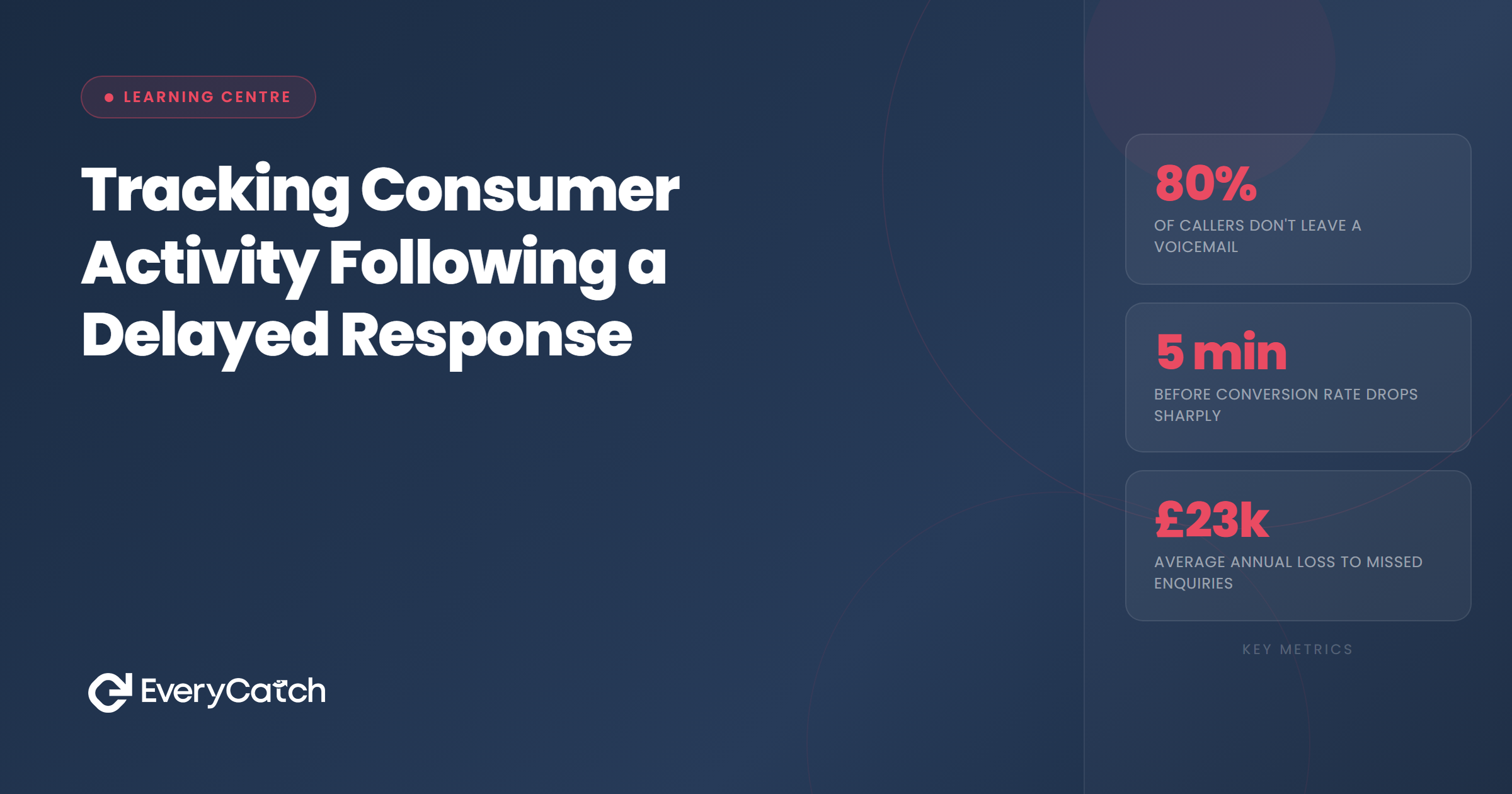
- A prospect's decision-making attention is highest in the first few minutes after submitting an enquiry
- After about 30 minutes, most people have returned to other tasks and are no longer actively comparing options
- By the one-hour mark, a competitor who responded earlier is likely already in a live conversation with your prospect
- After 24 hours, a late response arrives into a completely different context — often one where the prospect has already moved on
- The "thanks, all sorted" reply is the most common signal that a lead was lost to a faster competitor
When a business owner says they respond to enquiries the same day, they usually mean it. They do respond — eventually. The problem is what the prospect does in the time between sending the enquiry and receiving that reply.
Most service business owners have never mapped this sequence. They see the enquiries they did win and attribute it to their price, their reputation, or their quality. They see the ones that went quiet and write them off as tyre-kickers. The reality is often more straightforward, and more fixable, than either assumption.
The attention window and why it closes
When someone submits an enquiry, they are in a specific mental state. They have identified a need, done enough research to find some plausible options, and taken the concrete action of getting in touch. At that moment, this task is near the top of their attention. They are thinking about it.
That state does not persist. People have jobs, children, calls, meals, and a hundred other things competing for their focus. The decision to hire a kitchen fitter or find a business accountant is not an emergency for most people, even if it feels important. Life reasserts itself fairly quickly after the enquiry goes in.
The window during which someone is actively thinking about their enquiry and ready to engage with whoever responds is probably ten to twenty minutes for most non-urgent services. After that, they have moved on to something else. They will look at their phone or email again, but they are no longer in the same state of focused readiness.
This matters because an early response arrives during the window. A late response arrives after it has closed. They are not equivalent experiences for the prospect.
What prospects actually do while they wait
They continue searching. Someone who submitted a contact form on your website almost certainly found it through a search. After they submit it, the browser history is still there. The search results page is still a tab away. If they do not hear back quickly, they have no reason not to contact one or two more businesses from the same list.
This is not disloyalty. It is rational behaviour. They have a need, they have not yet heard from anyone, and there are other options available. Contacting a second or third business is a low-effort action that keeps their options open.
By the time you respond an hour later, you may be their third or fourth contact, not their first. You are entering a conversation they are already having with other people. Your response does not land in empty space — it lands in a context shaped by whoever responded before you.
What typically changes at the one-hour mark
The hour threshold is not a hard rule. Some prospects are more patient, some less. But one hour is roughly where the competitive landscape has usually shifted.
A business that responded within the first five minutes has had up to 55 minutes of conversation with the prospect. In that time, depending on the service, they may have answered questions, established a price range, offered an availability window, or even booked an initial call or visit. The relationship has structure. The prospect has invested time in it.
Your response, arriving an hour later, is asking the prospect to start over. They may do it — particularly if the early responder left a poor impression, or if your reputation is noticeably stronger. But you are asking them to reconsider a path they have already started down, which takes more effort from them than simply continuing the conversation that is already underway.
The most common outcome at this stage is not an outright rejection. It is the polite brush-off: "Thanks for getting back to me — I've actually just sorted it." You have no way of knowing how recently they sorted it, or how close you would have been if you had got there first.
Want to stop losing leads to slower competitors?
Book a discovery call and we will map your actual enquiry flow — including where the gaps are and what it would take to close them.
Book a free discovery callAfter 24 hours, the context has completely changed
By the following day, one of several things has usually happened. The prospect has had a satisfying conversation with someone else and is progressing toward a booking. Or they have heard from nobody and their initial urgency has faded. Or they have decided to defer the decision entirely and will revisit it next week or next month.
In none of these scenarios is a 24-hour-later response landing into the same situation it would have found if it had arrived within the first ten minutes. The prospect has moved. The moment has passed.
For some service types this matters less. A complex, high-value project where the decision naturally takes weeks will not be won or lost on the strength of a one-day response delay. But for the typical service business enquiry — trades, fitness, coaching, accounting, cleaning, pest control, landscaping — a 24-hour response might as well be no response at all.
This is not hypothetical. Why your business loses leads in the first five minutes explains why lost leads in this window are essentially invisible — the prospect does not tell you they went elsewhere, so the problem never gets measured or addressed.
The pattern most businesses recognise too late
There is a consistent pattern among service business owners who first start measuring their actual response times. The average is almost always higher than they expected. And when they cross-reference it against their conversion rate, there is often a clear relationship: enquiries that received a fast response converted at a higher rate than those that did not.
The explanation is not simply that fast-response businesses are better. It is that fast response keeps you in the conversation during the window where the conversation is most valuable. Slow response lets competitors in while you are still on your way to the door.
The fix does not require hiring additional staff. It requires a system that reliably responds to every incoming enquiry, regardless of when it arrives. How to respond to enquiries instantly without hiring more staff covers the options at different levels of complexity.
For businesses operating on EveryCatch's Speed-to-Lead, the first response goes out within 60 seconds across every channel — including evenings, weekends, and bank holidays. The conversation starts immediately. By the time the prospect might have considered contacting a competitor, they are already in dialogue.