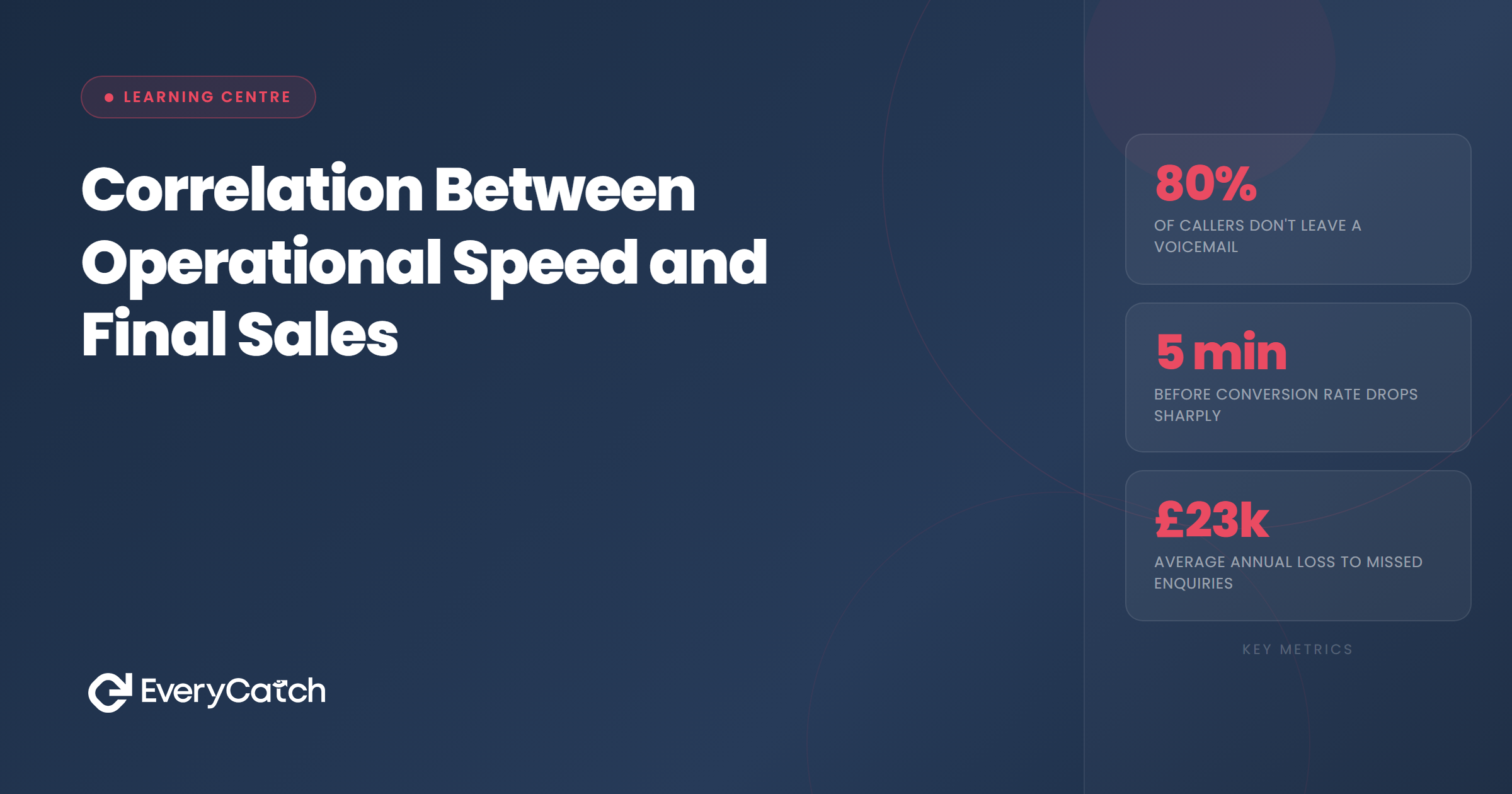

- Fast response keeps you in the conversation during the window when the prospect is actively comparing options
- Speed also functions as a proxy signal for operational reliability and professionalism
- Being first to respond in a competitive multi-quote situation carries a structural relationship advantage
- You can measure the impact on your own business by auditing response times against conversion rates
- Speed alone is not sufficient — quality, follow-up, and competitive pricing all remain relevant
The claim that fast response rates close more deals is not especially controversial. Most business owners accept it in principle. The more useful questions are: by how much, through what mechanism, and how do you actually measure it in your own business?
This article addresses all three, because understanding the mechanism makes it easier to act on — and because the impact on a specific business is always more convincing than a general claim.
The connection between speed and conversion rate
When service business owners audit their enquiry data for the first time — recording when enquiries arrived and when they were first responded to, then cross-referencing both against whether the job was won — a pattern typically emerges. Enquiries that received a fast first response converted at a higher rate than those with slow or no response.
This correlation is not proof of causation on its own. Faster responders might also have better sales skills, better prices, or better reputations. But the pattern holds consistently across businesses where these other factors are broadly similar, which suggests speed is doing real work in the conversion outcome — not just running alongside other things that matter.
The most straightforward explanation is the competitive one. Most prospects contact more than one business. The first to respond holds a structural advantage: they are in conversation while the others are not. By the time the slower responders arrive, they are competing against someone who has already built rapport, answered questions, and potentially moved toward a booking. The disadvantage compounds over time.
What happens to a lead if you don't respond within an hour covers the specific sequence in detail.
Speed as a trust signal
The competitive advantage explains part of the picture. The other part is about what speed communicates to the prospect.
Someone hiring a service business for the first time — and most service business enquiries come from people without an established relationship — is making a judgement about reliability. They cannot yet evaluate your actual workmanship. They cannot directly verify your quality. What they can observe is how you behave in the early stages of the relationship.
A business that responds quickly signals organisation, attentiveness, and the kind of operational reliability a customer wants in someone they are about to trust with their home, their finances, or their health. It is not a definitive signal — a fast responder can still be a disorganised operator — but it is a positive indicator that most prospects register, consciously or not.
The reverse is also true. A slow or absent response signal that the business is either disorganised or not particularly interested in this enquiry. Neither interpretation is attractive. Even if neither conclusion is accurate, the prospect's decision-making process does not pause to investigate further. They move on.
The first-mover advantage explained
The relational dimension of first-mover advantage is underappreciated. It is often described purely as a timing race — be first, win the deal. But the mechanism is more nuanced than that.
The first business to respond sets the relational context for the conversation that follows. If the first response is attentive — if it acknowledges what the prospect actually said, answers an obvious question, and asks something that moves things forward — it creates a frame. The prospect begins forming an impression of who this business is and how they operate.
When the second and third responses arrive, the prospect is comparing them against a conversation that already has structure. A later response that is equally good in isolation may feel less impressive because the comparison point has shifted. The prospect is no longer evaluating in a vacuum.
This is why the quality of the first response matters alongside the speed. An instant but hollow acknowledgement sets a neutral or slightly negative frame. A fast, relevant, specific response sets a positive one. The combination of speed and quality is what creates durable first-mover advantage, not speed alone.
Want to see how your response rate affects your conversion?
Book a discovery call and we will look at your current enquiry flow together, including where the gaps are between enquiry volume and conversion rate.
Book a free discovery callMeasuring your own response rate
The best evidence for this in your own business is your own data. Most business owners have not run this analysis, which is why the scale of the impact tends to be surprising when they do.
The methodology is straightforward. Take the last three months of incoming enquiries — ideally across all channels. For each one, record:
- When the enquiry arrived
- When you sent your first response
- Whether the enquiry converted to a job
Group the enquiries by response time: under 5 minutes, 5 to 30 minutes, 30 minutes to 1 hour, 1 to 4 hours, over 4 hours, next day or later. Calculate the conversion rate for each group.
The comparison is often stark. Fast-response enquiries convert at a noticeably higher rate. Enquiries that received a response the following day often show close to zero conversion — not because the prospects were inherently less likely to buy, but because the window had closed before the conversation started.
Running this analysis also tells you where your average response time currently sits. Service businesses that have not measured this are typically over-estimating their speed by a significant margin, particularly once out-of-hours enquiries are included.
Speed is one factor, not the only one
Faster response gives you a meaningful structural advantage in competitive enquiry situations. It does not replace the need to price well, deliver excellent work, maintain a strong reputation, or follow up effectively after the initial contact.
A business that responds in 60 seconds but quotes 40% above market rate is unlikely to see its conversion rate dramatically improve. Speed gets you in the conversation. What you do in that conversation — and in subsequent follow-ups — determines whether the job is won.
The most effective approach is to treat speed as the entry condition and invest equally in what comes after it: a relevant first message, a clear next step, and a follow-up sequence that keeps the conversation alive for prospects who did not commit immediately. What to say when you respond to a new enquiry addresses the message side of this.
EveryCatch's Speed-to-Lead handles the first-contact problem, responding within 60 seconds across SMS, WhatsApp, web chat, and social. The system is configured with the client's business knowledge so the response is specific to what the prospect wrote — not a generic acknowledgement, but the beginning of a real conversation.