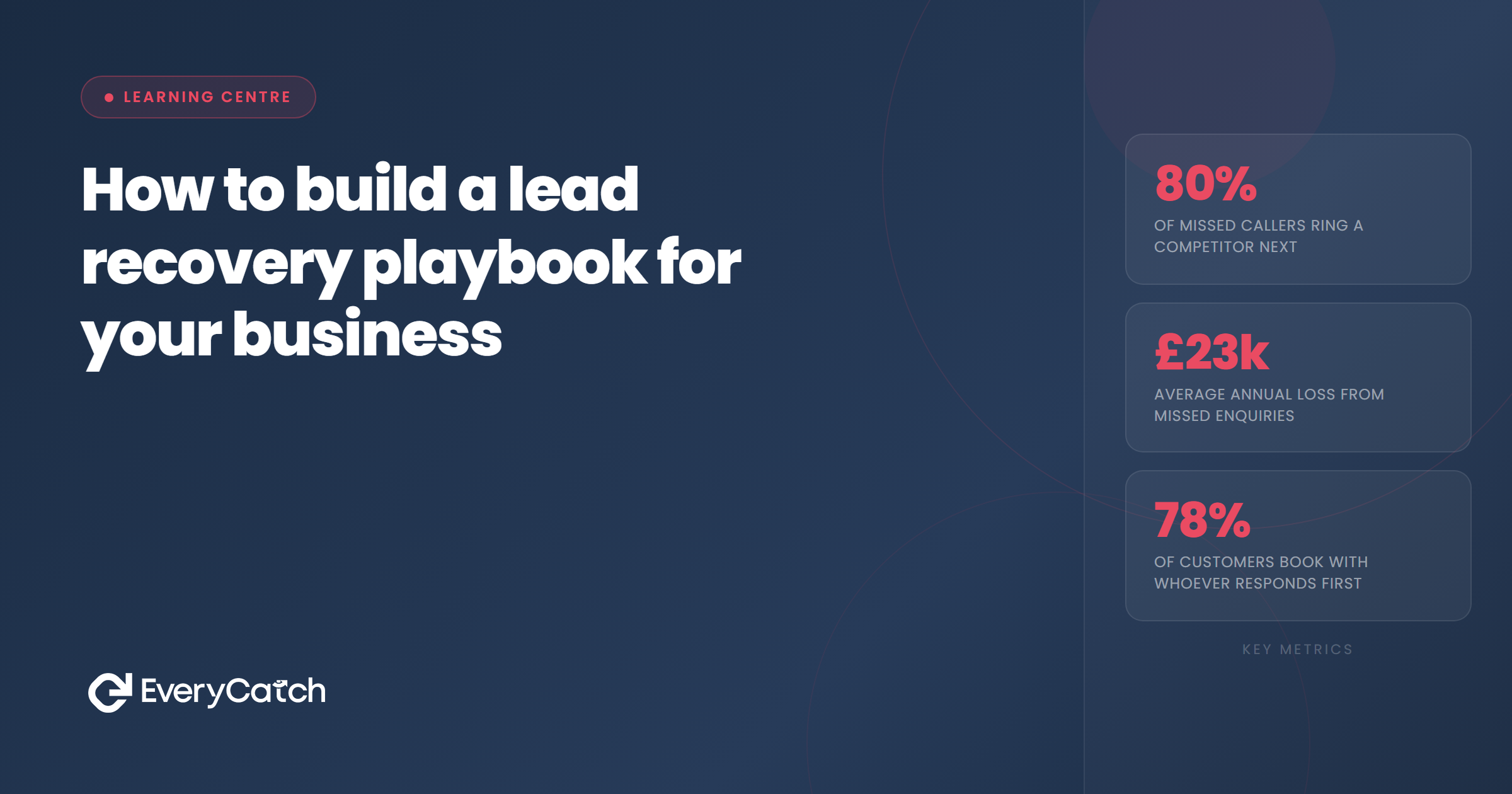

- A lead recovery playbook is a written set of rules covering every channel where an enquiry can go unanswered.
- Start by mapping your leaks. Most businesses lose leads through missed calls, slow form responses, and forgotten follow-ups.
- Set a specific response rule for each channel, with a timeframe and a named fallback action.
- Write your recovery messages once, in advance, so nobody has to compose them under pressure.
- Automation does the sending, but the playbook document is what keeps the whole system honest.
Most service businesses handle missed leads the same way. Someone notices a missed call at the end of the day, means to ring back, and sometimes does. A form enquiry sits in an inbox until it feels awkward to reply. Nobody decided this would be the process. It just happened, and it costs jobs every week.
A lead recovery playbook replaces that improvisation with a set of rules you write once and follow every time. Building one takes an afternoon. Here is how to do it properly.
What a lead recovery playbook actually is
A playbook is a short document, often a single page, that answers one question for every channel your leads arrive through: if this enquiry goes unanswered, what happens next, when, and who does it? That is the whole idea. It is not a marketing plan or a sales script. It is a safety net written down so it works even on your busiest day.
The reason it needs to exist on paper rather than in your head is simple. The days you miss leads are precisely the days you are too busy to think about missed leads. A playbook makes the recovery process something that runs regardless of how your day is going. If you have read our guide on how many leads your business is actually missing, you already know why the stakes justify the effort.
Step one: map where your leads go missing
You cannot recover leads if you do not know where they leak out. Spend thirty minutes listing every route an enquiry can take into your business. For most trades and local services, the list looks like this: phone calls, website contact forms, Facebook and Instagram messages, WhatsApp, email, Google Business Profile messages, and word-of-mouth referrals that arrive as texts.
Then look at last month's data for each one. Count the missed calls in your phone log. Check the timestamps on form enquiries against your replies. Look at how long social messages sat unread. Most owners find two or three channels doing the bulk of the damage, and missed calls almost always top the list. Our article on the real cost of a missed call shows how quickly those numbers add up.
Rank your channels by leak size. Your playbook should tackle the worst one first, because a rule that recovers half your missed calls will usually outperform perfect coverage of a channel that leaks one lead a month.
Step two: set a response rule for every channel
For each channel on your list, write one rule with three parts: the trigger, the action, and the deadline. A trigger might be a call that rings out. The action might be an automatic text to the caller. The deadline is how quickly it happens.
Deadlines matter more than most owners expect. Research on lead response consistently shows that contact within five minutes converts dramatically better than contact within an hour, and a lead left overnight has often already booked with a competitor. So a good rule reads something like this: any missed call receives a text within sixty seconds, and if the caller replies, a human responds within fifteen minutes during working hours.
Write a rule for out-of-hours enquiries too. A call at 8pm does not need a full conversation at 8pm. It needs an acknowledgement that keeps the lead warm until morning, plus a named first task for whoever opens up the next day.
Not sure where your biggest leak is?
We will walk through your enquiry channels with you and show you exactly where leads are slipping out, free and without obligation.
Book a free discovery callStep three: write your recovery messages in advance
The fastest way to kill a recovery system is to make someone compose a message from scratch every time. Write your templates once and store them in the playbook. You need surprisingly few. A missed-call text, an out-of-hours acknowledgement, a form enquiry reply, and a short follow-up for leads who went quiet will cover most situations.
Keep them human. A missed-call text that says "Sorry we missed you, we're on a job. What can we help with?" outperforms anything that sounds like a call centre. Include the business name, invite a reply by text, and never make the lead repeat information they have already given you. We cover tone and wording in more depth in what to say in a missed call text-back message.
Add one more template most businesses forget: the revival message for old leads. A short "Hi, you enquired about X a few weeks back, are you still looking to get it sorted?" recovers a steady trickle of jobs from enquiries everyone assumed were dead.
Step four: automate the parts nobody has time to do
A playbook that relies entirely on humans will fail on your busiest days, which are exactly the days it is needed. The first message after a missed call or form submission should be automatic, because no person can reliably respond within sixty seconds while up a ladder or with a customer.
This is the layer EveryCatch handles for the businesses we work with. Missed calls trigger an instant text back, form enquiries get an immediate reply, and follow-up sequences run on schedule without anyone remembering to send them. The playbook still matters, though, because automation only executes rules. You decide what the rules are, what the messages say, and where a human takes over. The best setups use automation for speed and people for conversation.
Whatever tools you use, make sure every enquiry lands in one place. A pipeline view that shows every lead and its current status turns "did anyone reply to that?" from a daily worry into a ten-second check.
Step five: review the numbers monthly
A playbook is only finished the first time. Once a month, look at three figures: how many enquiries came in, how many received a response within your deadline, and how many turned into booked work. If response rates are high but bookings are low, your messages need work. If response rates are low, a channel is leaking and the rule needs fixing.
Keep the review short. Fifteen minutes with the numbers beats an hour of guessing, and over a few months you will watch the gap between enquiries and bookings close. That gap is where your playbook earns its keep.

From the EveryCatch team
We help service businesses catch every enquiry with instant responses, automated follow-up, and one simple pipeline. Everything we publish comes from patterns we see across the businesses we work with every day.