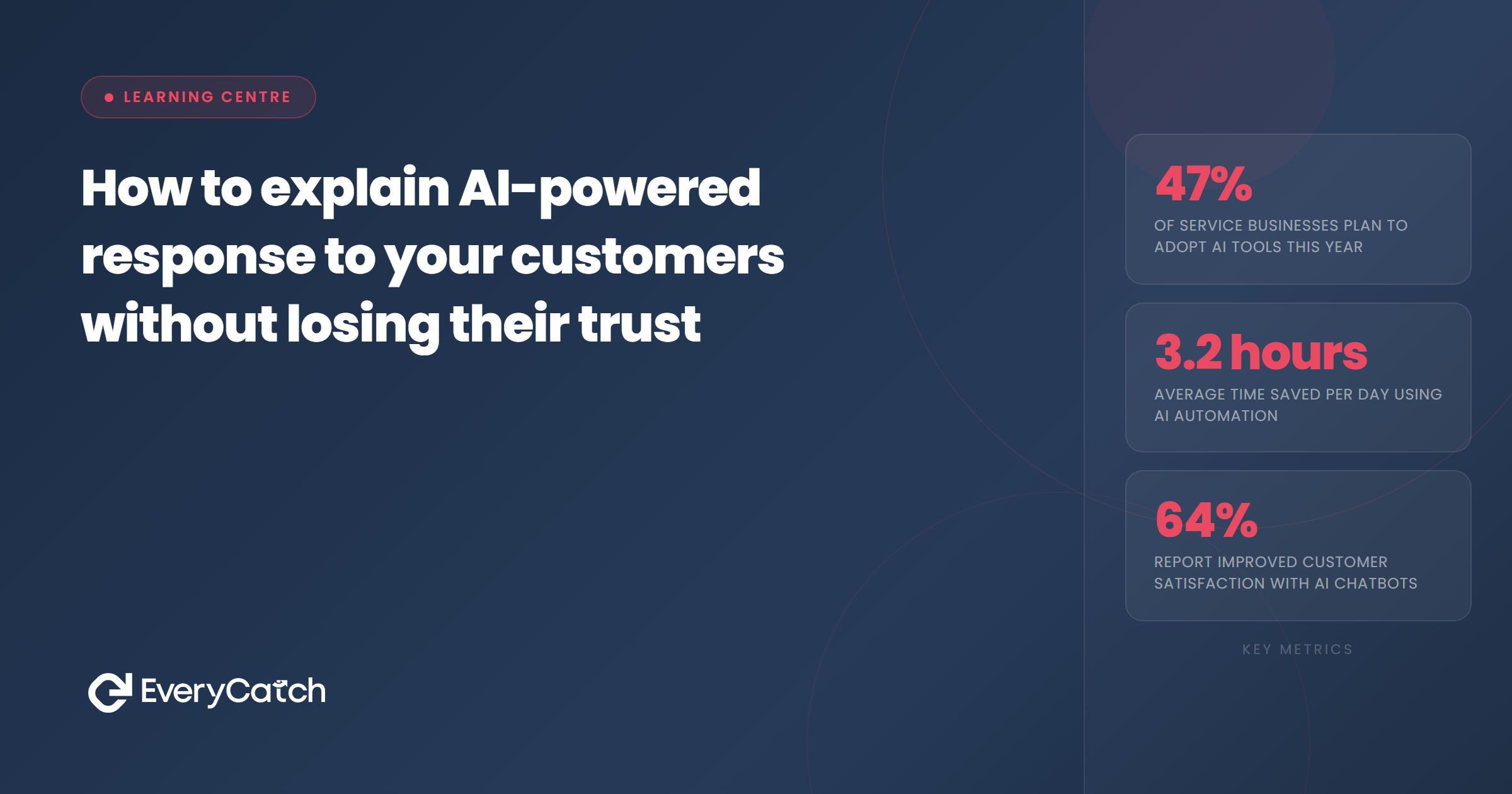

- Most customers are comfortable with AI first response when they know about it in advance
- The trust damage comes from finding out later, not from the AI response itself
- A clear, brief disclosure in your first response is the simplest and most effective approach
- Having a prepared answer for "am I talking to AI?" removes the awkwardness when it comes up
- Framing AI as a service benefit ("you hear from us instantly") lands better than framing it as a cost-saving measure
Many business owners worry about what their customers will think when they find out the initial response was AI-generated. The worry is usually misplaced. Most customers are more comfortable with AI assistance than the businesses using it expect.
What damages trust is not AI itself. It is the feeling of having been misled. A customer who receives a fast, helpful first response and knows it came from an AI system has a different reaction than a customer who later discovers they were talking to AI without being told. The first is fine. The second feels like a small deception, and in a service business where personal trust is the foundation of every booking, that matters.
Why being upfront about AI response builds trust rather than eroding it
Transparency signals confidence. A business that says "our first response is handled by AI, so you always hear from us within a minute" is telling the customer something useful about how the business operates. That is a value statement. Compare it to a business that says nothing, and the customer eventually figures out they were not talking to a person. The first business looks organised. The second looks like it was hiding something.
There is also a practical element. As AI becomes more common in everyday business interactions, customers are increasingly accustomed to it. Banks, insurers, and utilities have been using automated first response for years. What service business customers find reassuring is that the business behind the AI is reachable and responsive when it matters. The AI is the mechanism for being fast. The human is the answer to anything that needs one.
As the article on what AI can actually do for a service business right now notes, immediate acknowledgement is one of the highest-value uses of AI in a service business context. Disclosing it does not reduce that value. It adds the benefit of honesty to the benefit of speed.
What to say when a customer asks if they are talking to AI
This moment catches some business owners off guard. It does not need to. A clear, honest answer is both the right answer and the one that goes down best.
A straightforward response looks like this: "Our initial replies are handled by our AI assistant, which means you get an immediate response at any time of day. I'm Andrew from the team, and I'm following up personally to make sure your enquiry gets the right attention." That is it. No elaborate explanation, no apology for using AI, no defensive justification. Just a clear statement and an immediate move to the human part of the conversation.
Customers who ask this question are usually not hostile to AI. They are testing whether they will be fobbed off. The answer above tells them they will not be. EveryCatch's speed-to-lead approach is designed around exactly this handoff: AI responds in under a minute, and the business owner receives an alert to follow up personally once the AI has made first contact.
Want to see how the AI-to-human handoff works in practice?
Book a discovery call and we will walk you through how EveryCatch handles first response and personal follow-up together.
Book a free discovery callHow to explain AI response across your communications
The disclosure does not need to happen only when a customer asks. Building it into your standard first response message removes the uncertainty entirely. A simple line at the end of the acknowledgement message, something like "This message was sent automatically to make sure you heard from us straight away. A member of our team will be in touch shortly," tells the customer what they need to know without making a big deal of it.
Website copy can mention it too, in a way that positions it as a service benefit rather than a cost-cutting measure. "We respond to every enquiry within 60 seconds" is the customer-facing version of "we use AI for first response." It describes what the customer gets, not how the technology works. That framing lands far better.
Marketing materials that say things like "you will always hear from us, day or night" are also accurate descriptions of what AI response delivers without needing to use the word AI at all. The important thing is that when the question does arise, the business has a clear and confident answer.
What to avoid when disclosing AI involvement to customers
The main thing to avoid is pretending the AI is a person. Giving the AI a human name and a fictional persona, without any disclosure that the customer is interacting with AI, is the pattern most likely to cause a backlash when the customer realises what happened. The short-term benefit of appearing more human does not outweigh the long-term trust damage of the customer feeling deceived.
Overly apologetic disclosure is the other extreme to avoid. Saying "I should tell you, I'm afraid that message was automated" frames it as something to be embarrassed about. It is not. Fast, reliable first response is a service improvement. Treat the disclosure as a feature description, not a confession.

From the EveryCatch team
EveryCatch systems are designed to handle first response clearly and fast, with built-in handoff to the business owner at the right moment. The goal is not to replace the human conversation but to make sure it starts well and starts quickly.