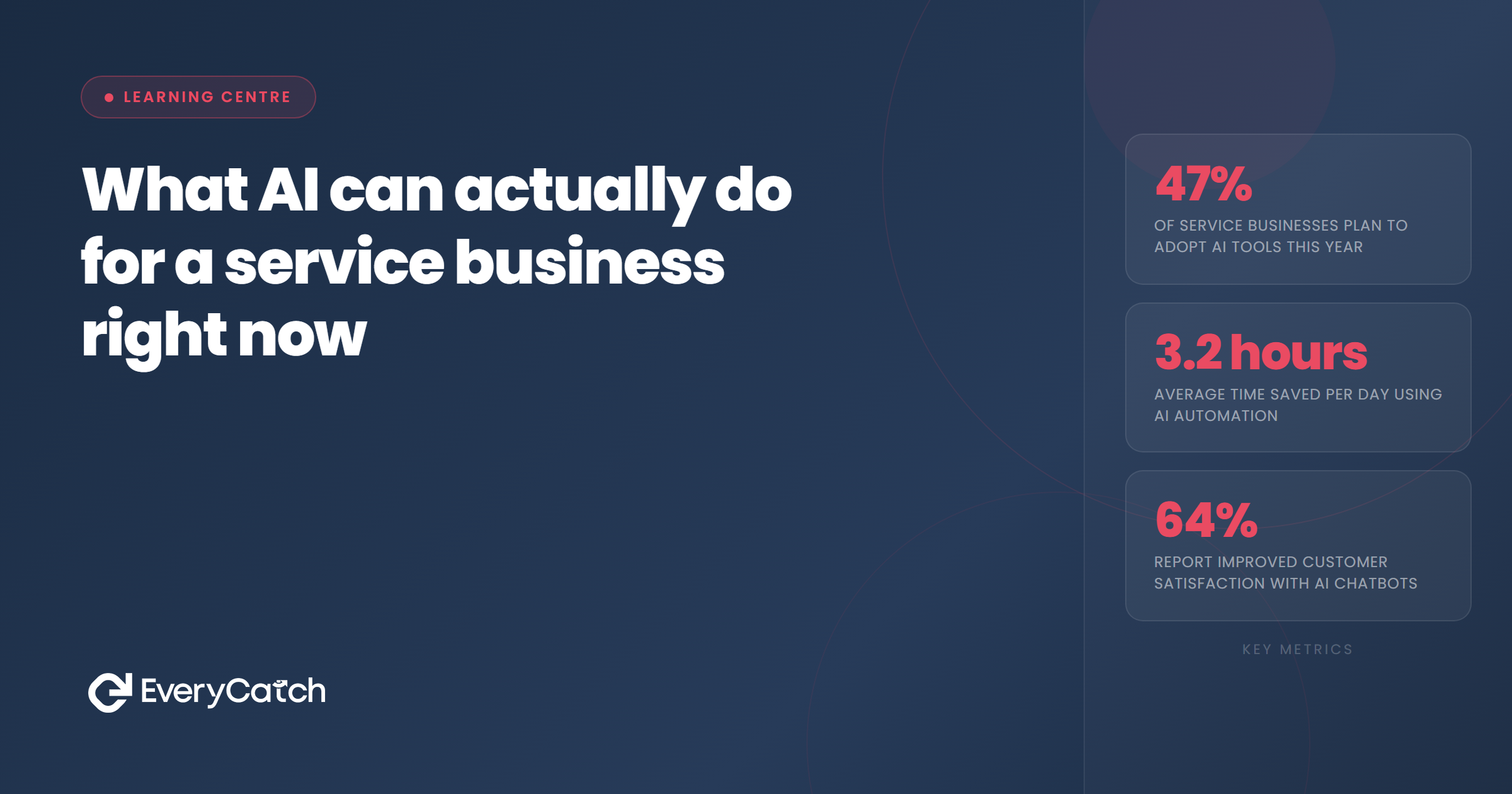
- AI is strongest at speed and availability: responding to new enquiries 24/7 without human delays
- Where it falls short: nuanced conversations, trust-building, and pricing discussions on complex jobs
- The highest-return application for most service businesses is automated first response to enquiries
- Setup time is hours, not weeks, and monthly costs are typically under £150 for a small service business
- Start narrow: one AI application done well outperforms several half-configured tools
The Reality Behind the AI Headlines
Every week brings another announcement promising that AI will transform everything about your business. If you are a plumber, a physio, a solicitor, a personal trainer, or any other service business owner, most of that coverage is not written for you. It is written for investors, for journalists, and for software engineers who find it easier to discuss what AI might eventually do than what it can actually do for a business like yours today.
That gap between the hype and the practical reality is worth closing quickly, because there are genuine applications that work now and are generating a measurable return for service businesses of all sizes. There are also applications that are not ready, not suitable, or simply not worth the setup effort for a small or specialist operator.
Getting clear on the difference means you can make a sensible decision rather than either ignoring AI entirely or investing in the wrong thing. The rest of this article is that distinction, as plainly as possible.
Where AI Delivers Real Value for a Service Business
AI has two clear strengths that apply directly to the way most service businesses operate.
The first is speed. AI can respond to a new enquiry in seconds, at any hour, on any day of the week. A prospect who fills in your contact form at 11pm on a Sunday gets an immediate, coherent reply. They are not left waiting until Monday morning, by which point your competitors may have already spoken to them. Speed of first response is one of the strongest predictors of conversion in service businesses: leads contacted within minutes convert at a significantly higher rate than leads who wait hours or days for a reply.
The second is availability. AI does not take annual leave, does not miss a call because it is already on another call, and does not have bad days. Your business can maintain a consistent, professional first point of contact even when you are mid-job, in a meeting with a client, or simply off for the evening. That consistency is hard to achieve with human cover alone, particularly for businesses that do not have dedicated reception staff.
These two strengths combine to address a problem that costs service businesses significant revenue: the leads who make contact, get no response, and move on to whoever does respond. Closing that gap is where AI currently delivers its clearest return.
Worried about missing enquiries?
Find out exactly how EveryCatch handles new leads and what a difference 24/7 response makes for a service business.
Book a free discovery callWhat AI Still Can't Do Well
Being honest about limitations is as useful as knowing what works. There are several areas where AI consistently falls short for service businesses, and deploying it in these areas without human backup will cost you customers.
Context-heavy conversations are one. A long-term client calling to raise a concern needs handling differently from a first-time enquirer. AI tends to treat them the same unless it has been given very detailed instructions and the customer history is easily accessible. Most small service businesses do not have systems clean enough to make that work reliably.
Pricing discussions for complex or variable-scope work are another. If your jobs require a site visit or a detailed brief before you can quote accurately, AI cannot substitute for that conversation. It can collect initial information and set up a handover, but it cannot negotiate, qualify edge cases, or build the kind of trust that a priced proposal from a known person carries.
Relationship management does not transfer well either. Long-term clients who call for a chat, referral partners you need to keep warm, and customers who want to know how a project is going all need a human. AI has no memory of shared history, no warmth, and no ability to read between the lines of what someone actually needs.
The clear pattern: AI works where you need speed, consistency, and availability. It does not work where you need judgement, nuance, or relationship.
The Application Worth Acting On Right Now
Given what AI does well, the highest-return application for most service businesses is automated first response to new enquiries.
When a prospect calls and you cannot answer, AI takes the call, collects the key details, and passes the information to your inbox or CRM within seconds. When someone fills out a contact form, AI sends an immediate, professional acknowledgement. When a message arrives outside business hours, AI responds and sets expectations about when to expect a full reply from your team.
None of this replaces you. It fills the gap that currently exists between when a prospect makes contact and when a real person in your business responds. Most service businesses lose a significant portion of their potential enquiries at this stage, not because of poor service but simply because the initial contact goes unanswered or takes too long. The prospect does not know how good you are yet. All they know is that someone else replied and you did not.
This is the application that pays for itself quickly, because the revenue it recovers was already being generated by your marketing and your reputation. It was just leaking through the gap between contact and response.
How to Start Without Getting Overwhelmed
The worst approach to AI is trying to implement five things at once. The best results consistently come from one narrow application implemented well, measured over 90 days, and then expanded once the return is clear.
Start with your biggest contact leak. If most of your leads arrive via phone and you regularly miss calls during working hours, an AI phone answering system is the right first step. If they come via web forms and your response time runs to hours or days, an automated acknowledgement and follow-up sequence is the priority.
Most tools that handle first-response AI plug into your existing phone number, CRM, or booking system. Setup time is measured in hours rather than weeks. Monthly costs for a small service business typically fall between £50 and £150, which is less than the value of a single missed job in most cases.
Test it on the contact channel with the highest volume. Measure response rates and conversion over 90 days. If the numbers improve, expand. If they do not, adjust the approach before adding complexity. The businesses that get the most from AI are the ones that start with a specific problem, not the ones that chase a full AI strategy from day one.

From the EveryCatch team
EveryCatch helps service businesses respond to new enquiries faster and capture more leads through automated first response. Every article in this Learning Centre draws on what actually works for local and specialist service businesses, built from real customer data rather than generic advice.