
- Automated replies sent within 60 seconds get 391% higher response rates than those delayed by an hour or more
- 78% of buyers choose the first business that responds, regardless of price or reputation
- Speed creates the perception of reliability, which is more valuable than initial personalisation
- Automated first responses free your team to focus on meaningful conversation during follow-up
- The goal is immediate acknowledgement, not immediate sales pitch
We have been told for years that automation feels cold. That customers want to speak to real people. That personalised, human responses always win.
The data tells a different story. When someone submits an enquiry, they care more about speed than they do about whether a human typed the first reply. An automated message that arrives in 30 seconds will get a higher response rate than a thoughtful, personalised message that arrives two hours later, every single time.
This is not about replacing people. It is about understanding what the first response is actually for, and using the right tool to deliver it.
The speed expectation has changed
Consumer behaviour studies show that 82% of people expect a response to a sales or marketing question within 10 minutes. Not 10 minutes during office hours. 10 minutes, full stop. At 8pm on a Saturday. On Boxing Day. During a family emergency.
This expectation did not exist 10 years ago. It has been created by the instant responses people receive from Amazon, from airlines, from food delivery apps, from retail chatbots. When someone fills in a quote form, they have already trained themselves to expect immediate feedback.
You may not like this expectation. You may think it is unreasonable. But your feelings about it do not change the commercial reality. If someone contacts you and a competitor at the same time, whoever responds first gets the conversation. Whoever gets the conversation books the job.
The first contact is not the place to demonstrate your expertise. It is the place to demonstrate that you are paying attention.
What the response time data shows
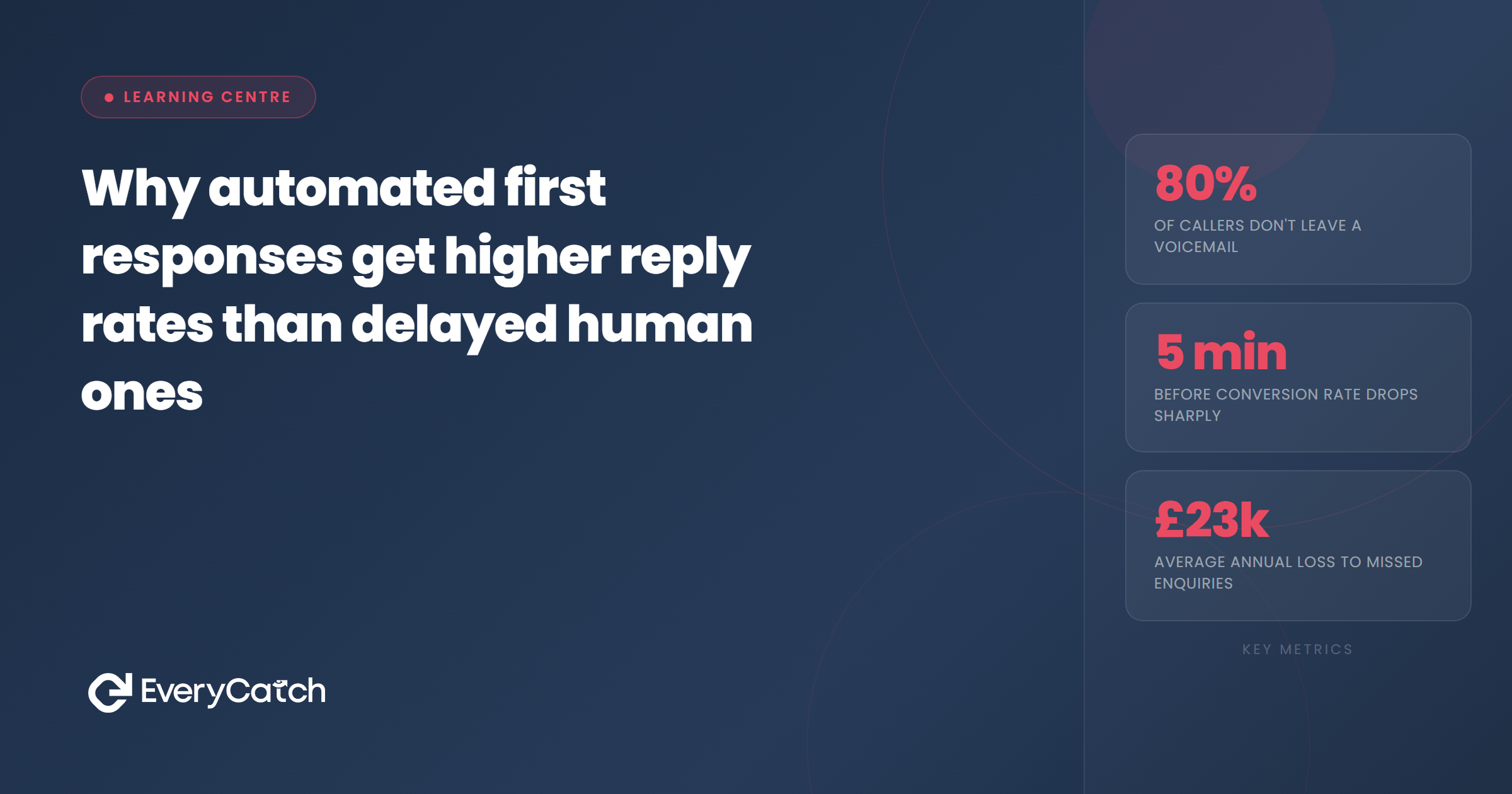
A Harvard Business Review study of 2,241 businesses found that only 37% of companies respond to leads within an hour. The average response time was 42 hours. The businesses that responded within five minutes were 100 times more likely to connect with the lead than those who waited 30 minutes.
Separate research by InsideSales.com tracked over 15 million leads and found that response time was the single biggest factor in conversion rate. The odds of qualifying a lead dropped by 400% if the first response took longer than five minutes. By 10 minutes, you have lost most of your advantage.
These studies were not comparing automated responses to human ones. They were simply measuring speed. But the implication is clear. If a human being cannot respond in five minutes, and an automated system can, the automated system will win.
Service businesses often argue that their customers are different. That they are not shopping on Amazon, they are making a considered purchase. But the same patterns appear across every sector. Plumbers, electricians, roofers, landscapers, cleaners, pet services. Speed wins. Always.
The competitive engagement window
When someone fills in an enquiry form, they are not waiting patiently for you. They are continuing to research. They are filling in other forms. They are checking Google reviews. They are comparing prices on competitor websites.
The moment they submit a form, they enter what we call the competitive engagement window. This is the period during which they are actively making a decision, and any business that engages during this window has a chance to influence that decision.
For most service businesses, this window is about 15 minutes. After that, the buyer has already formed a shortlist. They have already decided who looks credible and who does not. They have already mentally allocated their budget.
If your first response arrives after this window has closed, you are no longer competing for the job. You are competing for a place on the backup list, the one they call if their first choice falls through.
How many leads are you losing to response time?
Find out what instant responses could do for your conversion rate.
Book a free discovery callHow automation creates the advantage
An automated first response does three things that a delayed human response cannot do.
First, it acknowledges the enquiry immediately. This is not a trivial benefit. The moment someone submits a form and sees a confirmation, their brain registers that the process worked. They know you received it. They stop wondering whether the form was broken or whether it went into a spam folder. That uncertainty, that nagging doubt, is what sends them to your competitor.
Second, it creates the perception of attentiveness. A business that responds in 30 seconds is a business that is organised, that has systems, that will not forget about you halfway through the job. This perception is more valuable than any reassurance you could write in a sales email.
Third, it gives you control of the next step. A well-designed automated message does not just say "we got your enquiry". It tells the person what happens next, when to expect a call, what information you might need, and how to reach you if they have questions. You have moved them from uncertainty to a process. That process feels professional, even if no human has touched it yet.
The businesses that resist automation often say they want every message to feel personal. But the first message does not need to feel personal. It needs to feel fast. Personalisation comes later, during the conversation that only happens because you responded quickly enough to earn it.
Where human follow-up fits
Automated first responses do not replace human interaction. They protect it. When your team is not scrambling to respond to every new enquiry within five minutes, they can focus on the part of the process that actually requires judgement, empathy, and persuasion.
The second message is where personalisation matters. This is the one where you reference the specific service they asked about, acknowledge their timeline, answer the question they asked in the form. This is where a human adds value.
But that second message only happens if the first one arrived fast enough to keep the conversation alive. You cannot personalise your way out of being too slow.
Some businesses use a hybrid model. The automated message goes out immediately, and the human follows up within an hour with something more tailored. This works well, because it gives you the speed advantage and the quality advantage. But the sequence matters. Automated first. Human second.
The other advantage of this approach is consistency. A human might respond instantly to one enquiry and forget about another for three hours. An automated system treats every lead the same. That consistency is what builds predictable conversion rates.

From the EveryCatch team
We help service businesses respond to every lead in under 60 seconds, automatically. Our clients see an average 47% increase in qualified bookings within the first month.