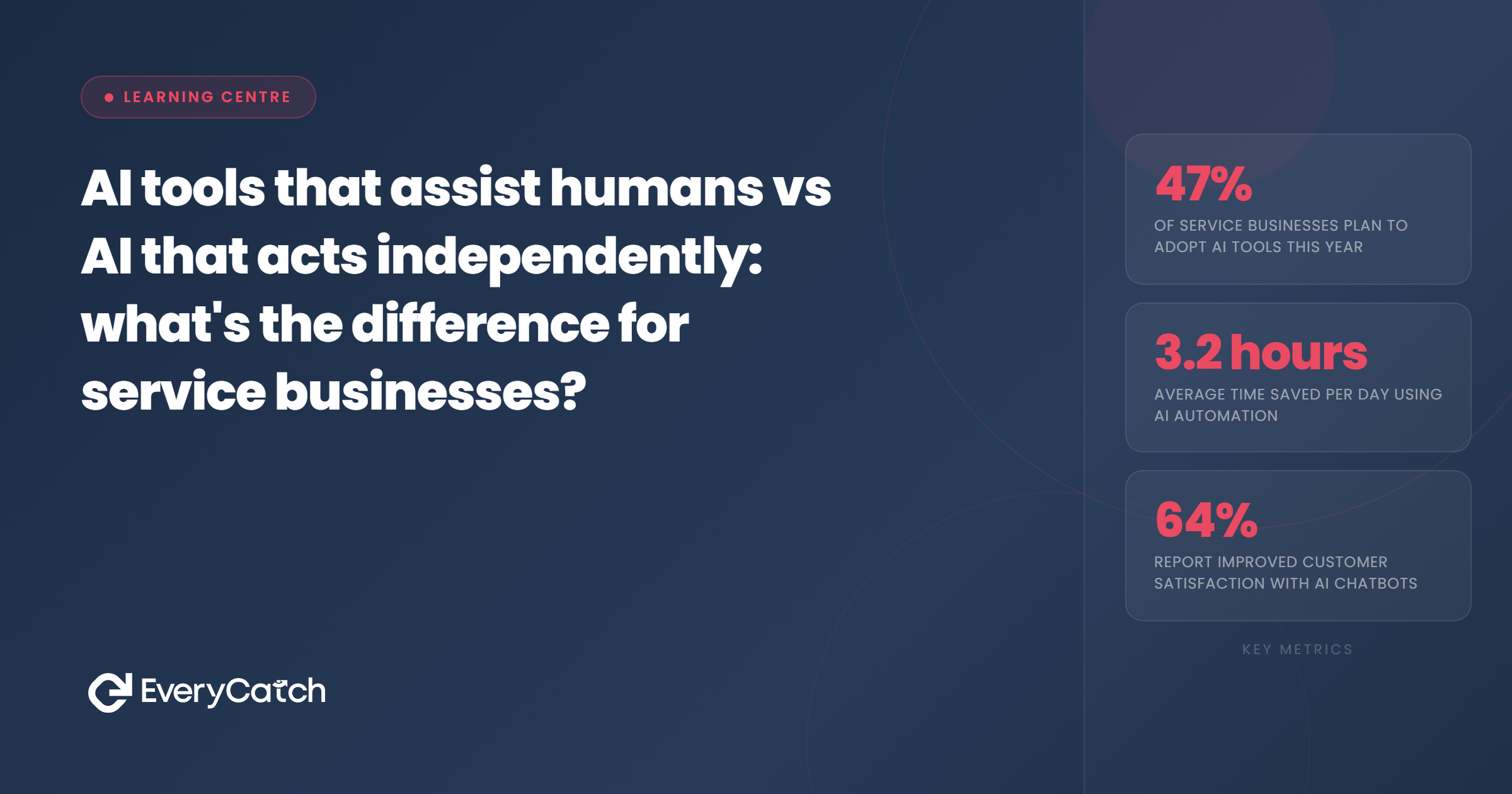

- Assistive AI supports a human decision, agentic AI makes and acts on its own decisions
- Most service businesses benefit most from agentic AI in the first response stage, assistive AI everywhere else
- Agentic AI carries more risk than assistive AI and requires more careful setup and boundary-setting
- The marketing terms for both often overlap, so looking at what the tool actually does is the only reliable way to categorise it
- A well-designed system will combine both: agentic for speed, assistive for judgement
The term "AI" covers a lot of different things. For a service business owner trying to decide what to buy and what to trust, the most useful distinction is not the technical one. It is the practical one: does this tool help a human do something, or does it do things on its own?
These two categories behave differently, fail differently, and suit different parts of your business. Getting them confused leads to either underusing what AI can do, or overextending it into situations where it should not be operating alone.
What assistive AI does for a service business
Assistive AI makes a human more effective. It generates a draft response for a team member to review and send. It suggests the next action in a pipeline without taking it automatically. It flags an enquiry as high-priority based on the keywords in the message, so the person checking their inbox knows where to focus first.
The common thread is that a human remains in the loop before anything is sent or acted on. The AI provides information, suggestions, or drafts. The human decides what to do with them.
For service businesses, assistive AI is well-suited to tasks where getting it wrong has a relationship or financial cost: drafting quotes, responding to complaints, writing follow-up messages for high-value prospects. The AI does the thinking work, the human does the approving. You get speed and quality without giving up control.
What agentic AI does, and how it differs
Agentic AI acts independently. It receives an enquiry, generates a response, and sends it without anyone reviewing it first. It can book appointments, send follow-up sequences, update records, and move a lead through a pipeline, all without a human approving each step.
The upside is obvious: it runs without you. An agentic AI system can handle enquiries at 11pm on a Sunday with the same speed and quality as it does at 9am on a Monday. For the first response stage of enquiry handling, this is the specific problem it solves. As the article on what AI can actually do for a service business covers, the immediate acknowledgement of every new enquiry is one of the highest-value things an agentic system can take over.
The downside is also clear: it can get things wrong without anyone catching the mistake in time. A response that misreads an enquiry, or sends the wrong follow-up to a customer who has already converted, is not caught before it goes out. Setting boundaries for an agentic system, defining exactly what it is allowed to do and what it must escalate, is the work that separates a good deployment from a damaging one.
Want to know how to set up AI safely in your business?
EveryCatch builds agentic response for the tasks where it creates value, with human handoff built in for the rest.
Book a free discovery callWhich type of AI a service business actually needs
Most service businesses need both, applied to different tasks. The practical answer breaks down by risk and repetition.
For high-repetition, low-risk tasks, agentic AI is the right choice. Sending the first acknowledgement to a new enquiry is low-risk. The worst outcome is that it is slightly off-tone. The cost of missing the window to respond is much higher. Let the agent run.
For low-repetition, higher-risk tasks, assistive AI protects you. A quote for a complex job, a response to a negative review, a message to a customer who has raised a complaint. These are cases where AI should draft and a human should approve.
EveryCatch's follow-up sequences are a good example of how this split works in practice: the immediate first response is agentic, subsequent follow-ups are triggered automatically but the content is pre-approved by the business owner, and anything involving a direct customer concern gets flagged for human review.
How to tell the difference in the tools you are looking at
Vendors do not always label their tools clearly. "AI-powered" can mean anything from a basic autoresponder to a fully autonomous agent. The way to find out which you are dealing with is to ask one question: does anything get sent or acted on without a human approving it first?
If yes, you are looking at agentic AI. Follow-up questions: What can it do without approval? What does it escalate? What happens when it encounters a situation it was not designed for? The answers tell you whether the safety boundaries are set correctly for the tasks you intend it to handle.
If no, you are looking at assistive AI. The relevant questions are about quality and efficiency: how good are the drafts, how much time does the review step actually take, and does the AI improve over time based on what gets approved and what gets changed?

From the EveryCatch team
EveryCatch uses agentic AI for the tasks where speed matters most, with clear escalation paths built in for anything that needs human attention. The design principle is simple: automate the routine, protect the relationship.