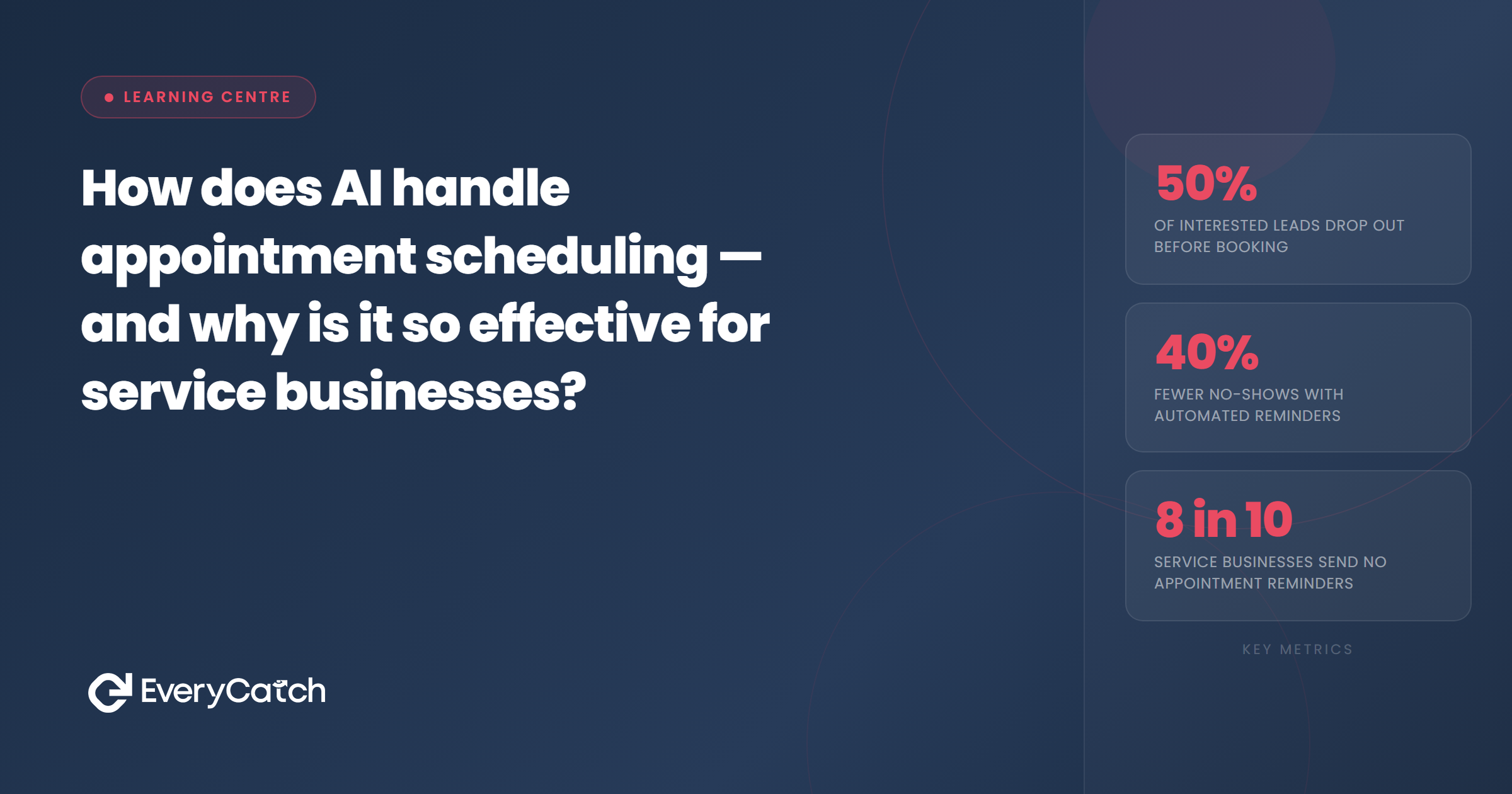

- AI appointment scheduling reads enquiries, qualifies prospects, checks availability, and books appointments automatically.
- The speed advantage is the main commercial reason it outperforms manual scheduling for service businesses.
- Qualification happens through natural conversation, not static forms, which reduces drop-off.
- AI works across SMS, web chat, and email from the same setup.
- The system hands off to a human when the enquiry is outside its configured scope.
AI handles appointment scheduling by doing what a skilled receptionist does, but without the working hours, the sick days, or the phone going unanswered at 8pm on a Tuesday. It reads the incoming message, determines whether it is a genuine booking enquiry, gathers the information needed to offer a slot, checks the calendar in real time, and confirms the appointment. The whole process takes under two minutes in most cases, and the customer never has to wait for a human to become available.
For service businesses, that speed is the practical difference between converting a lead and losing one. Most enquiries go to the first business that responds. AI appointment scheduling removes the window in which that lead can walk away. The speed-to-lead capability that sits beneath this is not a nice-to-have for service businesses competing on incoming enquiries. It is the core mechanism through which AI converts interest into bookings.
How AI appointment scheduling works in practice
The process starts the moment a prospect makes contact. That might be through a web form, a live chat widget, an SMS, or an email. The AI reads the message, identifies what the person needs, and opens a conversation. It does not send a generic auto-reply. It responds to the specific enquiry with a reply that moves the conversation forward.
If a prospect messages asking about a boiler service, the AI does not simply say "we'll be in touch." It responds by acknowledging the request and asking the one or two questions needed to check the right availability. What type of boiler? Roughly what area? Is there a preferred timeframe? These questions are configured by the business in advance and the AI works through them conversationally, not as a form.
Once it has the answers, the AI checks the live calendar and presents two or three available slots. The prospect picks one, the AI confirms, sends a summary message to the customer, and the appointment appears in the business owner's diary. No manual entry. No risk of the booking getting lost in a WhatsApp thread.
This same flow works across every channel. A prospect who contacts via web chat goes through the same process as one who sends an SMS. The AI handles both without any additional setup on the business side.
The qualification layer in AI appointment scheduling
Qualification is where AI appointment scheduling earns its place for service businesses. The alternative is either asking every prospect to complete a long intake form before booking, or doing the qualification manually over the phone. Both approaches lose people. Long forms drive drop-off. Phone calls require someone to be available.
AI asks qualification questions through conversation. One question at a time, in a natural order, building context as it goes. The prospect does not feel like they are filling in a form. They feel like they are having a quick exchange with someone who knows what they are doing.
The questions are set by the business. You decide what information you genuinely need before committing to a slot. A kitchen fitter might need to know whether the job is a full installation or a replacement. A driving instructor might need to know whether it is a first lesson or a refresher. The AI never asks more than it needs and never skips what is required.
This approach also produces better data than a form does. Prospects who are engaging in a conversation give more context, flag complications earlier, and are less likely to turn up at an appointment with the wrong information. The qualification conversation doubles as a light-touch relationship-building step.
How AI scheduling handles calendar sync and confirmation
The calendar connection is what separates AI appointment scheduling from a simple auto-responder. The system needs live access to the business diary to offer genuine slots, not estimated ones. Most platforms connect directly to Google Calendar, Outlook, or job management tools. The moment the connection is established, the AI can check real-time availability and only offer slots that actually exist.
Once a prospect confirms a slot, three things happen automatically. The appointment is added to the business calendar. A confirmation message goes to the customer with the appointment details, the business address or meeting link, and anything else they need. And a notification goes to the business owner so they know a new booking has come in.
Double-booking is prevented by the live sync. If two people enquire simultaneously, the first to confirm locks the slot. The second is automatically offered the next available time.
The confirmation message is also the start of the pre-appointment sequence. Reminders can fire automatically at set intervals before the booking, which reduces no-show rates without any manual follow-up from the business.
Want to see AI scheduling set up for your business?
Book a free call and we will show you how EveryCatch handles the full scheduling process from first enquiry through to confirmed appointment.
Book a free discovery callWhy AI appointment scheduling is particularly effective for service businesses
Service businesses have a specific structural problem that AI scheduling solves better than most other approaches. The owner, or the person who would normally handle bookings, is often unavailable precisely when enquiries arrive. They are on a job, in a meeting, or simply finished for the day. The prospect, meanwhile, is at peak intent. They have just decided they need the service and they are ready to book.
The gap between that peak intent and a human response is where most service business leads are lost. Understanding why the booking step loses more leads than most businesses realise makes clear how small the window actually is. Studies on lead response time consistently show that the probability of converting a lead drops by more than half if the first response takes longer than five minutes. For a business that relies on phone calls or manual message-checking, that window closes on most enquiries.
AI appointment scheduling closes that gap entirely. The response goes out in seconds. The qualification happens in real time. The booking is confirmed before the prospect has a chance to move to the next result on Google.
There is also a practical advantage for businesses with variable availability. A sole trader whose diary changes week to week cannot maintain a static booking page accurately. AI scheduling that connects to the live calendar reflects the actual current availability, not a best-guess estimate from last Monday.
What AI appointment scheduling cannot handle
AI scheduling works well for the majority of service enquiries, but there are situations it is not suited to. Complex pricing discussions that require a site visit or a detailed scope of work before a cost can be agreed are not something the AI can resolve on its own. Complaints from existing customers need a human in the conversation. Anything that requires judgement based on information the AI was not configured to expect will get routed out.
When those situations arise, the AI flags the conversation and notifies a human, passing across the full exchange so nothing has to be repeated. The customer is told someone will follow up shortly. The handoff is clean because the context is preserved.
The right way to think about AI appointment scheduling is not as a replacement for all human contact, but as the layer that handles the repeatable, high-volume part of the process so that human attention is reserved for the situations that genuinely need it.

From the EveryCatch team
EveryCatch is built for service businesses that need bookings handled automatically without losing the personal feel that keeps customers coming back. The system handles the scheduling process end to end, so your calendar fills while you focus on the work.