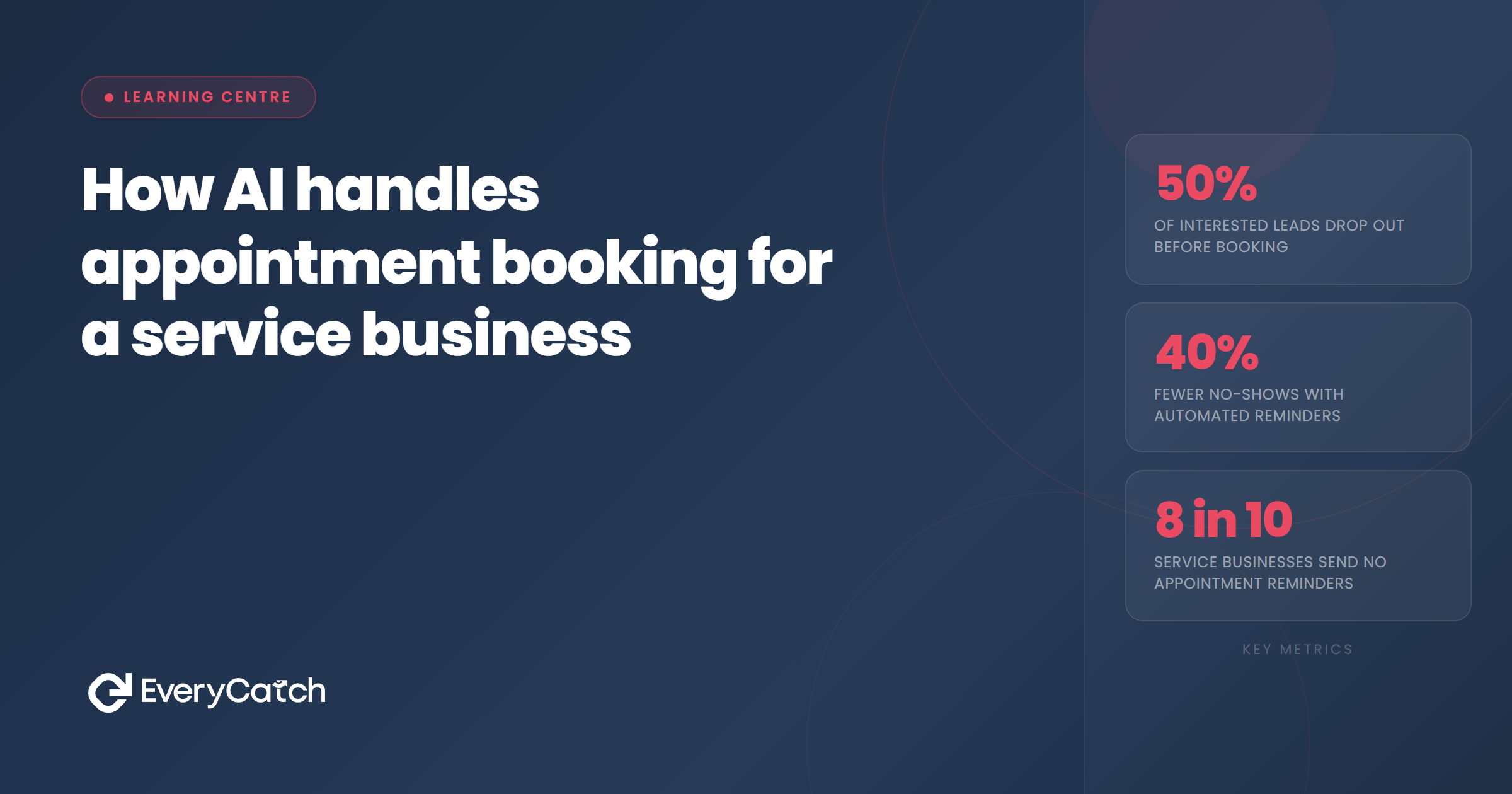
- AI booking tools handle the conversation between enquiry and confirmed appointment without human involvement.
- They can qualify leads, check availability, collect information and send confirmations inside a single automated exchange.
- The best implementations respond within seconds, regardless of when the enquiry arrives.
- AI handles repetitive booking tasks well, but complex or sensitive situations still benefit from a human step.
- The goal is not to remove people from the process, it is to remove the delays that cause leads to drop off before they book.
What AI booking actually does
When most people hear "AI booking," they picture a calendar widget on a website. Pick a slot, fill in your name, done. That is online booking, not AI booking, and the difference matters.
AI-powered booking handles a conversation. Someone sends a message, whether that is a text, a web chat, a missed-call text-back or a social media enquiry, and the system responds in natural language. It asks what service they need, when they are available, whether they have used the business before, and any qualifying questions specific to that business. Once it has what it needs, it checks the calendar and offers slots. The customer picks one, and the appointment is confirmed in the same thread.
The whole exchange can happen in under two minutes, at two in the morning, on a Sunday, while the business owner is on another job. That is the actual value proposition: not cleverness, but availability.
This matters because most appointment bookings do not fail because the customer changed their mind. They fail because the process took too long, required too much back-and-forth, or asked the customer to hold on while someone checked the diary. AI removes those friction points by handling the exchange the moment it starts.
The mechanics of an AI booking conversation
Behind the customer-facing conversation, several things are happening simultaneously. The AI is reading the message, identifying the intent, and deciding which branch of the conversation to follow. It is checking the connected calendar for availability in real time. It may be running the enquiry against a set of qualifying questions to filter out unsuitable jobs before a slot is offered.
When a slot is confirmed, the system writes the appointment to the calendar, sends a confirmation message with all relevant details, and queues the reminder sequence. The customer record is created or updated in the CRM. None of that requires a staff member to be present.
The conversation itself is built on a script that the business sets up in advance. It decides what questions to ask, in what order, and what to do with different answers. A plumber might ask whether it is an emergency or a scheduled job. A therapist might ask whether the caller is an existing or new patient. A cleaning company might ask the property size before offering a slot. The AI follows the logic exactly, every time, without rushing or forgetting a question.
Where AI tools differ is in how natural the conversation feels and how well they handle unexpected input. A customer who types "I need someone to look at my boiler, it keeps cutting out" should get the same result as one who types "boiler service." The best systems handle both. Poorly configured ones trip over anything that falls outside the expected phrasing.
Where AI booking fits in your workflow
Want to see what this looks like for your business?
We set up AI booking and appointment automation for service businesses, with everything configured around how you actually work.
Book a free discovery callAI booking does not replace your entire system. It fills a specific gap: the period between an enquiry arriving and a human being available to handle it. For most service businesses, that gap can be hours or, at weekends, an entire day.
In practice, AI booking works best when it is connected to the systems already in use. The calendar the business runs on, the CRM where customer records live, and the messaging channels where enquiries arrive. When those connections exist, the AI can act as the front-of-house for bookings without creating a separate data trail to manage.
For businesses with staff, AI booking can handle out-of-hours enquiries and pass the booked appointment straight into the team's diary. For sole traders, it can handle all initial booking conversations, freeing the owner to focus on delivery rather than admin. In both cases, the system works continuously without needing oversight.
The setup is where most of the thinking happens. Deciding which services can be booked automatically and which need a conversation with a person first. Setting the qualifying questions so that the AI does not book jobs the business cannot take. Defining the calendar rules so that travel time, preparation and minimum gaps are built in. Once that groundwork is done, the day-to-day operation is hands-off.
What it replaces, and what it does not
AI booking replaces the back-and-forth that happens before a date is confirmed: the "what times do you have available?" exchange, the "let me check and call you back," the missed call that starts the whole sequence over again. It replaces the gap between enquiry and response that currently costs businesses leads they never knew they lost.
It does not replace the service itself. It does not replace a pre-job assessment for complex work. It does not handle complaints, awkward conversations or anything that requires judgement outside the booking context. Those things still need a person, and a well-configured AI booking system should escalate to one cleanly rather than trying to manage what it cannot.
The clearest way to think about it is this: AI handles the administrative side of booking reliably and at scale. The human side of the business, the expertise, the relationship, the quality of work, stays exactly as it was. What changes is that more enquiries reach that human side, because fewer are lost in the gap between arrival and response.

From the EveryCatch team
EveryCatch builds booking and follow-up automation for service businesses that want to stop losing enquiries to slow response times. The systems are set up around how each business actually works, not a generic template.