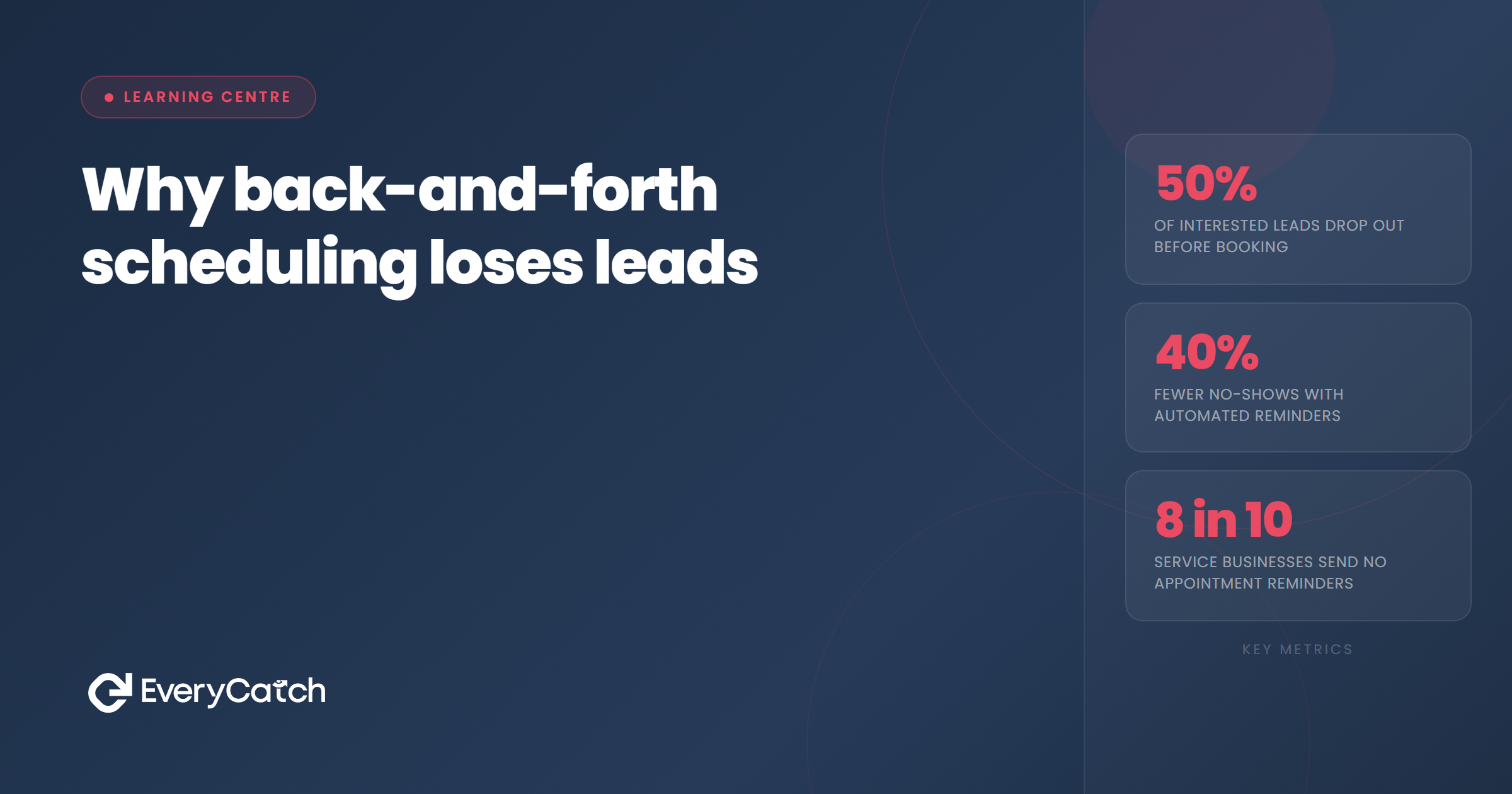

- A typical back-and-forth booking takes three to five messages and can stretch across several days, and each gap is a drop-off point.
- Lead interest peaks at the moment of enquiry and decays fast, so every hour spent negotiating a time works against you.
- Leads who go quiet mid-conversation have usually booked with a competitor who made it easier, not lost interest in the job.
- The manual dance also costs you admin time and produces appointments that no-show more often, because nothing was confirmed in writing.
- A self-scheduling link collapses the whole exchange into one step and captures the lead while their interest is at its highest.
You reply to an enquiry and ask when suits. The lead says Thursday might work. You explain that Thursday morning is full but the afternoon is open. They say they will check with their partner and come back to you. Two days later you send a gentle nudge. Silence.
That conversation happens in service businesses every single day, and it feels like normal customer behaviour. It is not. It is a scheduling process leaking leads at every step, and the leak is bigger than most owners realise.
The scheduling dance takes longer than you think
Agreeing an appointment by message or phone usually looks simple, but count the actual steps. The lead asks for availability. You reply with some options. The lead checks their diary, or their partner, or their work rota. They come back with a counter-suggestion. You confirm or offer an alternative. That is three to five exchanges at a minimum, and each exchange has a delay attached because you are on a job, or driving, or it is 9pm and you have stopped looking at your phone.
Stretch those delays end to end and a booking that should take thirty seconds regularly takes two or three days. During that window, the lead is not sitting patiently. They are getting on with their life, and in many cases they are getting quotes from other businesses at the same time.
The problem compounds when enquiries arrive outside working hours, which most of them do. Research on consumer enquiry patterns consistently shows that a large share of contact happens in evenings and at weekends. If your booking process needs a live human at both ends, those leads sit waiting until morning before the dance even starts.
Where leads actually drop out
Leads rarely say no during a scheduling exchange. They just stop replying. That silence tends to happen at predictable points, and understanding them explains why the back-and-forth is so costly.
- After your first reply with options. The lead now has homework. They need to check a diary and respond, and any task that requires effort gets deferred. Deferred tasks get forgotten.
- When your options do not fit. If Thursday afternoon does not work and the lead has to restart the negotiation, some percentage decide it is easier to try the next business on their list.
- During any gap longer than a few hours. Interest in a purchase decays quickly after the initial enquiry. A lead who was motivated on Tuesday evening is measurably less motivated by Thursday, and someone else may have already booked them in.
The competitor factor deserves emphasis. Most leads who go quiet have not abandoned the job. The boiler still needs servicing and the garden still needs landscaping. They have simply given the work to whoever made booking effortless. Speed and ease win a striking share of jobs regardless of price, which is the same dynamic that makes fast first response so valuable.
The hidden costs beyond the lost lead
Lost bookings are the headline cost, but the back-and-forth extracts payment in other ways too.
There is your time. If every booking takes four messages and you handle thirty enquiries a month, you are spending hours each week as an unpaid scheduling clerk. That is time you could bill, or time you could rest, and neither happens while you are negotiating Thursday afternoons.
There are also errors. Verbally agreed appointments and loose text threads produce misunderstandings about dates, times and addresses. A booking agreed as "Thursday around two-ish" with no written confirmation, no calendar entry and no reminder is far more likely to end in a no-show. If missed appointments are already hurting you, our guide on reducing no-shows covers why confirmation and reminders matter so much.
Finally, there is the impression it leaves. A lead who spends two days pinning you down for a quote quietly wonders whether the job itself will run the same way. Ease of booking is the first sample of your service that a customer ever experiences.
How many bookings is your diary process costing you?
We will look at how enquiries reach you now and show you exactly where leads are slipping away, free and without obligation.
Book a free discovery callThe fix is one link, not more effort
The instinctive response to leaking leads is to try harder. Reply faster, chase more, keep the phone closer. That helps at the margins, but it does not remove the underlying problem, which is that your process requires two people to be available and decisive at the same time.
A self-scheduling link removes that requirement entirely. The lead enquires, receives a link, sees your genuine availability and picks a slot that works for them. The entire negotiation disappears. There is no diary tennis, no waiting for you to finish a job, and no gap for interest to decay in. The booking lands in your calendar with the customer's details attached, a confirmation goes out in writing, and reminders follow automatically before the appointment.
The commercial effect comes from timing. A lead who books within minutes of enquiring is captured at the peak of their motivation, before a competitor answers and before life gets in the way. Businesses that switch from manual scheduling to instant booking consistently report more enquiries turning into confirmed appointments, along with fewer no-shows because every booking arrives confirmed and reminded by default. If you want the full case for the switch, read the benefits of online booking for service businesses.
Some owners worry that a booking link feels impersonal for trades and local services. In practice the opposite is true. Customers experience it as respect for their time, and the personal touch moves to where it belongs, which is the appointment itself.
Where EveryCatch fits
EveryCatch connects the whole chain rather than just handing you a calendar. When an enquiry comes in through your website, a form, a message or a missed call, the system responds straight away and offers the lead a booking link tied to your live availability. The lead picks a time, the appointment appears in your calendar, and confirmations and reminders go out without you touching anything. If the lead does not book immediately, automated follow-up keeps the conversation alive instead of leaving it to your memory.
The result is that the back-and-forth simply never starts. Leads book while they are interested, your evenings stop being admin time, and the jobs that used to vanish mid-conversation end up in your diary instead of a competitor's. That matters most for the enquiries you never even see, which is why pairing instant booking with missed call text back tends to deliver the biggest lift.

From the EveryCatch team
EveryCatch helps service businesses catch every lead with instant responses, automated follow-up and self-scheduling that fills the diary without the admin. We write these guides so owners can fix the leaks in their pipeline, whether they use our platform or not.