Managed agents in EveryCatch can now work as a coordinated team so they handle complex tasks faster, with better focus, and at a lower cost.
With new subagents, a managed agent can automatically break a complex job into smaller, targeted tasks, hand those tasks off to specialized subagents, and run independent work in parallel when that makes sense.
Each subagent is responsible for one clearly defined part of the work, while the main agent plans the overall approach, keeps everything in sync, reviews the results, and returns a complete response to you or your customer.
What changed
Intelligent task delegation
Managed agents in EveryCatch can now automatically create and use subagents based on how complex a task is and what it requires.
Each subagent is scoped to a specific job and only gets the tools, data, and context it needs to complete that one task well.
When parts of a workflow do not depend on each other, EveryCatch can run those subagent tasks in parallel so your overall execution finishes sooner.
You can simply describe what you want done in natural language, and the AI Builder will decide how to structure the work and set up the subagents for you.
More cost-efficient execution
Subagents work with a smaller, task-specific context instead of loading and processing the entire conversation or workflow history for every step.
Lighter-weight AI models can handle focused subagent tasks, while the main managed agent takes care of overall planning, reasoning, and orchestration.
This reduces how much context is passed around, which helps lower the AI execution cost for complex workflows and long-running processes.
Usage from all subagents is included in the billing for the parent managed agent run, so you do not need to track or bill them separately.
Complete visibility into subagent activity
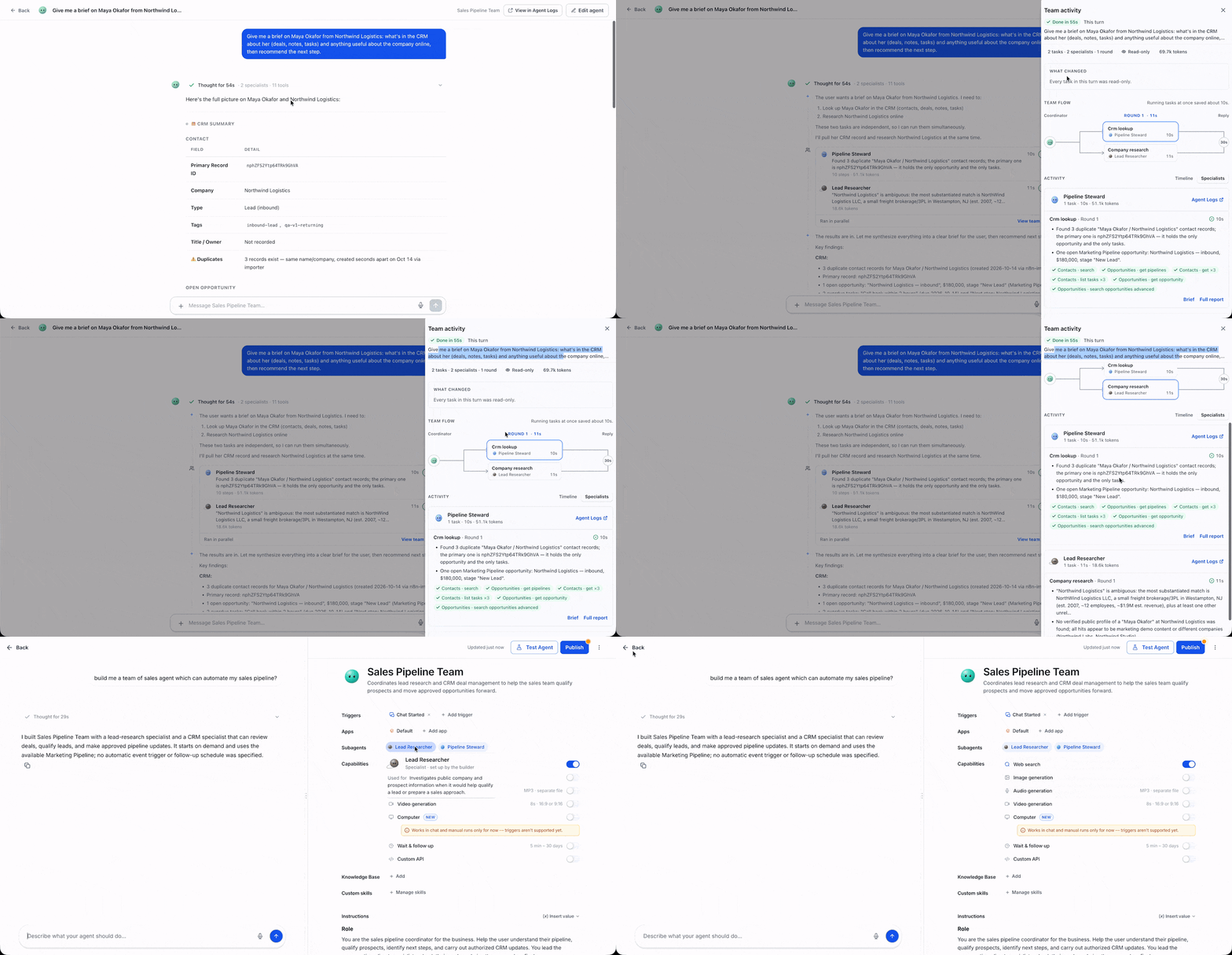
You can use the View subagent activity option to see how work is being split up, which subagents are created, and how each task is handled.
From there, you can inspect each individual task, review execution steps, check results, and see exactly what changes a subagent made.
You can monitor subagent runs from your usual Activity and Agent Logs, so all execution details stay in one place.
Controlled and secure execution
Each subagent only receives the tools, app connections, and permissions required for its assigned task, which keeps access controlled and scoped.
Tasks that are configured as read-only are restricted from modifying any records.
Before any customer-facing message created by a subagent is actually sent, the main managed agent reviews it as part of the overall flow.
Existing app connections are securely shared inside the managed agent’s execution environment so subagents can use them without exposing credentials.
Works across managed agents
Subagents are supported wherever managed agents run in EveryCatch, including chat, triggers, scheduled executions, follow-ups, and API-initiated runs.
They work with your existing knowledge bases, memory, and custom values, so you can start using subagents with the setups you already have.
There is no extra configuration needed to enable subagents. As soon as you use managed agents, they are ready to take advantage of subagents when appropriate.
How to use
Go to AI Agents → Agent Studio → Managed in your EveryCatch account.
Create a new managed agent or open an existing one, then describe the task or workflow you want it to handle as clearly as you can.
The AI Builder will automatically assess the task, decide if subagents are helpful, and configure them in the background when needed.
If you want more control, you can also tell the builder to "Split this task into subagents" or "Add a subagent to handle calendar operations."
When you run your agent, select View subagent activity to watch how it delegates and completes work step by step.
Example use case
Prompt
"Every Monday, identify opportunities that have not progressed in the last 14 days, check their recent conversations, and create follow-up tasks for the assigned owners."
Your managed agent can now break this down and hand parts of the job to specialized subagents.
Opportunity subagent: Finds opportunities that have been inactive for 14 days.
Conversation subagent: Reviews recent customer interactions linked to those opportunities.
Follow-up subagent: Creates follow-up tasks for the right owner on each opportunity.
The main managed agent organizes the overall workflow, coordinates these subagents, and then returns a clear, consolidated summary of what happened.
Why this matters
Handle more complex workflows: Break large, multi-step jobs into smaller tasks that are easier to manage and improve.
Faster execution: Run independent parts of a workflow in parallel instead of waiting for each step to finish before starting the next.
Lower AI costs: Cut down on unnecessary context and token usage by keeping each subagent focused on only what it needs.
Better reliability: Let specialized subagents handle focused responsibilities so each part of the workflow can be tuned and checked separately.
Full transparency: See which tasks were delegated, what actions were taken, and what results were produced across the entire run.
With one managed agent coordinating multiple specialized subagents, you get more capable automation in EveryCatch with less manual setup and lower overall effort and cost on complex work.