- Google Ads problems split into ad-side (targeting, quality score, match types) and post-click (lead handling speed and follow-up)
- Most guides only address the ad-side, but for service businesses, the post-click gap is often the bigger revenue drain
- A paid lead is more impatient than an organic or referral lead. Slow response costs you the click spend and the job.
- High click-through rate with low conversions usually points to a landing page mismatch or a response speed problem, not a bidding issue
- Before increasing ad spend, close the response gap first
The ad-side problems: how to diagnose them
Before assuming the problem lies outside the platform, it's worth ruling out the most common ad-side causes. Many campaigns that appear not to be converting have a fixable technical reason sitting in the account settings.
Keyword match types are one of the first things to check. Broad match keywords trigger your ad on searches that can be loosely related to what you do, sometimes very loosely. If your ad for "boiler repair" is appearing for "boiler repair course" or "how to repair a boiler yourself," that traffic will not convert. Switching to phrase match or exact match for your core service keywords tightens the pool significantly. Use broad match sparingly if at all, and only with a well-developed negative keyword list.
Search term reports show the actual searches that triggered your ads, as opposed to the keywords you're bidding on. Running through this report weekly and adding irrelevant terms as negatives is often more valuable than any other optimisation. Businesses that skip this step frequently find a significant proportion of their budget going to searches with no commercial intent.
Quality Score determines both how often your ad is shown and how much you pay per click. It measures the alignment between your keyword, your ad copy, and your landing page. A low Quality Score on a high-value keyword means your ad is appearing less often and costing more when it does. The fix is matching your landing page content tightly to the intent of the search. Someone searching "emergency electrician Birmingham" should land on a page specifically about that, not your general services homepage.
Conversion tracking deserves its own check before drawing any conclusions. Many "not converting" campaigns are simply measuring the wrong thing, or not measuring conversions at all. Confirm that form submissions and phone calls are both tagged as conversion events. If conversion tracking isn't installed correctly, the data is unreliable and any optimisation based on it will be misdirected.
Bid strategy also matters more than most people realise. Target CPA and Maximise Conversions strategies rely on historical conversion data to function properly. A campaign with fewer than 30 conversions in the last 30 days doesn't have enough signal to drive automated bidding effectively. For newer or lower-volume campaigns, manual CPC or Maximise Clicks tends to perform more consistently while the data builds.
The post-click problem nobody talks about
Addressing those issues can take a few days and will often move the needle. But for many service businesses, fixing every ad-side issue still doesn't fully resolve the problem. The reason is that conversion in a service business doesn't end at the click.
A Google Ads lead is typically a stranger who searched for something specific and clicked your ad over several alternatives. They've done no prior research on your business. They have no loyalty, no prior contact, no warm relationship. The moment they submit a form or click to call, they are in active decision mode, and they are almost certainly comparing you to competitors at the same time.
Research into service business lead handling consistently shows that the probability of converting a lead drops sharply within the first hour after submission. After two hours, you are competing against a business that has already had a conversation with that person. By the following morning, the window has usually closed entirely. The lead didn't disappear because your ad was bad. They disappeared because nobody reached them in time.
For a service business running Google Ads, this matters more than it might for other lead sources. A referral or organic search lead typically has slightly more patience. There's some pre-existing context, a recommendation behind the click, or a longer research process. A paid lead clicked an ad. They are in shopping mode. They will take the first meaningful response they get.
Paying for leads that go unanswered?
EveryCatch ensures every paid enquiry gets an immediate response, automatically, so the click spend isn't wasted on leads that go cold before you call back.
Book a free discovery callPaid leads and response speed: why the math gets brutal fast
The cost of slow follow-up on paid traffic compounds in a way that's worth making explicit.
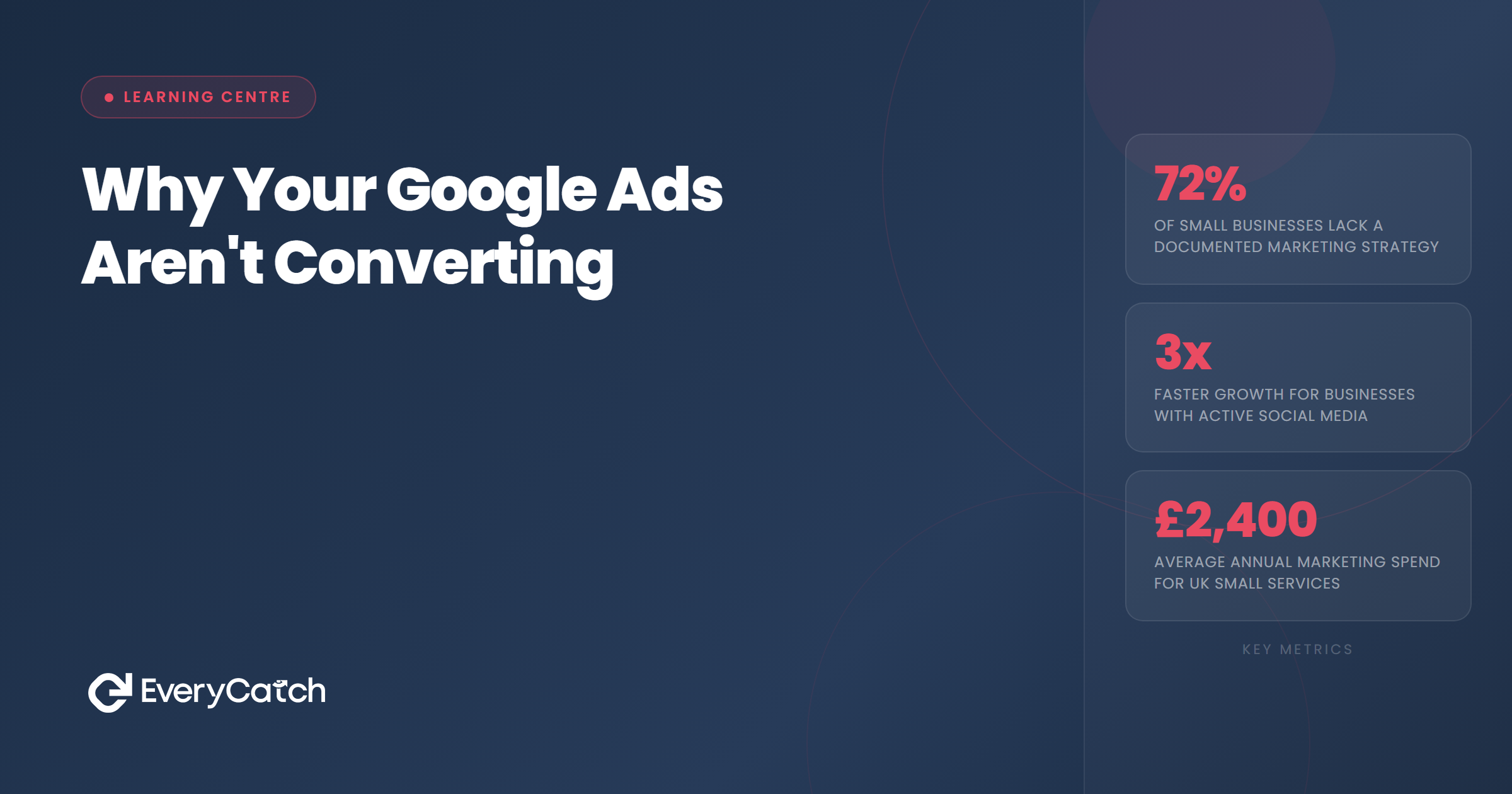
Say a Google Ads campaign is generating 10 enquiries a month at a total cost of £400. The average job value is £600. At a 100% contact rate and a 40% close rate, that's four bookings, £2,400 in revenue, and a return of six times the ad spend.
Now add a 50% contact rate (a realistic figure for a business without a reliable response system, where calls are missed on-site and emails sit until the end of the day). Four out of ten leads never have a conversation. The close rate on those you do reach might even improve slightly, since you're filtering for the more patient leads. But the return drops sharply. The ad spend didn't change. The campaign settings didn't change. The only variable was whether a real person was reachable in time.
This doesn't show up as an ads problem in Google Ads reporting. The platform records clicks and what happens immediately after. It has no visibility into whether the form submission was followed up within five minutes or the following afternoon. Businesses in this situation typically conclude their ads aren't working and either pause them, increase the budget, or keep making platform adjustments that have no effect on the actual bottleneck.
How to fix both ends
The practical approach is to address both sides in parallel rather than sequentially.
On the ad side: tighten match types, run through the search term report and add negatives, ensure the landing page content mirrors the ad copy precisely, and confirm conversion tracking is recording actual lead actions rather than just page visits. If the campaign is running automated bidding on limited data, switch to manual CPC until you have at least a month of clean conversion history.
On the follow-up side, the goal is to ensure every paid lead gets a meaningful response before they move on. The simplest first step is an immediate confirmation when a form is submitted — an automatic email saying "We've received your enquiry and will be in touch within the hour" is enough to keep most leads in play while the team becomes available. A designated person whose first task when free is to check and respond to paid enquiries brings a consistent manual process to campaigns with manageable volume. For businesses running high-intent campaigns where calls are the primary action, a phone answering service handles inbound calls in the company name during busy or out-of-hours periods. For higher volumes or teams where consistent manual response isn't realistic, an automated first-contact system that reaches every enquiry within minutes closes the gap without depending on someone being available. A missed call text-back ensures no paid caller hits voicemail without an immediate reply. A follow-up sequence means a lead that doesn't respond to the first contact doesn't quietly disappear. The right level of infrastructure depends on volume and team structure — but some version of it, scaled to fit, is the difference between a campaign that returns on its spend and one that doesn't.
The two sides reinforce each other. Better ad targeting brings in higher-quality leads. A faster, more consistent response process converts more of them. Investing in one without the other leaves significant return on the table.

From the EveryCatch team
EveryCatch was built for service businesses that invest in lead generation but lose return through slow or inconsistent follow-up. The platform handles first contact, missed call responses, and follow-up sequences automatically, so every enquiry from a paid campaign gets a real shot at converting.