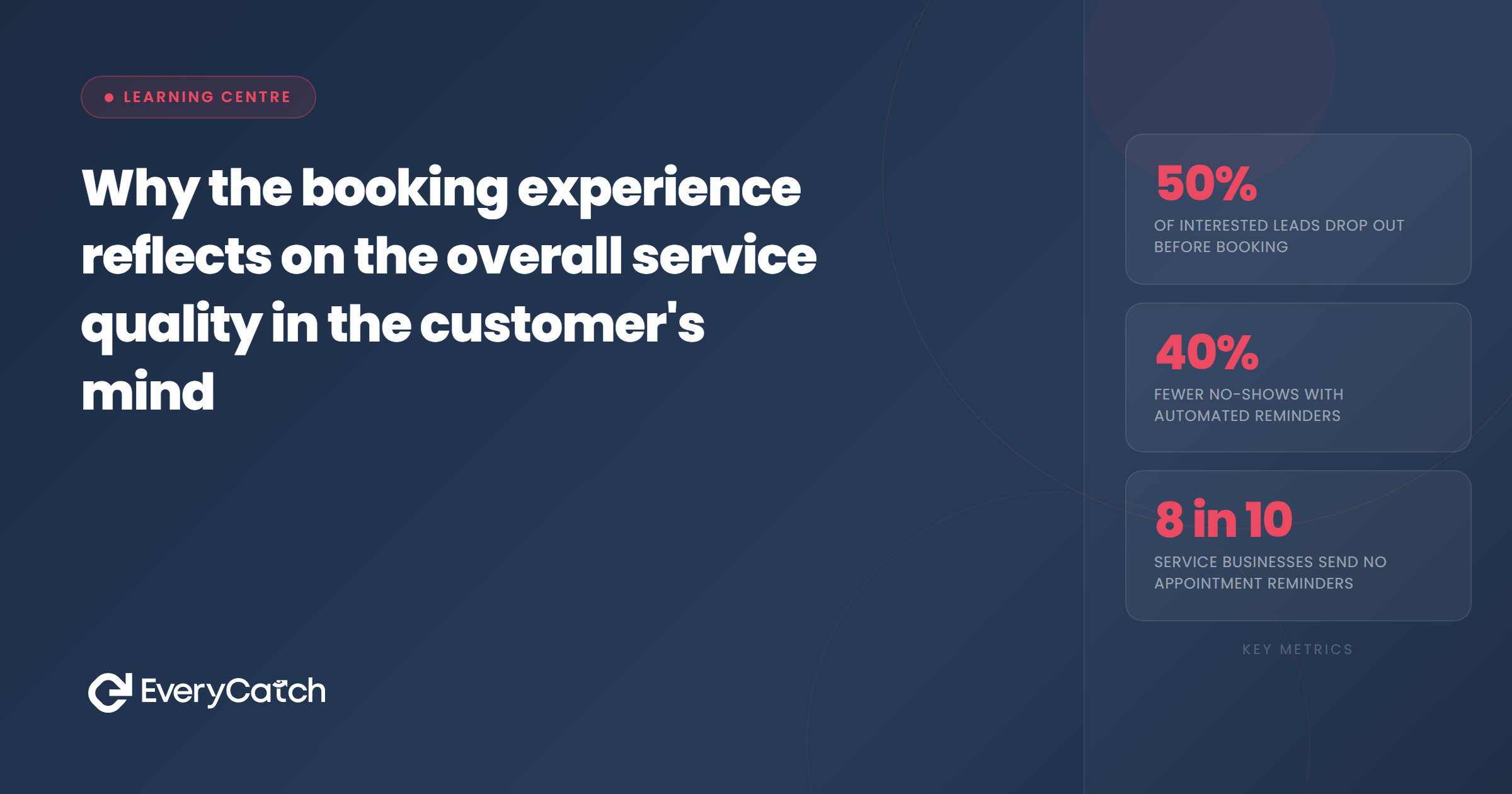

- The booking experience is the customer's first test of how you run your business
- Friction at booking — slow responses, unclear confirmations, manual back-and-forth — plants doubt before the work begins
- Customers unconsciously correlate operational organisation with service competence
- A professional confirmation, prompt response time, and clear communication signal reliability before a single job is done
- Improving your booking experience is one of the highest-return investments in customer perception you can make
Most service businesses focus almost entirely on the quality of the work they deliver. The skills, the materials, the finished result. This makes sense — doing the job well is the point. But many of those same businesses pay little attention to what happens before the work starts, when the customer is still forming their first impression of who they have chosen to hire.
The booking experience is where that first impression is made. And first impressions in service businesses carry disproportionate weight — both because they set the frame through which everything that follows is interpreted, and because they often happen before a business has had any opportunity to demonstrate its technical ability.
The booking as first impression
A customer who contacts your business to make an appointment is already past the decision to enquire. They have found you, considered you, and decided to take the next step. What happens in that interaction tells them whether they made a good choice.
A fast, professional response confirms the instinct. A slow or fumbling one introduces the first element of doubt. The booking itself — how it is handled, what confirmation they receive, how clearly the appointment details are communicated — becomes the first data point in a mental evaluation that will continue through the service and beyond.
This is not about making things look artificially impressive. It is about giving people accurate information about how you operate. A business that books efficiently, confirms promptly, and communicates clearly is almost certainly going to show up on time and do the work properly. Customers sense this correlation, even if they could not articulate why. They read the booking experience as a signal about the service experience, because in practice it usually is one.
When friction at booking plants doubt
Friction at the booking stage takes many forms. A phone enquiry that goes unanswered and requires a second attempt. A text message that receives a reply two days later. An email confirmation that is vague about the date or time. A booking process that requires multiple exchanges to establish what should have been captured in one.
Each of these generates a small moment of doubt in the customer's mind. Individually, they may not be decisive. Cumulatively, they build a picture: this business is slightly disorganised. And disorganisation is the thing customers most fear in a service provider, because it is the quality most directly correlated with showing up late, miscommunicating the scope of work, and leaving jobs half-done.
The trouble is that the business owner often has no idea this is happening. The job got booked. The client showed up. The work was done well. The review was positive. What went unobserved was the doubt the client carried into the appointment, the slightly lower starting point from which they evaluated the service, and the minor hesitation they felt before recommending the business to someone else.
What customers read into your booking process
Customers draw conclusions from the booking experience that go well beyond the booking itself. A few of the most common inferences:
- Response speed signals availability and demand. A business that responds in minutes is assumed to be organised and likely busy for good reasons. A business that takes days is assumed to be either disorganised or indifferent.
- Confirmation detail signals care. A clear, well-formatted booking confirmation that includes the date, time, address, what to expect, and a contact number says the business has done this before and does it properly. A one-line text with just the time says the opposite.
- The booking form signals professionalism. An online form that captures the right information in one step suggests a business that respects clients' time. Having to chase clients for an address three times after booking suggests a business still running on instinct rather than process.
- Follow-up signals interest. A pre-appointment reminder the day before says the business values the booking and wants the client to be prepared. No reminder says nothing has been thought about beyond getting the enquiry into the diary.
The specific elements that signal professionalism
Not all aspects of the booking experience carry equal weight. The elements that have the most impact on customer perception are:
Response time. Speed of response is the single most visible signal in the early stage. Responding to an enquiry within an hour during working hours is the threshold above which most customers feel well-served. Below that threshold, every hour erodes confidence in proportion.
The confirmation message. A booking confirmation should include everything the customer needs to know — date, time, location or call link, what to bring or prepare, who they will be dealing with, and a contact method if anything changes. A confirmation that covers these points requires no follow-up questions, which is itself a signal of organised thinking.
The reminder. A 24 to 48-hour reminder before the appointment does two things. It reduces no-shows, which is the practical benefit most businesses focus on. But it also communicates to the customer that the appointment is in hand, that they are expected, and that the business is thinking about them. This changes the emotional starting point for the appointment itself.
Want your booking experience to match your service quality?
EveryCatch builds professional booking flows, automated confirmations, and reminder sequences for service businesses.
Book a free discovery callHow to audit your own booking experience
The most effective way to understand what your booking experience is actually like is to go through it yourself. Submit an enquiry to your own business and observe every step — how long before you get a response, what the confirmation looks like, whether a reminder arrives.
Most business owners have never done this, which is why booking friction persists in businesses that genuinely care about quality. The service itself gets scrutinised continuously because it is visible. The booking process, because it operates behind the scenes from the owner's perspective, tends to stay unreformed longer than it should.
A useful checklist:
- How long does a new enquiry wait for a first response during business hours?
- What does the booking confirmation say, and does it answer every question the customer might have?
- Is there a reminder, and does it arrive at a useful time?
- How many exchanges are typically required to complete a booking?
- If a booking needs to change, how easy is the process?
Where the answer to any of these creates friction, there is an opportunity to improve the first impression before a customer ever experiences the service.

From the EveryCatch team
EveryCatch builds booking and communication systems that make service businesses look and operate as professionally as their best work deserves. The booking experience is not separate from the service experience — it is the first chapter of it.