
- Mobile no-shows cost you the job fee and the travel time — the stakes are higher than for static businesses
- Capture full address, access notes, and a contact number at the point of booking, not on the day
- Build travel buffers between appointments or you will consistently run late
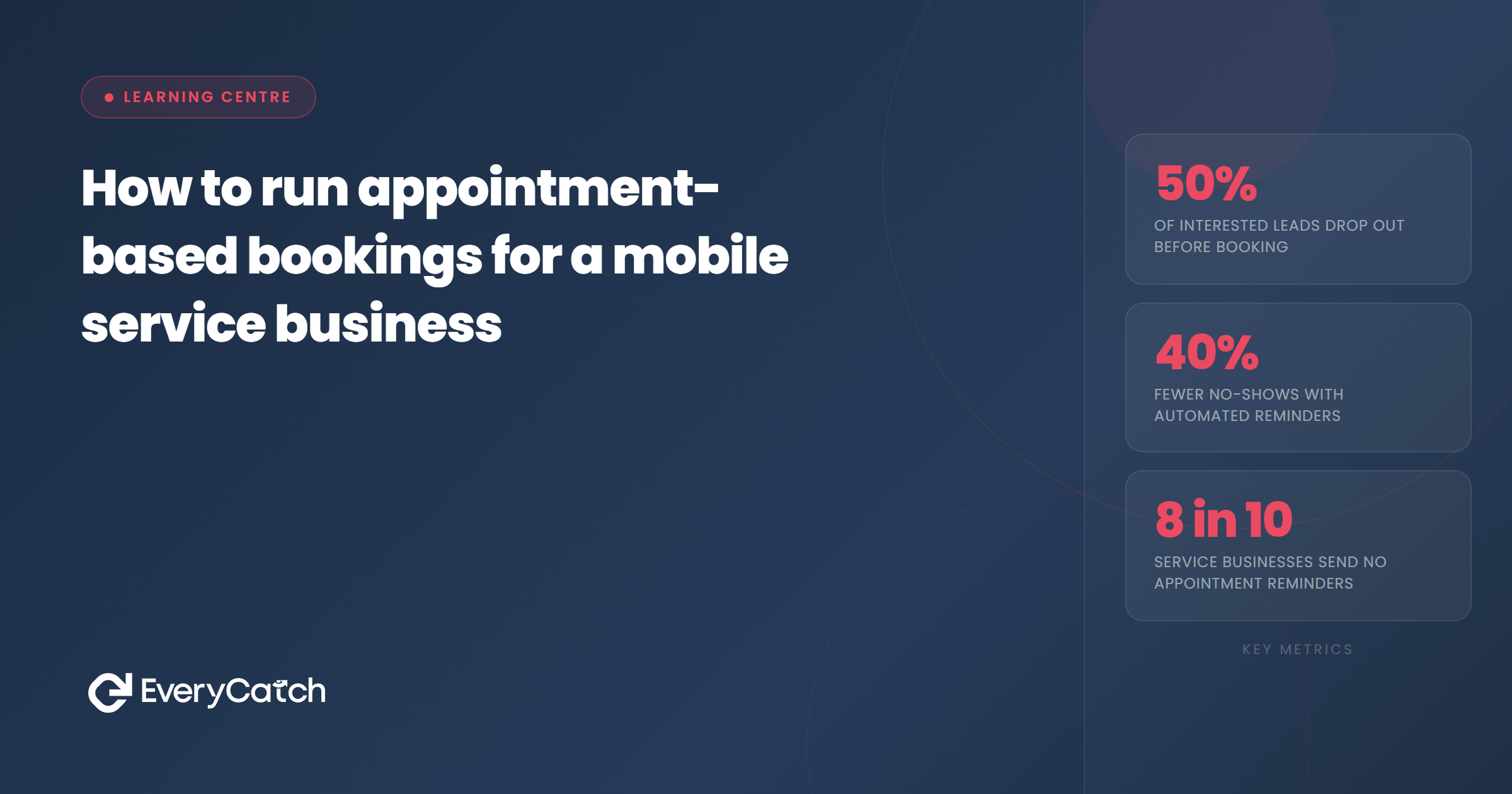
- A morning-of confirmation text is the single most effective no-show prevention tool for mobile businesses
- Deposits are a reasonable expectation for mobile work, particularly for new clients
Running a mobile service business — whether you are a plumber, electrician, mobile dog groomer, window cleaner, or personal trainer who travels to clients — places a different set of demands on your booking operation than a business with a fixed location. Every appointment you drive to is a commitment of time and fuel, and a no-show or a last-minute cancellation is not just an empty slot. It is an active cost.
Most mobile service businesses manage their bookings informally for longer than they should, relying on a combination of text messages, phone calls, and a mental diary. That works until it does not, and when it fails it tends to fail badly. Getting organised earlier is worth the effort.
The unique challenge of mobile service bookings
When a client does not show up to a fixed-location appointment — a salon, a clinic, a gym — the provider loses the time. When a client is not at home when a mobile tradesperson arrives, the provider loses the time, the travel, the fuel, and often the ability to recover the slot with another booking on the same day.
This asymmetry makes every booking decision higher stakes. A 30-minute late-cancellation policy that might be lenient for a fixed-location business is inadequate for a mobile business that has already driven 40 minutes to reach the job. The policies, communication systems, and booking information you need to collect are all slightly different as a result.
There is also the route-planning dimension. Mobile businesses need to think not just about whether a diary slot is filled, but about whether the sequence of jobs on a given day is efficient. Two jobs on opposite sides of a large town, back to back, will eat into margins in a way that a static business never has to consider.
Setting up a booking flow that captures the right information
The biggest single error mobile service businesses make when taking bookings is failing to capture the information they need before the day of the job. On the day itself, there is no time to track down a correct postcode, confirm gate access, or find out that the client will not be home but a neighbour will let you in.
At the point of booking, collect:
- Full address including postcode — not just "I'm in [town]"
- Mobile number for a confirmation text on the morning of the appointment
- Access information — is there a gate code? Is someone home? Is parking available nearby?
- Nature of the job — enough detail to confirm you have the right equipment and can allocate the right amount of time
- Whether they have used you before — new clients warrant a deposit; existing clients generally do not
An online booking form that captures all of this on submission is far more reliable than collecting it verbally during a phone call, where details get missed or misheard. If your booking process is currently phone-based only, building a simple form — even a basic one — that feeds into your diary system will make a measurable difference within the first month.
How to structure your diary to reduce dead travel time
One of the practical advantages of running an appointment-based mobile business is that you have some control over where your day takes you. Use it deliberately. Grouping appointments by geography — spending Tuesday mornings in one part of town and Tuesday afternoons in another — is not always possible, but it should be a conscious goal in your diary management rather than an afterthought.
Build travel time into your booking slots. If a job takes 60 minutes and the next client is 20 minutes away, your slot needs to be at least 90 minutes, not 60. Running consistently late erodes client satisfaction and creates a pressure that leads to corners being cut on the job. Better to book fewer jobs per day and complete them well than to run a schedule that can only work if nothing goes wrong.
Leave contingency space in your diary for jobs that run over. A blocked-out 30-minute buffer in the middle of the day costs nothing when everything goes smoothly and saves the day when it does not.
Spending too much time managing your mobile diary?
EveryCatch automates booking confirmations, reminders, and follow-up for mobile service businesses, so you can focus on the work itself.
Book a free discovery callHandling no-shows when you have already travelled to the site
A morning-of confirmation text is the most effective single intervention for reducing no-shows in a mobile business. Something brief — "Hi [name], just confirming I will be with you at [time] today at [address]. Any questions, give me a ring." — gives clients a final prompt and surfaces any problems while you can still reorganise your day.
If you arrive and the client is not present, the standard approach is:
- Ring their mobile immediately. Most no-shows are not deliberate — they have simply forgotten.
- If no answer, send a text saying you have arrived and will wait for a few minutes.
- After 10 to 15 minutes with no contact, photograph the property to record the visit, then leave.
- Follow up the same day with a message explaining that you were unable to gain access and asking when they would like to rebook, alongside any callout fee that applies.
Having a written callout policy — stated clearly at the point of booking — is what gives you standing to charge a fee. Without it, clients can reasonably claim they were not informed. The policy does not need to be punishing, but it needs to exist and to be communicated before the job.
Deposits and policies: protecting your time on the road
Asking for a deposit from new clients is standard practice in mobile services and most clients expect it. A deposit of 20 to 25 per cent is a reasonable starting point — enough to signal commitment without being a barrier. The deposit should be non-refundable within a specified window before the appointment (24 or 48 hours is typical).
For existing clients with a reliable track record, dropping the deposit requirement is a sensible relationship decision. For clients who have cancelled or rescheduled before, reinstating it is equally reasonable. Your deposit policy does not have to be one-size-fits-all; it just has to be consistent and clearly communicated.
Payment terms also matter more for mobile businesses than many owners realise. Collecting payment at the point of booking or immediately on completion, rather than issuing an invoice payable within 30 days, removes the most common cashflow problem in mobile service work: completing the job, then spending weeks chasing the invoice.

From the EveryCatch team
EveryCatch builds automated booking and follow-up systems for mobile and fixed-location service businesses. The goal is the same either way: get more confirmed bookings into the diary, protect your time when clients do not show up, and remove the admin that slows you down on the road.