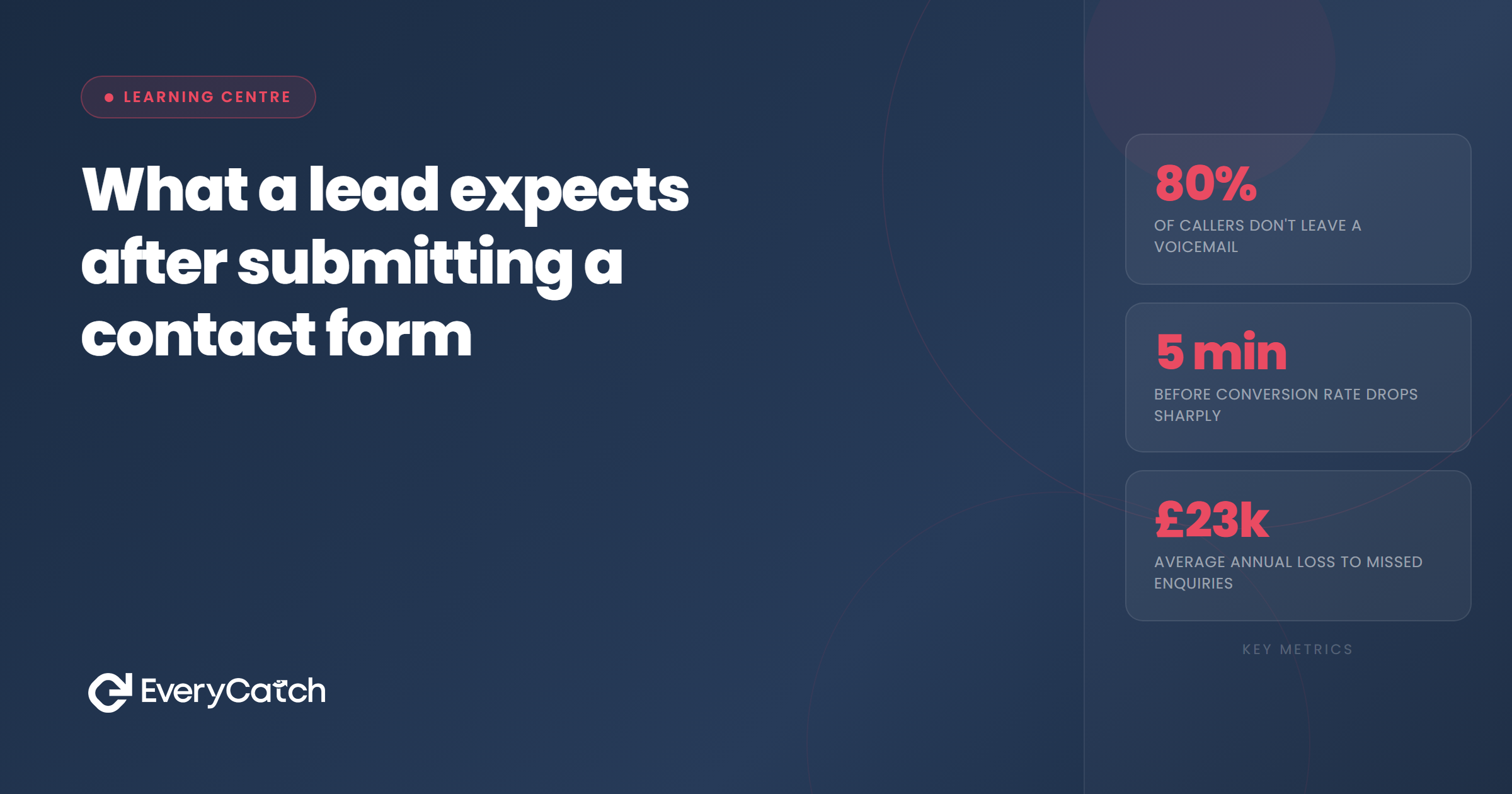

- Leads expect acknowledgement within 5 minutes of form submission, not 5 hours
- An instant confirmation message is now a baseline expectation, not a nice-to-have
- People want to know when a human will contact them, and how
- Silent forms with no automated follow-up kill 30-40% of your potential conversions
- The gap between expectation and reality is where you lose to faster competitors
Someone fills out your contact form at 3pm on a Tuesday. They hit submit. Then they wait. What are they expecting to happen next?
Your answer to that question shapes whether they become a paying customer or abandon ship before you even know they were interested. The expectations gap between what leads want and what most service businesses actually deliver is staggering, and it is costing you money every single day.
The harsh reality is that your form submission page probably says "Thank you, we'll be in touch soon," and then delivers radio silence for hours or days. That is no longer acceptable in a world where people expect instant confirmation when they order a taxi, book a hotel, or buy something online.
Immediate acknowledgement
The first thing a lead expects after hitting submit is instant proof that something happened. They want to see a confirmation page, receive an email, or get a text message within seconds. Not later. Not when someone gets round to it. Right now.
This is not about being demanding. It is about basic reassurance. When you submit a form online and nothing happens, your brain immediately questions whether it worked. Did it go through? Should I submit again? Did I make a mistake? The anxiety builds, and within minutes, the person moves on.
Research from Velocify shows that leads who receive instant automated acknowledgement are 10 times more likely to engage than those who hear nothing for an hour. That number alone should terrify you if your current process is "we'll get back to them when we can."
An instant response does not need to be complicated. It just needs to confirm that the form worked, acknowledge the specific enquiry, and tell them what happens next. Without those three elements, you have already lost half the room.
Confirmation and clarity
Beyond the instant acknowledgement, leads expect clarity about what they just signed up for. If they asked for a quote, they want confirmation that a quote is coming. If they asked for a callback, they want to know when. If they submitted an emergency job request, they need reassurance that someone has seen it.
Most contact forms offer none of this. They display a generic "thank you" page, send a lifeless auto-reply email, and assume the job is done. Then the business wonders why only 15% of form submissions turn into actual bookings.
The confirmation message is your first opportunity to manage expectations and set the tone. A good confirmation tells the lead exactly what happens next, when it will happen, and who will contact them. It also gives them a way to reach you immediately if the matter is urgent, which builds trust even if they do not use it.
Compare these two confirmation messages. The first is what most businesses send. The second is what leads actually want to see.
Generic version: "Thank you for your enquiry. We'll be in touch shortly."
Clear version: "Thanks for requesting a quote for your bathroom refit. We've received your details and Andy will call you between 2-4pm today to discuss the project. If you need to speak sooner, call us on 01234 567890."
The second version answers every unspoken question the lead has. It names a person, gives a time window, confirms what was requested, and offers an escape hatch. That is what clarity looks like.
Expected response timeline
Leads no longer expect you to respond "soon." They expect you to respond fast. The definition of fast has shifted dramatically in the past five years, and if your internal standard is still "within 24 hours," you are already behind.
Research from Harvard Business Review found that leads contacted within 5 minutes are 100 times more likely to convert than leads contacted after 30 minutes. That is not a typo. The drop-off is exponential, not linear.
Most people now expect a human response within the same working day, and preferably within an hour. If they submit a form in the morning, they assume someone will call them before lunch. If they submit on a weekday evening, they expect contact the next morning. Weekend submissions are the grey area, but even then, people are surprised when they hear nothing until Monday afternoon.
Your leads are not being unreasonable. They have been conditioned by every other online interaction they have, where speed is the default. Amazon delivers same day. Uber arrives in minutes. Their GP surgery sends appointment reminders by text. You are competing with that standard, whether you like it or not.
Want to know where your leads are disappearing?
We'll show you exactly what happens after someone submits your contact form, and how much it's costing you.
Book a free discovery callHuman contact expectations
Automated messages buy you time, but they do not replace human contact. After the instant confirmation, leads expect a real person to reach out, preferably by phone, and definitely within a few hours.
The preference for phone over email is stronger than most business owners realise. A text or email might confirm the form worked, but people want to hear a human voice before they commit to anything. That is especially true in service industries where trust and rapport matter.
Phone calls also force a decision. When you email someone, they can ignore it, archive it, or "deal with it later." When you call, they either answer and have a conversation, or they do not answer and you have useful data about how serious the enquiry is. Either way, you move the lead forward.
People also expect you to reference what they submitted in the form. If they wrote three paragraphs describing their problem, they do not want a generic "I'm calling about your enquiry" opener. They want you to show that you read it and understand what they need. That basic level of personalisation is now table stakes.
What happens when nothing happens
When leads do not get what they expect, they do one of three things. They submit another form on a competitor's website. They call a competitor directly. Or they mentally downgrade your business from "professional" to "probably not worth the hassle."
The third option is the most damaging because it is silent. The lead does not complain. They do not ask for a refund. They just disappear, and you never know they were warm in the first place.
Every hour you delay, the lead gets colder. Leads have a shelf life, and it is shorter than you think. By the time you get round to calling them two days later, they have already spoken to three other businesses, received two quotes, and mentally moved on.
The window of opportunity is narrow. When someone submits a form, they are in decision mode. They are ready to talk, ready to book, ready to move forward. That readiness does not last. It evaporates within hours, sometimes within minutes.
If you are not there when the lead is hot, someone else will be. It is that simple.
Fixing the gap
The gap between expectation and reality is fixable, but it requires you to rethink how form submissions flow through your business. Most service businesses treat form submissions as passive data entry. A form comes in, it sits in an inbox or a spreadsheet, and someone deals with it when they remember.
That approach worked in 2005. It does not work now.
The fix has three parts. First, you need instant automated acknowledgement that tells the lead exactly what happens next. Second, you need a system that alerts a human immediately so someone can respond within minutes, not hours. Third, you need follow-up sequences that keep the lead warm if the first contact attempt fails.
Most businesses have the first part covered badly and ignore the second and third entirely. That is why conversion rates from form submission to booked job are so low across the industry.
The good news is that fixing this does not require you to hire more staff or work longer hours. It requires you to automate the boring bits and focus your time on the leads who are ready to talk. When a form comes in, the system should handle acknowledgement, route the enquiry to the right person, send reminders if no one responds, and follow up automatically if the lead does not answer the phone.
You should only be involved in the part that matters, which is having the actual conversation. Everything else can and should run on autopilot.

From the EveryCatch team
We built EveryCatch because we were tired of watching good service businesses lose leads to poor follow-up. Every submission should turn into a conversation, and every conversation should have a fighting chance of becoming a customer.