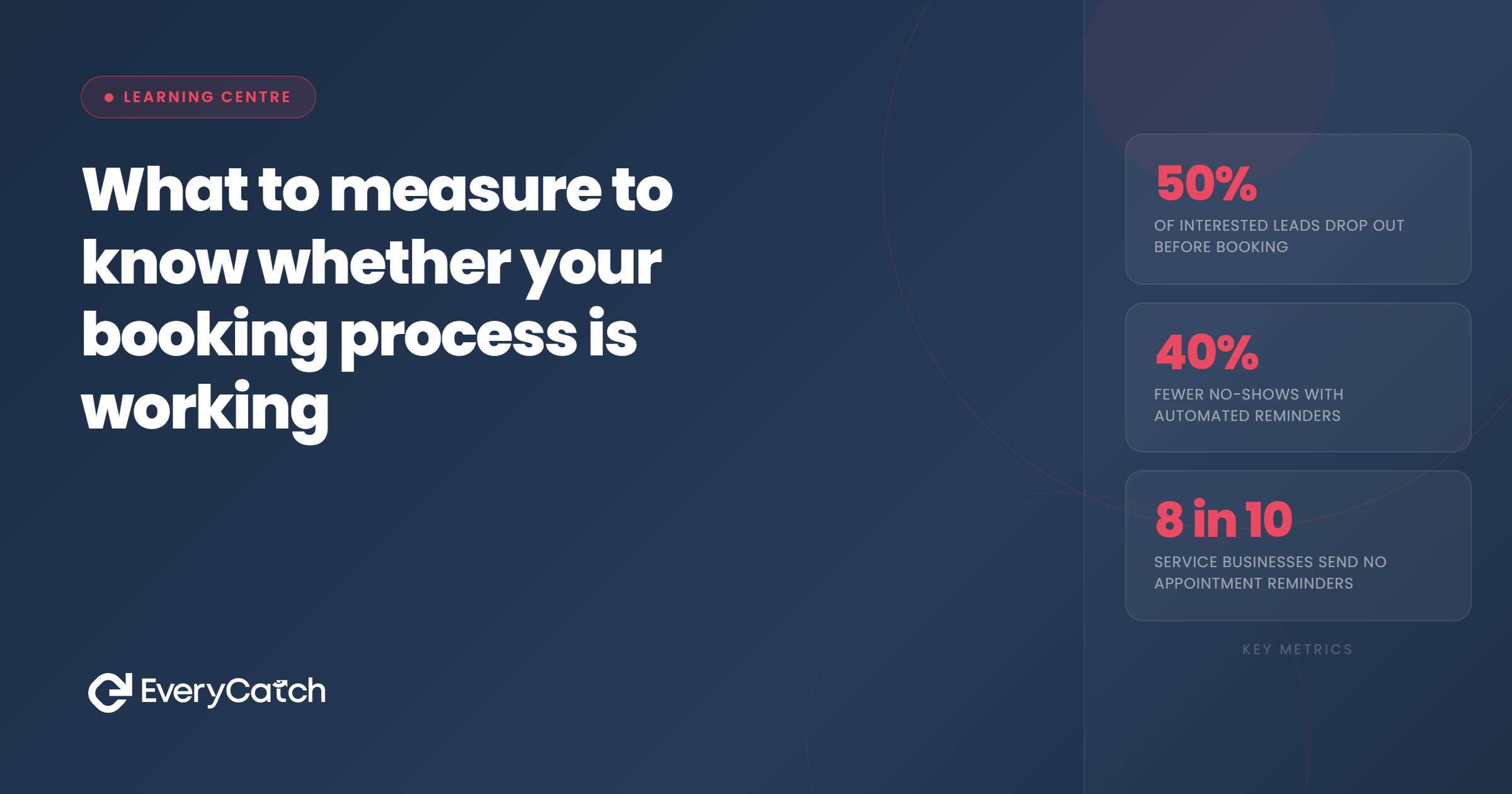

- Most service businesses do not measure their booking process at all, which means problems go undetected until they show up as revenue gaps.
- The five most useful metrics are: enquiry-to-booking rate, time to book, no-show rate, cancellation rate, and booking admin time per appointment.
- Each metric isolates a different part of the process, so a drop in one tells you specifically where to look.
- You do not need complex reporting. A CRM that logs contacts and appointments gives you most of what you need.
- The goal is to make problems visible before they become expensive habits.
To know whether your booking process is working, measure five things: how many enquiries convert to bookings, how long the conversion takes, how many booked customers show up, how many cancel, and how much time the booking process takes to manage. These five metrics tell you where the process is leaking revenue and where it is running efficiently. Without them, you are guessing.
The five metrics that measure your booking process
Most service businesses track revenue and customer numbers. Very few track the process that produces those customers. This means problems in the booking step go undetected, often for months, while leads quietly go elsewhere.
The five metrics below do not require a data analyst or complex software. They require a CRM that logs contacts and appointments, and a habit of checking them weekly. The broader context for why this step matters is in the article on why the booking step loses more leads than you think.
1. Enquiry-to-booking rate. Of every 100 enquiries received, how many result in a confirmed appointment? This is the headline metric. A rate below 40% is a problem. A rate below 25% is a significant problem that suggests the booking step itself is creating friction.
2. Time to book. How long does it take from the moment a customer first makes contact to the moment the appointment is confirmed? Hours is good. A day is acceptable. More than two days points to a bottleneck, either in response speed or in the back-and-forth required to settle on a time.
3. No-show rate. What percentage of confirmed appointments result in the customer not turning up? For most service businesses, a no-show rate above 10% is costing real money. Above 20% is an indication that the confirmation and reminder process needs attention.
4. Cancellation rate. How many confirmed appointments are cancelled before the day? Cancellations are less costly than no-shows because they at least give some notice, but a high cancellation rate often points to bookings that were not fully committed in the first place, or a long gap between booking and appointment during which the customer loses motivation.
5. Booking admin time per appointment. How many minutes does it take, across all the messages, calls, and diary entries, to get one appointment confirmed? If the answer is more than five minutes on average, automation is likely to produce a meaningful return.
Not sure where your booking process is leaking?
EveryCatch surfaces the metrics that matter so you can see exactly where enquiries are dropping off and why.
Book a free discovery callWhat each metric tells you about your booking process
The value of measuring these separately is that each one points to a different cause when it is off.
A low enquiry-to-booking rate usually means one of three things: the wrong leads are coming in (a marketing problem), the response is too slow (a speed-to-lead problem), or the booking step itself has too much friction (a process problem). EveryCatch's follow-up sequences address the third cause by automating the steps that move a lead from interested to booked, without requiring the owner to manage each conversation manually.
A long time to book usually means back-and-forth. The customer asks about availability. The business checks. The customer picks a time. The business confirms. That sequence often takes days when it could take minutes with a proper booking flow.
A high no-show rate almost always points to a weak confirmation and reminder process. A booked appointment without a confirmation message and at least one reminder is far more likely to result in a no-show. The data on this is consistent across service business types.
A high cancellation rate with short notice sometimes indicates that the initial booking commitment was low, which points back to the qualification stage. Customers who were only mildly interested and booked without fully committing tend to cancel when something else comes up.
Reasonable benchmarks for service business booking metrics
These figures reflect typical performance for service businesses with a reasonably structured booking process. They are targets to work toward, not guarantees.
- Enquiry-to-booking rate: 50% or above is good. 40-50% is acceptable. Below 40% needs attention.
- Time to book: under 4 hours for most enquiry types. Under 1 hour for urgent service businesses.
- No-show rate: below 10%. With a solid reminder sequence, 5% or below is achievable.
- Cancellation rate: below 15%. Short-notice cancellations (within 24 hours) below 5%.
- Booking admin time: under 3 minutes per confirmed appointment with automation in place.
How to track booking process metrics without complex reporting
A CRM that logs every contact and every appointment is the starting point. From that data, the metrics above can be calculated manually on a weekly basis, or automatically if the platform has basic reporting built in.
The minimum viable setup is a system where every enquiry creates a contact record, every booking creates an appointment record linked to that contact, and every no-show or cancellation is logged against the appointment. With that in place, the five metrics can be calculated by dividing counts from each stage.
Tracking these weekly rather than monthly catches problems before they have had weeks to compound. A drop in enquiry-to-booking rate spotted in week one is a much smaller problem than the same drop identified a month later.

From the EveryCatch team
EveryCatch logs every enquiry, booking, no-show, and cancellation automatically so service businesses can see their booking metrics without manual tracking. Problems in the process become visible before they become habits.