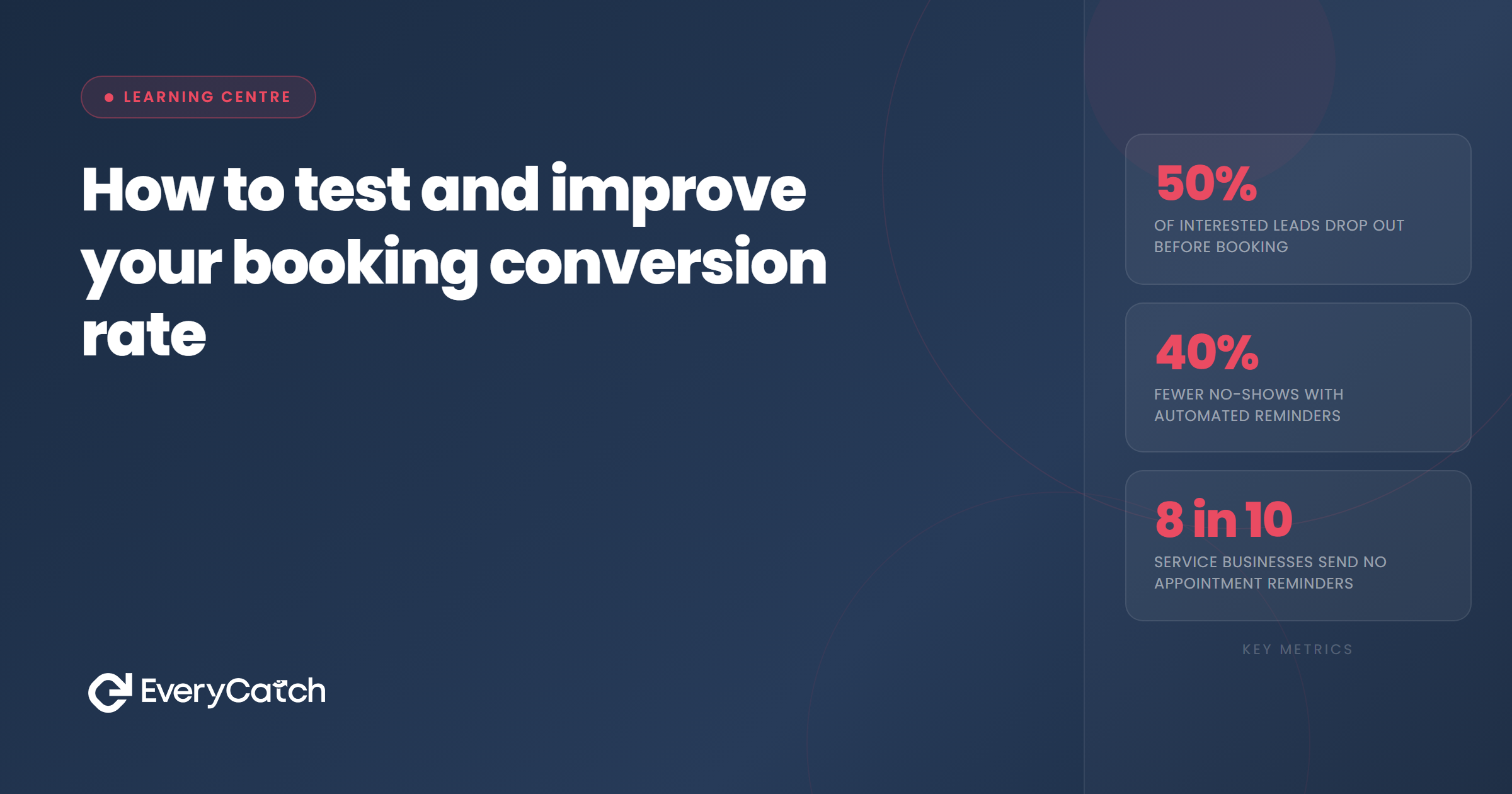
- Booking conversion rate is the percentage of enquiries that result in a confirmed appointment. Calculate it before trying to improve it.
- The three most impactful levers are response speed, friction in the booking step, and follow-up for leads that did not book first time.
- Change one thing at a time and measure the effect over at least 20 enquiries before drawing conclusions.
- Most conversion rate problems in service businesses are speed problems, not pricing or quality problems.
- A structured follow-up sequence for unconverted enquiries typically recovers 10-20% of leads that would otherwise be lost.
To test and improve your booking conversion rate, start with the number itself: divide confirmed bookings by total enquiries over the same period. Once you know where you stand, change one part of the process, run it for two to three weeks, and check whether the rate moved. Repeat. The three changes that move the rate fastest for most service businesses are a faster first response, fewer steps to confirm the booking, and an automated follow-up sequence for leads that did not book immediately.
How to calculate your booking conversion rate
Take the number of confirmed appointments over a given period and divide it by the total number of enquiries received in the same period. Multiply by 100 to get a percentage. If you received 60 enquiries last month and 27 of them resulted in confirmed bookings, your booking conversion rate is 45%.
This sounds simple, but many service businesses cannot do this calculation because they do not have a reliable record of all enquiries. Calls that were not answered, messages that were read but not replied to, and form submissions that went to a general inbox all become invisible. If you cannot count your enquiries, the first step is a CRM that logs every incoming contact automatically.
The broader context for why this number matters so much is in the article on why the booking step loses more leads than you think. The short version: the gap between an interested lead and a booked appointment is where most revenue is lost in service businesses, not in the marketing that preceded it.
The three levers that improve booking conversion rate most
Lever 1: Response speed. The single largest driver of booking conversion rate in service businesses is how quickly the first response reaches the customer. Leads that receive a reply within 5 minutes convert at dramatically higher rates than those that wait an hour. Leads that wait more than a day have often already booked elsewhere. EveryCatch's speed-to-lead capability fires an automated first response within seconds of an enquiry arriving, which addresses this without requiring the owner to be at their phone.
Lever 2: Friction in the booking step. Every additional step between "I'm interested" and "appointment confirmed" is a point where a customer can drop off. A booking process that requires a customer to fill in a long form, wait for a callback, confirm via email, and then wait for a calendar invite is losing people at multiple stages. Removing steps or combining them into a single flow consistently improves conversion rates.
Lever 3: Follow-up for leads that did not book immediately. Many enquiries do not convert on first contact. The customer was not ready, got interrupted, or went quiet. A structured follow-up sequence that re-engages them 24 hours, 3 days, and 7 days later recovers a significant proportion of these. Without it, these leads simply disappear.
Know your booking conversion rate but not how to move it?
EveryCatch implements the three levers that move conversion rates fastest for service businesses.
Book a free discovery callHow to test changes to your booking conversion rate properly
Testing booking conversion rate changes in a small service business is not the same as A/B testing a website. You do not have thousands of visitors. You have tens or hundreds of enquiries per month. The approach needs to reflect that.
Change one thing at a time. If you change your response speed and your booking form on the same week, you cannot know which change moved the rate. Pick the most likely lever, implement it, and give it three to four weeks or a minimum of 20 enquiries before evaluating the effect. Then move to the next change.
Keep the baseline measurement. Before making any change, calculate your current conversion rate and note it down. This is your reference point. After the change period, recalculate. If the rate went up, the change had a positive effect. If it stayed flat or dropped, revisit.
Look at where in the process enquiries are dropping off, not just the overall rate. If 70% of enquiries get a first response but only 40% reply to that response, the first message is the problem. If 80% of people who get to the booking step drop off there, the booking step is the problem. Each stage of the funnel is a separate test opportunity.
Common reasons booking conversion rate stays persistently low
A conversion rate that does not respond to process changes usually points to one of three underlying issues.
The first is lead quality. If the enquiries coming in are not a good fit for the service, improving the booking process will not help much. Conversion rate and lead quality are separate problems. If you improve response speed and reduce friction and the rate still sits below 30%, the enquiries themselves may be the problem to address.
The second is pricing friction. If customers frequently drop off after hearing the price, the booking process is not the issue. That is a pricing conversation or a value communication problem, and it needs to be addressed at the point in the process where price comes up.
The third is geographic or timing mismatch. Enquiries that arrive when there are no available slots, or from customers who are too far away, will never convert regardless of how good the booking process is. Reviewing the distribution of failed conversions by time of day, day of week, or customer location often reveals patterns worth addressing.

From the EveryCatch team
EveryCatch helps service businesses identify where enquiries drop off and implements the specific changes that move booking conversion rates most: faster first response, reduced booking friction, and automated follow-up for leads that went quiet.