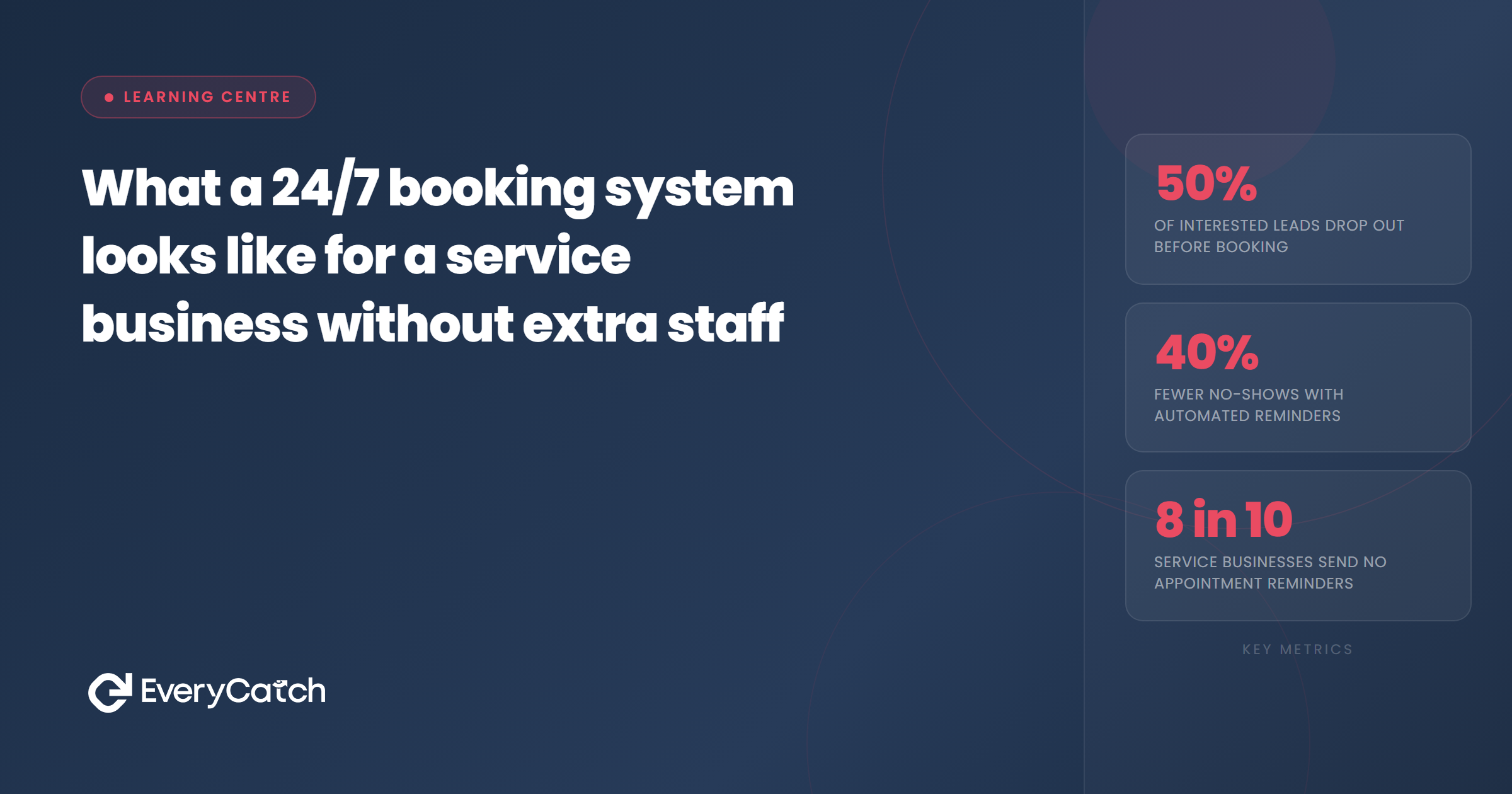
- A 24/7 booking system is not about being available around the clock yourself. It is about having automation handle the steps that do not need a human.
- The system covers first response, qualifying questions, slot selection, confirmation, and reminders without the owner being present.
- Leads who contact you outside business hours expect a prompt acknowledgement. Silence sends them to a competitor.
- The technology required is a connected CRM, a booking calendar, and an automated conversation layer. None of it requires additional staff.
- You only get involved once an appointment is already in the diary.
A 24/7 booking system for a service business looks like this: a customer enquires at 10pm, receives an immediate automated response, answers two qualifying questions, selects a time from the available slots, and gets a confirmation message. The appointment is in the calendar. Reminders are scheduled. The owner finds out about it the next morning. No staff were involved. That is what the system looks like in practice.
What a 24/7 booking system actually means for a service business
The phrase "24/7 booking" gets conflated with having someone available all day and night to answer calls. That is one approach, and an expensive one. The alternative is building a system that handles the conversation automatically and hands off to a human only when a human is genuinely needed.
Most of the booking process does not require human judgement. Acknowledging a message, asking what the customer needs, showing available slots, confirming an appointment, and sending reminders are all steps that automation can handle accurately and instantly. The owner's time is better spent on the job itself, not managing the diary at 11pm.
The article on why the booking step loses more leads than you think explains why delays in this part of the process are so costly. A lead who contacts you on a Sunday evening and hears nothing until Monday morning has a significant chance of having already booked with someone else.
What the 24/7 booking system handles automatically
An effective system takes care of five stages without the owner being present.
First response. The moment a customer contacts the business, via phone, text, website form, WhatsApp, or any other channel, they receive an immediate acknowledgement. This is not a generic "we will be in touch" message. It is a relevant reply that moves the conversation forward, typically asking what they need and when they are looking to book.
Qualification. A short automated sequence gathers the essential details: type of service, preferred location if relevant, and a rough timeframe. This replaces the back-and-forth that would otherwise happen over several messages or calls.
Slot selection. Once the customer's needs are known, the system presents available slots from the connected calendar. The customer picks one. No manual diary checking required.
Confirmation. The booking is confirmed instantly. The customer receives a message with the date, time, and any preparation instructions. The calendar is updated. A contact record is created or updated in the CRM.
Reminders. Automated messages go out at pre-set intervals before the appointment. 24 hours and 2 hours are the most common. These run without prompting, whether the owner is on a job or asleep.
Want to see what this looks like for your business?
We set up 24/7 booking automation for service businesses so every enquiry gets a response and a slot, regardless of when it arrives.
Book a free discovery callThe components of a 24/7 booking system for service businesses
Getting this running requires three connected pieces: a central inbox, a booking calendar, and an automation layer.
The central inbox captures enquiries from every channel in one place. Phone calls, text messages, WhatsApp messages, website forms, and social media messages all appear in the same interface. This prevents anything from being missed because it came in on a channel that was not being monitored.
The booking calendar holds your availability and connects to the automation so it can offer real slots rather than placeholder options. It updates in real time, preventing double bookings.
The automation layer is what connects the customer's incoming message to the appropriate response and eventually to a confirmed appointment. EveryCatch's speed-to-lead capability ensures that first response fires within seconds of the enquiry arriving, which is the single most important factor in conversion rates for service businesses.
Together these three components allow the booking process to run without a person managing it. The owner reviews the diary in the morning and knows exactly what is coming, without having been involved in scheduling any of it.
What still requires a human in a 24/7 booking setup
Automation handles the process, but some decisions belong with the business owner. Complex or unusual jobs that fall outside the standard qualification criteria may need a call to clarify scope. High-value enquiries where a conversation would help close the booking faster might be flagged for follow-up rather than left to automation. And any time a customer expresses frustration or raises a complaint, a human should step in.
The goal is not to remove all human contact. It is to remove the administrative work that does not require human judgement, so the owner spends time on things that actually need them. A booking that arrives at 9pm, gets confirmed by 9:05pm, and appears in the morning diary achieved that without anyone working late.

From the EveryCatch team
EveryCatch builds 24/7 booking systems for service businesses that run without additional staff, capturing enquiries and confirming appointments automatically. The owner sees a full diary in the morning without having lifted a finger the night before.