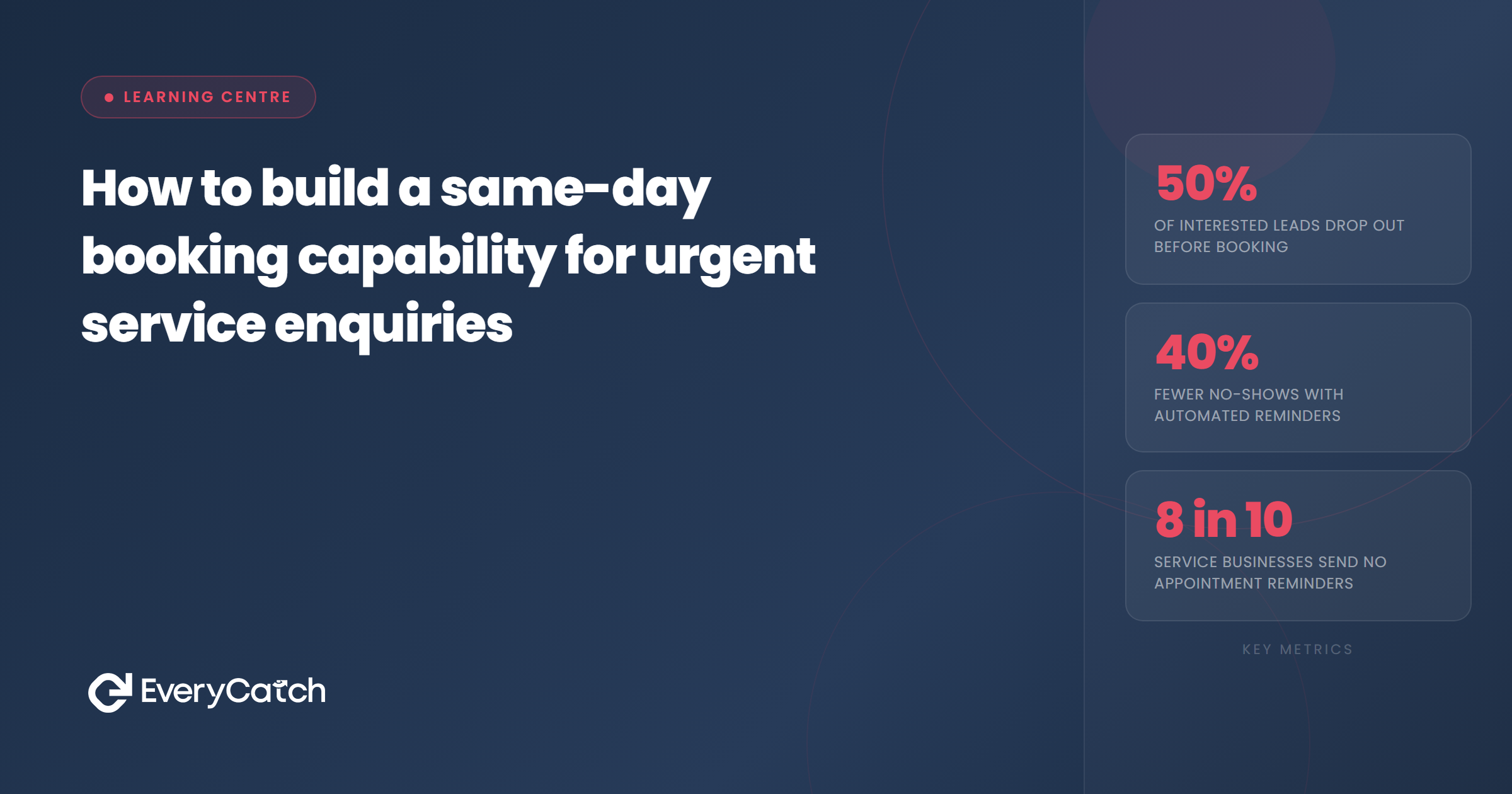

- Urgent leads expect a response in minutes, not hours. Delay costs you the job.
- Same-day booking requires both available slots and a system that can fill them without human intervention.
- An automated first response keeps the conversation alive while you are busy on site.
- Shorter booking paths convert better. Every extra step is a dropout point for someone in a hurry.
- Reserving a small block of same-day slots gives you something to offer without disrupting existing work.
When someone has a blocked drain, a broken boiler, or a water leak, they are not browsing options at their leisure. They want help today, and the first business that can credibly offer that wins the job. Building a same-day booking capability means having three things in place at once: a way to respond instantly, a short path to confirm the booking, and actual availability to offer. Miss any one of those and the lead disappears.
Why urgent enquiries behave differently from standard leads
Most enquiries allow for some back-and-forth. The customer is weighing options, comparing quotes, or planning something in advance. Urgent enquiries have none of that patience. The person contacting you has a problem right now, and their primary question is not "who is cheapest?" but "who can come today?"
This changes how you need to respond. Standard lead-handling, where you reply within a few hours and schedule a call for the following day, simply does not work here. By the time you get back to an urgent enquiry at your normal pace, the customer has already booked someone else. That is not an exaggeration. Research consistently shows that leads contacted within five minutes are far more likely to convert than those contacted even 30 minutes later. For urgent work, that window is tighter still.
The other thing that sets urgent enquiries apart is the emotional state of the customer. Someone with a real problem is relieved to find a solution quickly. That relief creates goodwill, reduces price sensitivity, and makes them more likely to leave a positive review. The same-day booking capability is not just a revenue play. It is also a reputation play.
Understanding why the booking step loses more leads than most businesses expect is worth reading alongside this, because the failure points in urgent booking are the same as in any booking, just compressed into a much shorter window.
Step 1: Make availability visible immediately
The first thing a customer with an urgent problem needs to see is that you actually have time today. If your booking system shows nothing until next week, or worse, shows nothing at all and asks them to "call for availability," you have already lost them.
Set your booking calendar to show same-day slots as soon as they are released. If you are using an online booking page, make sure it reflects your real calendar, not a static placeholder. Customers booking urgently want to self-serve. They do not want to call, wait on hold, and explain the situation three times. A booking page that shows "today, 2pm" in plain text converts immediately.
If you are not yet using an online booking tool, the minimum viable version is a consistent reply that names a specific time. "I can be there at 2pm today" is infinitely more effective than "I'll try to fit you in." Specificity signals competence and builds confidence in the moment the customer is most anxious.
Step 2: Respond before the lead goes cold
The window between an urgent enquiry arriving and that person calling a competitor is short. If the enquiry comes in while you are on site, driving, or otherwise unavailable, the lead will go to someone who can answer faster.
The fix is an automated first response that fires the moment an enquiry arrives, regardless of when you see it. This is not a generic "thanks for contacting us" message. It should acknowledge the urgency, confirm that same-day availability exists, and give the customer a direct link to book a specific slot. Something like: "Got your message. We have availability today. Book your slot here: [link]." That message does three things simultaneously: it keeps the customer from calling someone else, it demonstrates responsiveness, and it moves them towards a confirmed booking without requiring you to be available at that exact second.
Speed to lead automation is the mechanism that makes this work reliably. Rather than depending on you to notice and reply to every message immediately, the system handles the first response automatically and consistently, at any hour.
Step 3: Keep the booking path as short as possible
For same-day booking, friction is fatal. A customer with an urgent problem will not fill in a five-page intake form, verify their email address, create an account, and then select from a list of service types before finding a time slot. They will abandon the process and call someone else.
The target for an urgent booking flow is three steps or fewer: select a time, confirm a name and number, done. Everything else, including detailed job descriptions, address verification, and payment collection, can happen after the booking is confirmed. The goal at this stage is simply to secure the slot. Details follow once the customer is committed.
Test your own booking path from a phone, on a mobile connection. If it takes more than 90 seconds to complete, it is too long for an urgent context. Cut anything that is not strictly necessary at the point of booking.
Step 4: Reserve same-day slots deliberately
A same-day booking capability only works if you actually have same-day slots. If your calendar fills up on a rolling basis with standard bookings, you may find that urgent enquiries arrive on days when nothing is available until next week. That is a problem you need to solve in advance, not in the moment.
One approach is to hold back a fixed number of same-day slots each morning and only release them to the general calendar if they remain unfilled by a set time, say 10am. This gives you a buffer for urgent work without permanently reducing your standard capacity. It also gives you something concrete to offer: "We hold emergency slots each day. Book now to secure one."
The exact number of reserved slots depends on your trade and typical demand. One slot per engineer per day is a reasonable starting point. You can adjust based on how often urgent enquiries actually arrive. The key is having a deliberate policy rather than hoping the calendar works out.
Step 5: Confirm instantly and reinforce the commitment
Once a same-day booking is made, the confirmation message needs to be immediate and specific. A delay of even a few minutes can cause anxiety in a customer who is already stressed about their problem. The confirmation should include the name of the person coming, an approximate arrival time, a contact number for the day, and a brief note about what to expect.
This is also the right point to send a short SMS reminder an hour before arrival. For same-day work, there is rarely a need for a reminder the night before, but a one-hour heads-up reduces the chance of missing the customer on arrival, which wastes your time and damages the relationship before it has started.
Keeping the post-booking communication tight and professional sets the tone for the job itself. Customers who feel well-informed are more patient with minor delays and more likely to recommend you afterwards.
See how EveryCatch handles urgent enquiries automatically
From first message to confirmed same-day slot, without manual effort on your part.
Book a free demo
Andrew Gardiner
Andrew is the founder of EveryCatch and has spent years helping service businesses fix the gap between first contact and confirmed booking. EveryCatch builds the systems that close that gap automatically.