- Booking links convert well when leads are warm and ready to act. They fail when the lead still has questions.
- Text conversations convert cold and hesitant leads better because they remove friction and build confidence.
- A hybrid approach, text conversation that ends with a booking link, performs better than either method alone in most service business contexts.
- The channel the lead used to contact you should influence which method you lead with.
- Measuring both dropout rate on the booking page and response rate on text gives you the data to choose.
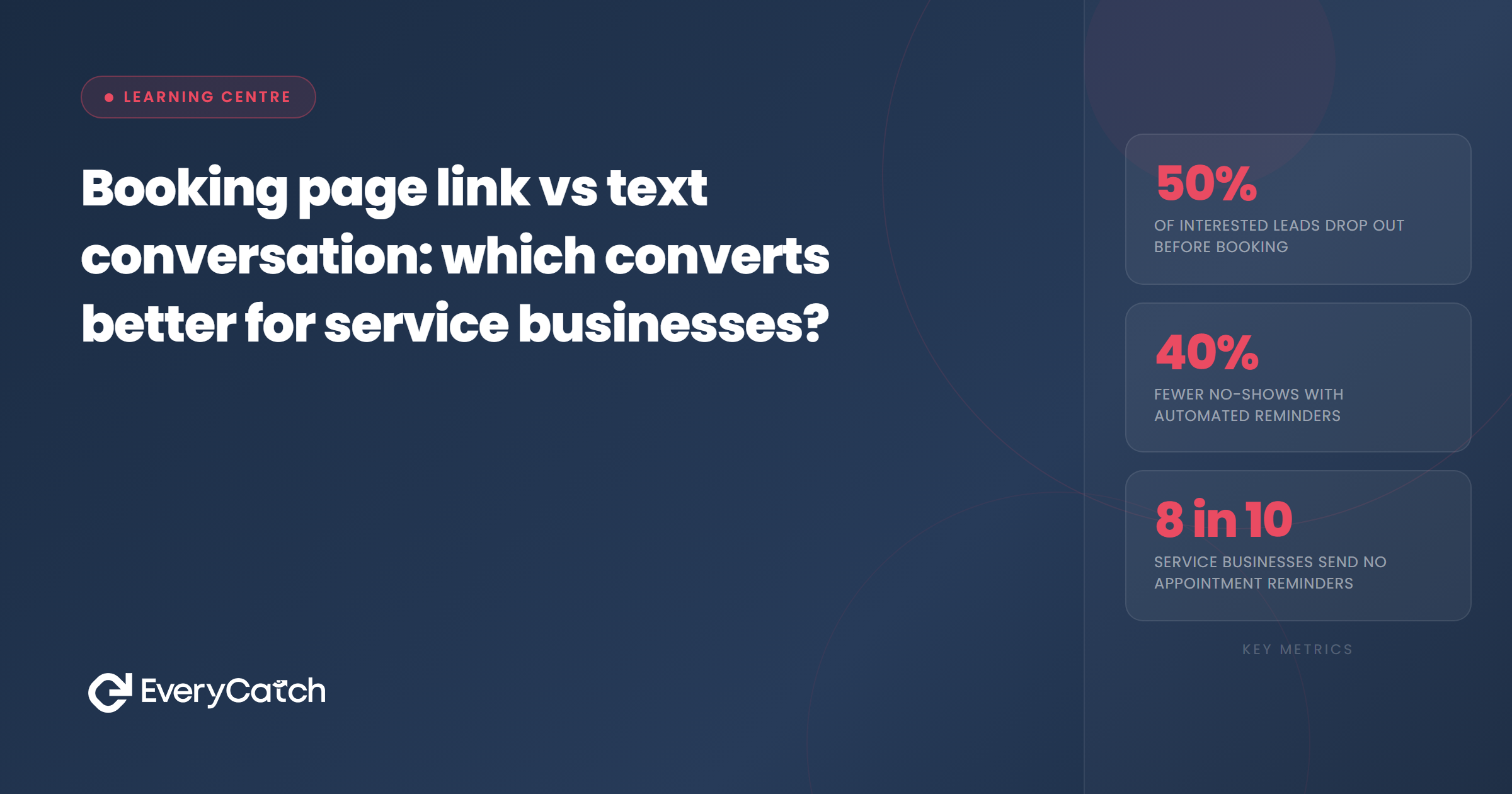
When a service business asks whether to send a booking link or start a text conversation, the question underneath is: which one turns enquiries into confirmed appointments more reliably? The answer is not the same for every situation. A booking link sent to someone who is already decided will land cleanly. The same link sent to someone with doubts will get ignored, and you will not know why. Understanding the conversion dynamics of both approaches lets you pick the right method for the right moment, rather than defaulting to whichever feels more modern.
Evaluation criteria: what actually matters in this comparison
Before comparing the two approaches, it is worth being clear about the metrics that matter. Conversion rate is the obvious one: what percentage of people who receive a booking link or start a text conversation end up with a confirmed appointment? But there are two others worth tracking as well.
Dropout point is the first. With a booking link, you can often see exactly where people leave the page. If most drop off at the time selection step, the issue is availability. If they drop off at the form, the form is too long. With a text conversation, dropout is a non-reply. Understanding where the process breaks down tells you what to fix.
Speed to booked appointment is the second. A text conversation that takes three days of back-and-forth and eventually results in a booking is technically a conversion, but the time cost is high. A booking link that produces a confirmed appointment in 90 seconds is operationally more efficient, assuming the lead was warm enough to use it.
With those criteria in place, the comparison becomes more useful than a simple "which is better" framing.
Where booking links win
A booking link converts best when the lead already trusts you and has mentally committed to booking. This typically applies to existing customers rebooking a regular service, warm referrals who have been recommended by someone they trust, and leads who have already had a quote conversation and are now ready to schedule.
In these situations, the booking link removes friction from a decision the lead has already made. They do not need to be convinced. They just need a fast and easy way to pick a time. A booking link delivers that. A text conversation adds an unnecessary step.
Booking links also perform better for planned, non-urgent services where the customer is comfortable doing things online. Annual boiler services, landscaping quotes, cleaning contracts. These customers expect a professional online booking experience and a text conversation can feel slightly informal for higher-value services.
Where text conversation wins
Text conversation converts better for cold leads, first-time enquirers, and anyone who has a question before they are willing to commit. Sending a booking link to a lead who is not yet sure about you is a fast way to lose them. They click the link, see a calendar, and think "I haven't even spoken to anyone yet." Then they close it.
A short text conversation does something a booking link cannot: it builds confidence. A well-timed reply that acknowledges the enquiry, answers an implied question, and then moves naturally towards booking converts cold leads at a significantly higher rate than a direct link. The lead feels heard rather than processed.
Text also wins in contexts where the service requires some qualification before booking is possible. If the job varies significantly based on location, access, or scope, dropping a booking link without any context can result in wasted appointments. A brief conversation filters that before the slot is committed.
The Missed Call Text-Back feature is a practical example of this. When a lead calls and gets no answer, sending an automated text that opens a conversation keeps the lead engaged in the channel they chose to use, rather than asking them to switch to a booking page they were not expecting.
The conversion point that matters most: link delivery timing
One variable that changes the booking link vs text conversation comparison more than almost anything else is when the link is delivered. A booking link sent in the first message to a cold lead converts poorly. The same booking link sent at the end of a short text exchange, once the lead has had a question answered and confidence has been established, converts well.
This is the principle behind most high-performing follow-up sequences: qualify and warm up the lead over text, then send the booking link at the moment they are most ready to commit. The text conversation does the convincing. The booking link makes it easy to act.
Understanding why the booking step loses more leads than you think is directly relevant here. The link itself is rarely the problem. The problem is usually the timing of when it is sent and what has happened in the conversation before it arrives.
The hybrid approach and why it outperforms both in isolation
For most service businesses, the highest conversion rate comes from a combination: an automated text conversation that opens immediately when an enquiry arrives, answers common questions, and then delivers a booking link once the lead has engaged. This approach captures the warmth-building benefit of conversation and the frictionless completion of a booking link.
The practical version of this looks like: lead enquires via website form or missed call, automated text replies within seconds, lead replies with a question, system provides a short answer and includes the booking link in the same message, lead books. That sequence can complete in under five minutes without any manual input.
The alternative, sending a booking link immediately on enquiry, will convert a portion of your leads. But it will silently lose the ones who had questions, and you will not know how many that was.
Which to use for your service business
Start with the channel the lead used to contact you. If they called, text is the natural continuation and a booking link can follow the conversation. If they submitted a web form with enough detail to confirm they are qualified, a booking link in the first reply is reasonable. If they came in via a social media message or chatbot, text conversation is the right channel to stay in.
Then consider lead temperature. Returning customers and warm referrals: lead with the booking link. First-time enquirers from ads, cold outreach, or general website traffic: lead with text and move to the booking link once they have replied.
The businesses that convert the highest percentage of their enquiries into booked appointments are not choosing one method and applying it universally. They are using the right method for the right lead at the right moment, and they have built automation that handles the distinction without manual decision-making every time.
Want to see both approaches working together?
EveryCatch combines automated text conversations with booking links at exactly the right moment in each enquiry.
Book a free demo
Andrew Gardiner
Andrew is the founder of EveryCatch and has spent years helping service businesses fix the gap between first contact and confirmed booking. EveryCatch builds the systems that close that gap automatically.