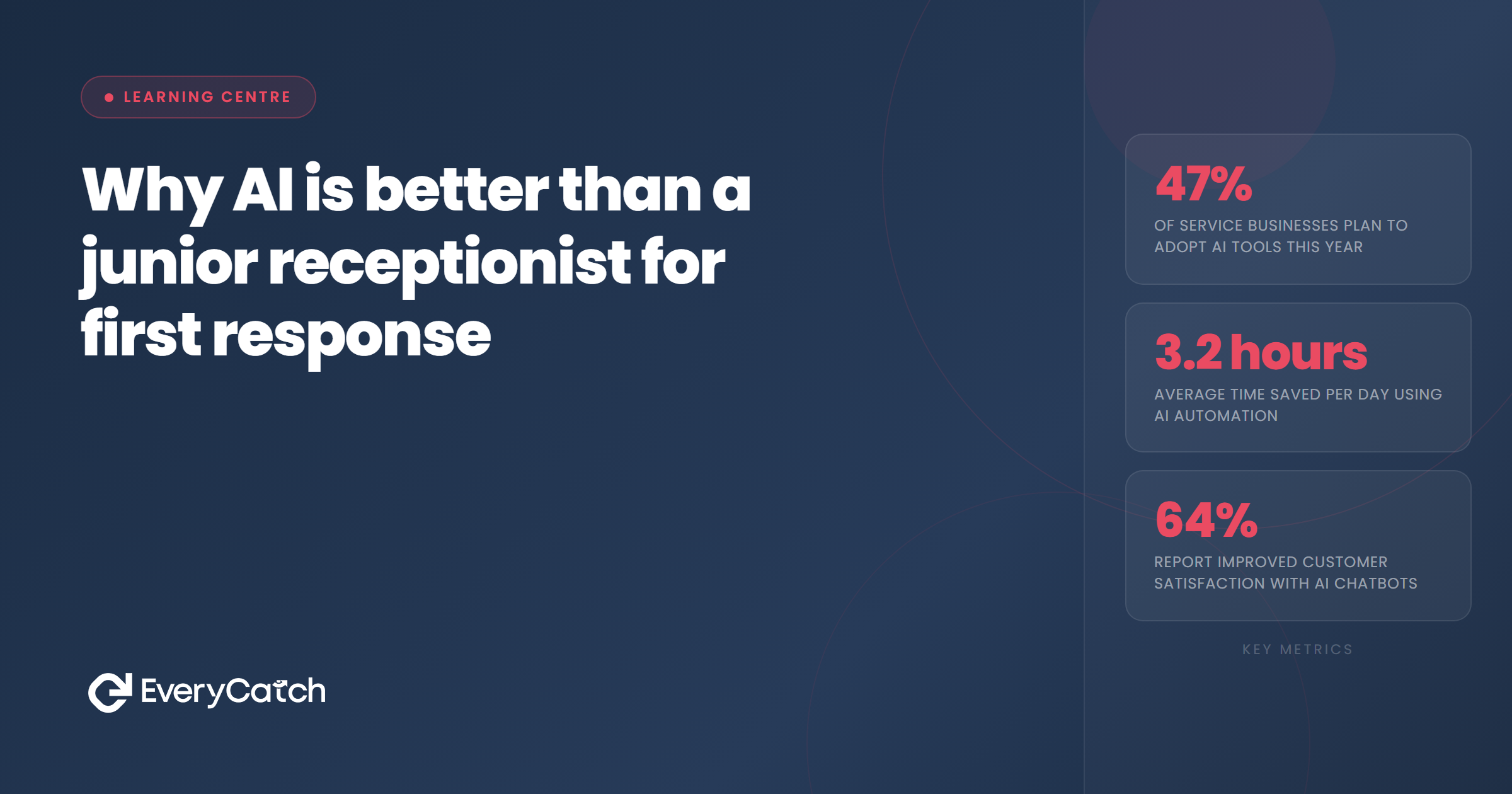

- AI is faster, more consistent, and available at all hours — three things a junior receptionist cannot reliably match
- A junior receptionist brings relationship warmth and real-time judgment that AI cannot replicate in complex conversations
- For first response on standard enquiries, AI handles the job better in most measurable ways
- The comparison shifts when enquiries become complex, emotional, or require on-the-spot negotiation
- Most service businesses do best with AI handling first response and humans handling the conversation from quote stage onwards
This is a comparison that matters for a practical reason: most small service businesses cannot justify a full-time receptionist, so the real choice is a junior part-timer or a well-configured AI. The question is which one performs better at the specific job of responding to a new enquiry and moving it toward a conversion.
The answer is not simple, because both options have genuine strengths. But for the specific window of first response, AI wins on the criteria that matter most to whether an enquiry converts.
What a junior receptionist brings to first response
A junior receptionist brings things that genuinely matter. They can read tone: if a customer sounds frustrated, they can soften their response. If someone seems confused, they can slow down and explain. They can use initiative in ways that an AI cannot, particularly when a situation does not match any scenario that was anticipated during setup.
There is also social warmth. A friendly human voice on the phone, or a message that sounds genuinely engaged rather than templated, has a quality that a well-written AI response approaches but does not fully replicate. For businesses where the relationship is most of the product, such as personal care, counselling, or high-end home services, this matters more than response speed.
And a junior receptionist can handle a phone call, which still makes up a significant portion of inbound enquiries for many service businesses. AI phone handling exists, but it is less mature than text-based AI and less accepted by most customers.
Where AI is better than a junior receptionist for first response
For the specific job of first response on a text-based enquiry, AI is better in the following ways.
Speed. AI responds in seconds, at any hour. A junior receptionist responds when they are at their desk, during working hours, after checking their messages. Research consistently shows that enquiry conversion rates drop significantly with each minute of delay past the first five. A customer who enquired at 10pm and received an AI response within 90 seconds has a different experience than one who received a response at 9am the next morning.
EveryCatch's speed-to-lead feature is built around this specific advantage: the AI catches the enquiry the moment it arrives, regardless of when that is, and responds before the customer has moved on to the next business on their list.
Consistency. A junior receptionist has good days and off days. They miss things when they are tired or distracted. They phrase things differently depending on their mood. AI applies the same level of accuracy and tone to the first enquiry of the day and the forty-seventh. For businesses where a high proportion of enquiries are price-sensitive or comparison-shopping, consistency in how the response positions the business matters.
Availability. Most service enquiries do not arrive during a nine-to-five working day. Evenings and weekends are peak times for many trade, home services, and personal service businesses. A junior receptionist is not available then. An AI is always available.
Scalability. A busy week with twenty simultaneous enquiries is handled the same way as a quiet Tuesday with two. There is no queue, no dropping balls because things got hectic, no inconsistency in response quality under volume. The cluster overview on what AI can actually do for a service business right now covers this scalability advantage in more detail.
See how first-response AI compares to your current setup
Book a discovery call to look at response time data and what it costs you in unconverted enquiries.
Book a free discovery callWhere a human still outperforms AI in the first contact window
The comparison is not entirely one-sided, and a fair assessment has to say where AI falls short.
Complex or emotionally charged enquiries favour a human. A customer phoning because their boiler has failed in winter and they have two young children at home is not looking for a speed-optimised response. They need to feel heard, and a human receptionist who picks up that register and matches it will convert that enquiry at a higher rate than an AI that responds quickly but clinically.
Genuinely unusual situations also favour a human. An enquiry that does not match any of the business's standard services, a customer with requirements that span multiple offerings, or a conversation that requires real-time negotiation over scope or price, all require judgment that AI cannot provide. A human can think through an edge case and reach a reasonable position. AI applies its configured logic and either handles it correctly or escalates it.
Phone calls, as noted, are still a limitation. For businesses that receive most of their enquiries by phone rather than text or web form, the AI first-response advantage shrinks considerably.
What the right setup looks like for a service business
For most service businesses, the practical answer is not one or the other but a clear division of labour. AI handles first response on text-based enquiries, covers out-of-hours activity, and manages the initial qualification steps. A human, whether that is the business owner or a more senior team member, takes over at the point where the conversation requires judgment, relationship-building, or negotiation.
This is more effective than a junior receptionist alone because the AI catches everything and responds instantly, which a human cannot match. It is more effective than AI alone because the conversations that genuinely need a human get one rather than being handled inadequately by an AI that is not equipped for them.
The cost comparison tends to favour AI for most small service businesses at current pricing levels. A junior receptionist, even part-time, costs more than most AI platforms designed for this purpose, and provides less coverage, less consistency, and slower response on the enquiries that matter most.

From the EveryCatch team
EveryCatch is built for service businesses that want AI to handle first response while humans focus on the conversations that actually require them. That split is where the best results come from.