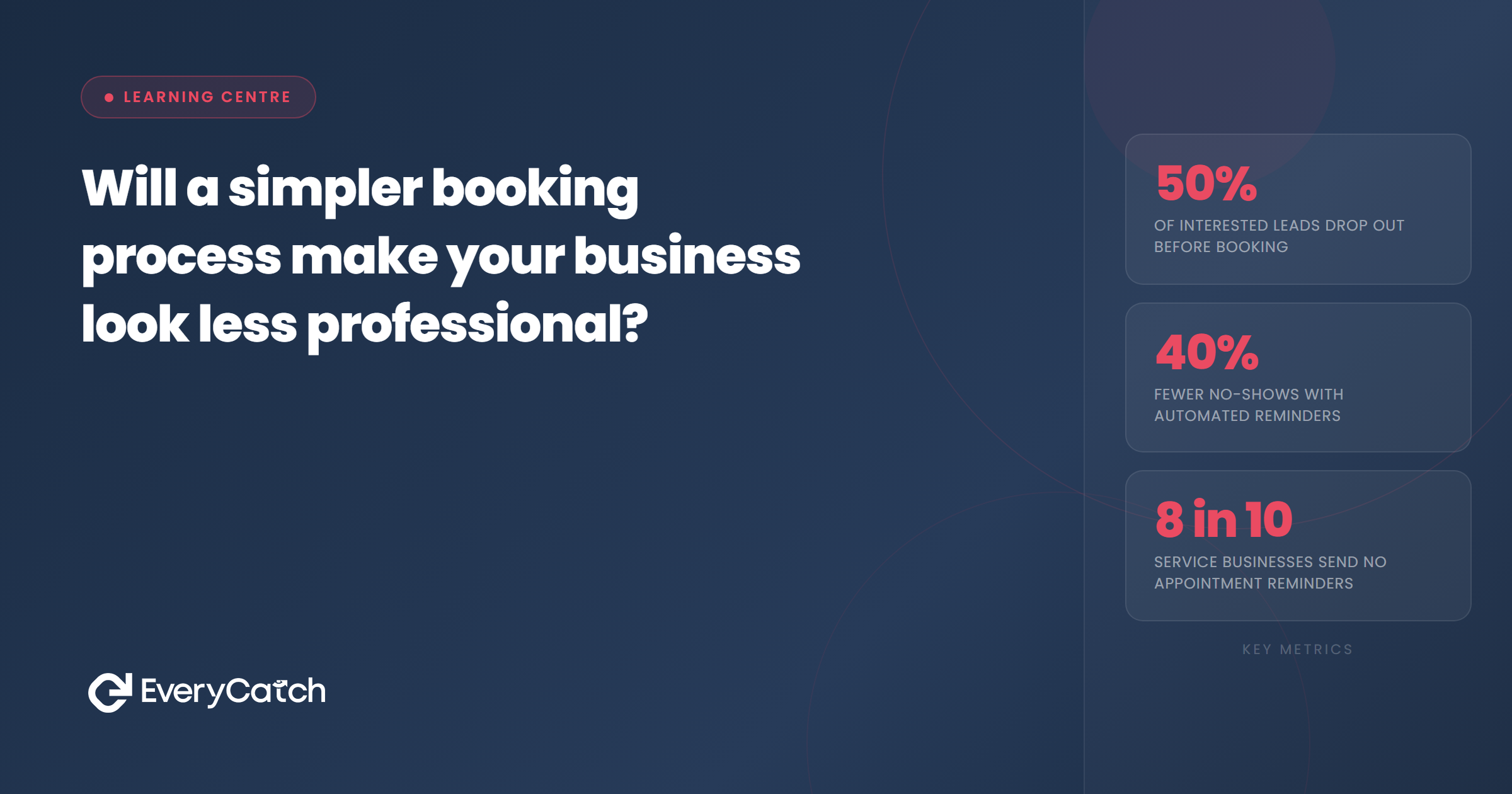

- Simplicity in a booking process does not reduce perceived professionalism. Most complexity adds friction without adding credibility.
- Customers judge professionalism by speed of response, clarity of communication, and reliable follow-through, not by the number of steps in the process.
- A long, complicated booking form often signals bureaucracy, not quality.
- There are genuine cases where removing steps can feel abrupt. These are fixable with clear confirmation messages and structured communication afterwards.
- The businesses that look most professional are usually the ones that make the customer's experience the easiest.
A simpler booking process will not make your business look less professional. That concern comes up regularly, and it is worth addressing directly: complexity does not signal quality to customers. What they actually associate with a professional booking experience is hearing back quickly, getting a clear confirmation, and knowing what to expect. A five-step booking form does not achieve any of those things. A fast response and a well-written confirmation message does.
Where the concern about simpler booking looking less professional comes from
The worry usually stems from a reasonable instinct: that a rigorous, detailed process signals that the business takes things seriously. If a doctor's surgery asks you to fill in a health questionnaire before your appointment, that feels appropriate. If a solicitor sends a detailed intake form, that feels measured. The assumption is that the same logic applies to a plumber, a personal trainer, or a web designer.
It does not apply in the same way. The context is different. In regulated or high-risk professions, pre-booking paperwork serves a genuine function. In most service businesses, it serves the business's administrative convenience, not the customer's experience. A customer who wants a kitchen installation quote does not feel more confident because they completed a 15-field form before someone called them back. They feel more confident when someone called them back within ten minutes of their enquiry.
The confusion also sometimes comes from equating "thorough" with "professional." Thorough is good. Thorough in the confirmation message, in the preparation instructions, in the follow-up after the appointment. Thorough in the initial booking form tends to reduce conversion without improving service quality.
What customers actually associate with a professional booking process
Customers do not rate booking processes on the number of steps. They rate them on how the experience felt. The signals that consistently associate with professionalism in a booking context are:
Speed. Hearing back quickly after an enquiry is the most consistent indicator of professionalism from the customer's perspective. A business that responds in minutes feels organised and capable. A business that responds the next day, regardless of the quality of its service, feels like it does not have its act together. This is explored in depth in the article on why the booking step loses more leads than you think.
Clarity. A confirmation message that tells the customer exactly what is happening, when, where, and what they need to do before the appointment reads as highly professional. Vague confirmations or no confirmation at all read as amateurish, regardless of how complicated the booking process was.
Reliability. Following through on what was communicated. If a reminder was promised, it should arrive. If a time was agreed, it should be respected. Customers associate reliability with professionalism far more strongly than they associate process complexity with it.
Worried a simpler process might not reflect well on your business?
EveryCatch builds booking flows that feel professional to customers: fast, clear, and followed through properly.
Book a free discovery callWhere simplicity in a booking process can genuinely signal less professionalism
This is worth being honest about. There are specific situations where removing steps without replacing them with something else does create a less professional impression.
If a business removes its intake questions but sends no confirmation message at all, the customer is left uncertain. That uncertainty does not feel professional. The solution is not to reinstate the questions. It is to send a proper confirmation that covers what the customer needs to know.
If simplification means accepting a booking by text message with no written record sent to the customer, that can feel informal in contexts where a more formal process would be expected. A simple but well-formatted confirmation email or message addresses this without reinstating unnecessary steps.
EveryCatch's follow-up sequences handle this by sending structured, professional communications at each stage after the booking is made, so the process stays simple for the customer to complete while still feeling properly managed.
What a simple but professional booking process actually looks like
The goal is not to strip everything back to a single message and hope for the best. It is to keep the number of steps the customer has to take as low as possible, while making the communication around those steps as clear and reliable as possible.
In practice, this means a customer should be able to enquire, pick a time, and receive a confirmation in under five minutes. The confirmation covers everything they need to know. Reminders arrive automatically. Any preparation instructions reach them in advance. The customer does not have to chase anything, ask any follow-up questions, or wonder if the booking is properly recorded.
That experience, where everything is handled quickly and clearly without requiring repeated effort from the customer, is what feels professional. The business that achieves it is almost always the one that automated the parts of the process that do not require human judgement, rather than the one that retained complexity for its own sake.

From the EveryCatch team
EveryCatch builds booking processes that are simple for customers to complete and professional in how they communicate, because the two are not in conflict. Speed and clarity do more for perceived professionalism than complexity ever has.