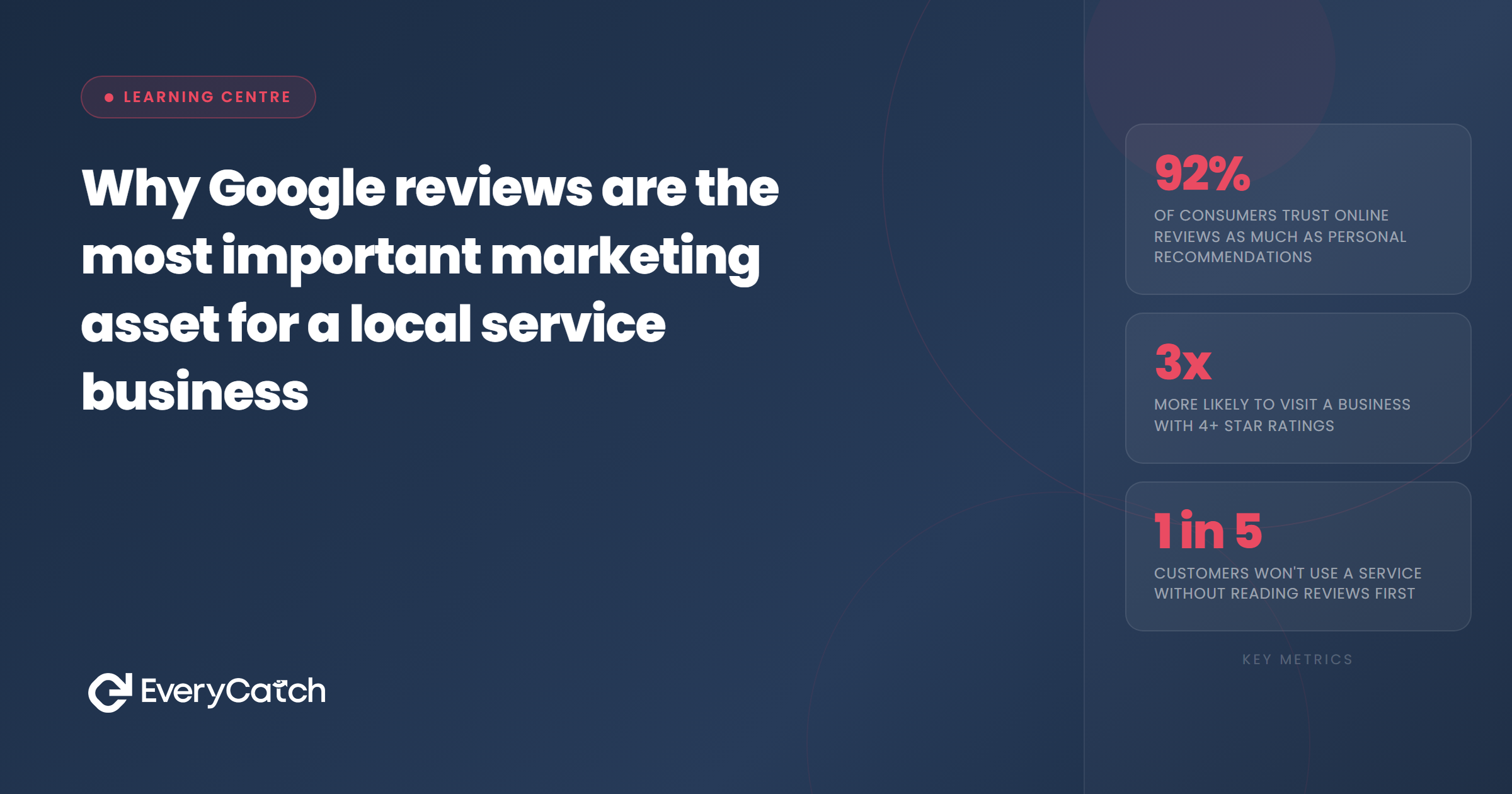
- Google reviews are the strongest ranking signal for local service businesses in map pack search results
- Review volume and recency both matter, not just your average star rating
- Most buyers read at least three reviews before making first contact with any service business
- The best moment to ask for a review is immediately after a successful job, while the experience is fresh
- A well-handled negative review builds more trust than a business with a suspiciously perfect record
Why Reviews Beat Every Other Channel
Every pound a local service business spends on advertising has to fight against the fact that most buyers have already made up their minds before they call. That decision is shaped almost entirely by what other people have said about you on Google.
Reviews are not social proof in the abstract. They are the visible, searchable, ranked record of what your past customers thought of your work. When a potential customer searches for a plumber, a physio, a solicitor, or a personal trainer in their area, they see your rating and review count before they see your website. They see it before they read a single word you have written about yourself. That framing changes everything about how the decision gets made.
The comparison with other marketing channels is not subtle. A business spending nothing on paid advertising but holding 70 reviews at 4.8 stars will consistently outperform a competitor with a strong ads budget and 12 reviews at 3.9. The reason is simple: buyers trust other buyers more than they trust anything a business says about itself. Reviews are the form of marketing you cannot write for yourself, which is exactly why they carry more weight than anything you can.
How Reviews Affect Your Google Ranking
Google uses many signals to decide which businesses appear in local search results, but for service businesses competing in a defined area, reviews are among the most influential. The map pack, the three businesses that appear above the regular search results alongside a map, is where most local service enquiries go. Getting into that map pack, and staying near the top, depends significantly on your review profile.
Three factors within your review profile carry weight. Volume tells Google that your business is active and trusted by a meaningful number of real customers. Recency signals that your business is still delivering at a good standard today, not just three years ago when a cluster of reviews came in. Response rate, meaning whether you actively reply to your reviews, shows Google that an engaged business sits behind the listing.
None of this requires gaming the system. It requires running a good business and asking your customers to say so publicly. Businesses that build a consistent review cadence as part of a regular workflow, rather than a one-off push, hold local ranking positions that paid advertising cannot replicate over the long term.
How Buyers Use Reviews Before Contacting You
Most people read between three and ten reviews before deciding whether to contact a service business for the first time. For services that involve someone entering your home, accessing financial records, or making decisions about health, that number is higher. The research is consistent across sectors: reviews are the primary trust signal for first-time buyers, and no amount of polished website copy substitutes for them.
What buyers look for is not a perfect rating. A business with 95 reviews and a 4.6 average is significantly more credible than one with 4 reviews and a 5.0. The former looks like a real business with real customers who had slightly varied experiences. The latter looks like it may have asked only its most enthusiastic clients to leave a review, or worse, that the reviews are not genuine at all.
The response to negative reviews is evaluated carefully too. Buyers read those responses as a test of what dealing with you might be like if something goes wrong on their job. A professional, measured response to a complaint signals competence and accountability. An aggressive or defensive reply signals the opposite, and that response is permanent and visible to every potential customer who reads the review thread.
Want reviews to come in automatically?
EveryCatch sends a review request to every customer after a completed job, so your Google reputation grows without you having to remember to ask.
Book a free discovery callGetting More Reviews Without the Awkwardness
The most common reason service businesses have too few reviews is not that customers are unwilling to leave them. It is that no one asks. The window for asking is narrow: the best time is immediately after a job is completed and the customer is satisfied. Wait a week and the likelihood of a review drops sharply. Wait a month and it is close to zero.
A direct verbal request at the end of a job is highly effective. Most customers who are happy with the work will follow through if asked clearly and given a simple way to do it. "If you are happy with the work, a Google review would really help us" is enough. Most people find that awkward to say, which is why it so rarely happens. The fix is to make the ask feel like part of your normal close, not a favour you are requesting.
Sending a follow-up text within an hour of the job being completed, with a direct link to your Google Business Profile review page, removes every piece of friction. The customer does not need to find you on Google, navigate to the review section, or remember to do it later. The link takes them directly to the box where they write the review.
The challenge is consistency. Even owners who know they should ask forget when they are busy, tired, or rushing to the next job. Automating the follow-up removes that dependency entirely. A text sent automatically when a job is marked complete generates reviews at a far higher rate than anything relying on human memory. That automation is one of the most straightforward things EveryCatch handles as part of the post-job workflow.
What to Do When a Review Goes Wrong
A negative review is not the worst outcome for a local service business. Ignoring it is. Every response you write is visible to every person who reads that review in future, which means a negative review that has been handled professionally becomes an active demonstration of your service standards rather than just a black mark.
The right response is short, calm, and non-defensive. Acknowledge the experience. Apologise for any shortfall, even if you believe the situation was not entirely your fault. Offer a direct line to resolve the matter. That is the full formula. The goal is not to win the argument publicly. It is to show every future reader that you take concerns seriously and do not hide from them.
Fake reviews require a different approach. Use the report function on your Google Business Profile to flag any review you believe is fraudulent. Include any evidence that the reviewer was not a customer. While the report is being assessed, respond professionally and briefly note that you cannot find a record of the experience described. Do not accuse the reviewer publicly. Many fraudulent reviews that clearly violate Google's policies are eventually removed, though the timeline varies and removal is not guaranteed.

From the EveryCatch team
EveryCatch helps local service businesses build stronger reputations through automated review requests and faster responses to new enquiries. Every article in this Learning Centre draws on what works for real service businesses, not generic marketing advice.