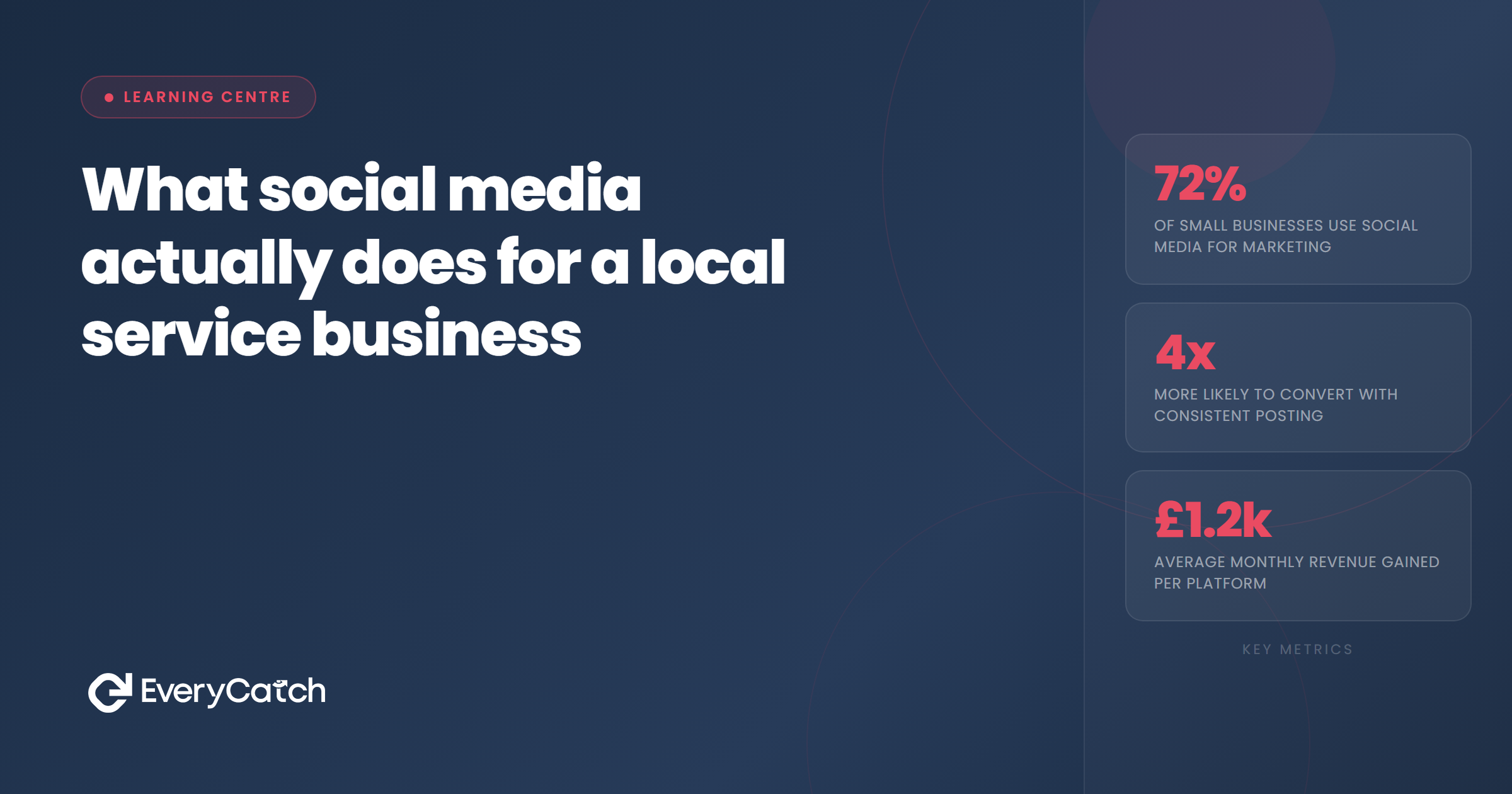
- Social media is a trust-maintenance channel, not a lead generation engine for most local service businesses
- Facebook and Instagram are the most practical platforms for the majority of local service sectors
- Enquiries from social media go unanswered more often than from any other channel — response speed matters as much as the post
- Posting consistently beats posting elaborately, at any audience size
- Content that shows the actual work outperforms promotional copy every time
What Social Media Actually Does Well
Social media is not where most local service businesses generate their primary volume of new enquiries. That distinction belongs to Google search, word of mouth, and for some sectors, the Google Maps pack. What social media genuinely does, and does well, is keep your business visible to people who already know you exist.
When a past customer sees a post showing a completed job, a new service, or a useful piece of advice, that visibility keeps your business top of mind when they next need what you offer or when a friend asks for a recommendation. That kind of passive, ongoing presence has real value. It is not a replacement for active lead generation, but it is a different kind of asset: one that compounds slowly over time.
The businesses that get the most from social media understand this framing. They treat posts as a trust-maintenance activity rather than a direct response campaign. The expectation is not "this post will generate five new enquiries today." It is "this post keeps us in the minds of the 400 people who follow us because they liked what we did." Both outcomes are useful. Confusing one for the other leads to frustration and poor decisions about where to invest time.
What Social Media Cannot Do for You
Social media will not reliably replace Google search as a source of new, cold enquiries for a local service business. People searching for a plumber at 9pm on a Wednesday are not scrolling through Facebook looking for one. They are typing into Google and reading the results. Social media reaches people who are already warm to your business, not people who are actively searching for what you offer right now.
Paid social advertising can bridge some of this gap by putting your business in front of people who match a demographic profile in a defined area. But organic social posting, the free kind, does not function as a direct acquisition channel for most service sectors. Expecting it to generate a steady stream of cold new leads will lead to exactly the kind of disappointment that makes people give up on social media entirely.
The businesses that are disappointed with social media almost always went into it expecting it to do something it was never designed to do. Setting the right expectation changes what you measure, what you decide to post, and whether you conclude it is working.
Getting enquiries from social media but losing them?
EveryCatch connects your social channels to a single response system so no message goes unanswered, wherever it arrives from.
Book a free discovery callWhich Platform Is Worth Your Time
For most local service businesses, Facebook and Instagram are the most practical starting points. Facebook has an older, homeowning demographic that closely matches the buying profile for many trades, home services, and professional service businesses. Its local groups are also genuinely useful for visibility in a defined geographic area, and the platform's events and recommendations features carry weight with local audiences.
Instagram works well for any business where the work is highly visual: landscapers, interior designers, kitchen fitters, beauty therapists, personal trainers. Before-and-after posts perform strongly on Instagram because the format suits the content and the audience is trained to expect it.
LinkedIn has specific value for professional services businesses, particularly those reaching other business owners or professionals rather than residential customers. A consultant, solicitor, or accountant targeting SME owners will find a more relevant audience on LinkedIn than on any other platform. For a plumbing business reaching homeowners, it is the wrong channel.
TikTok and YouTube have genuine reach for businesses willing to invest in regular video content. Where an owner has the time and inclination for video, these platforms can build an audience quickly. For businesses that do not, they are a distraction from the channels that require less production overhead to maintain.
The Content That Actually Works
The content that performs best on social media for service businesses is the content that shows the work. A photo of a completed installation, a short video walkthrough of a finished renovation, a before-and-after of a garden transformation: these consistently outperform posts that promote the business in abstract terms. "Trusted and reliable service for over 15 years" tells a potential customer nothing they can verify. A photo of last Tuesday's completed kitchen refit tells them everything they need to know about quality and style.
Customer testimonials shared with permission work well, particularly when they are specific rather than generic. A quote that mentions a real detail ("they came the same day and fixed the boiler by 2pm") carries more weight than "very professional and would definitely recommend." Posts that answer questions your customers commonly ask also perform well, as does behind-the-scenes content that shows the care and skill involved in work that might otherwise look straightforward.
Consistency matters more than frequency or production quality. One genuine post per week over a year outperforms ten polished posts in January followed by six months of silence. Audiences disengage from accounts that appear and disappear. They reward accounts that show up reliably with higher reach and more engagement over time.
How to Show Up Without Burning Out
The most common failure pattern in social media for service businesses is starting with high enthusiasm and dropping to zero within a month. The solution is to make the habit small enough to sustain indefinitely. A single post per week, with a photo from that week's jobs and a brief caption, is enough to maintain a useful presence on most platforms. It does not require a content strategy, a professional photographer, or a social media manager. It requires a phone, a few minutes per week, and the discipline to treat it as part of the job rather than an optional extra.
The second failure pattern is not responding to enquiries that arrive through social media. Messages on Facebook or Instagram left unanswered for hours or days cost real jobs. People who message on social media are often in the early stages of looking and move quickly once they get a response. Whatever your system for handling phone calls and web form submissions, it needs to cover social media messages with the same urgency. Research consistently shows that social media enquiries go unanswered at a higher rate than any other channel, which means getting this right is a genuine competitive advantage in most local markets.

From the EveryCatch team
EveryCatch helps local service businesses manage enquiries from all channels, including social media, so no message goes unanswered. The Learning Centre covers the practical tools and approaches that make a measurable difference to service business revenue.