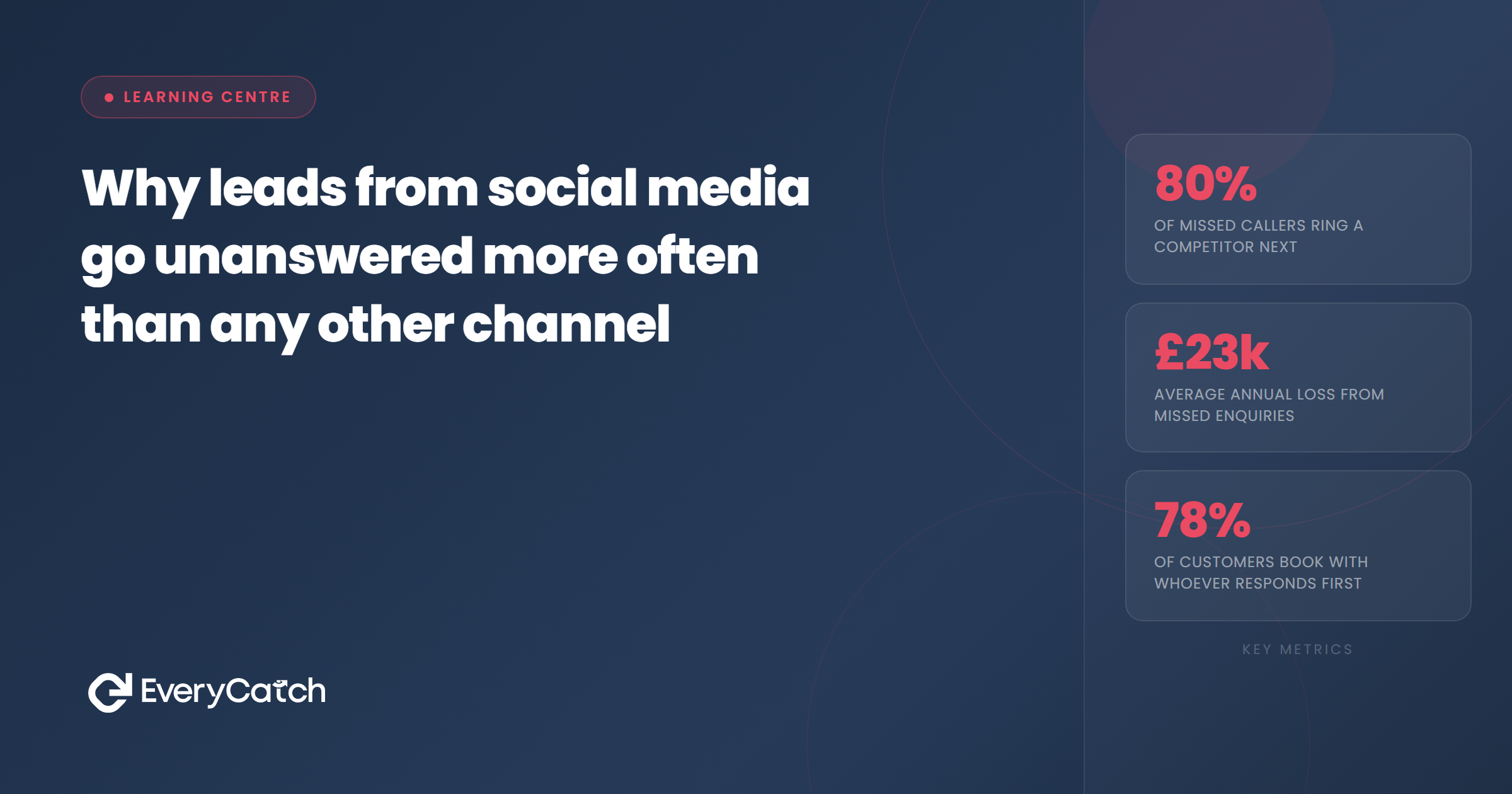
- Social media leads arrive across five or more separate inboxes, so no single person owns them and no single place shows them all.
- Facebook, Instagram and other platforms actively hide messages from strangers in filtered folders that most business owners never open.
- Comments, story replies and DMs feel casual, so owners treat them as chat rather than as buying signals, and prioritise calls and emails instead.
- Social enquirers expect the fastest replies of any channel, so a slow answer loses them faster than it would on email.
- Routing every social message into one inbox with an instant automated first reply removes the problem at its source.
Ask any service business owner where their missed leads come from and most will point at the phone. The data tells a different story. When you audit where enquiries actually go cold, social media channels consistently show the worst response rates of all. A missed call at least leaves a number to ring back. A Facebook comment asking "how much for a full rewire?" can sit there for a week without anyone noticing it exists.
This is not because business owners do not care about social media. Most spend real money and real hours posting there. The problem is structural. Social platforms are built for conversation, not for lead capture, and that mismatch produces a specific set of failure points that no other channel has. Here is what actually goes wrong.
Social leads arrive in too many places at once
A typical trades or service business today has a Facebook Page, an Instagram profile, possibly a Google Business Profile with messaging switched on, maybe TikTok, and often a personal Facebook account that customers message anyway. Each of those has its own inbox. Facebook alone splits enquiries across Messenger, Page comments, post comments, reviews and recommendations. Instagram adds DMs, story replies and comment threads.
Compare that with a phone call. There is one phone, one voicemail, one place to check. Email is the same. Social media is the only channel where a single lead can arrive in one of eight or nine locations, and where checking all of them requires opening multiple apps and tapping through multiple tabs within each one. Nobody does that reliably while running jobs, quoting and invoicing. The enquiry that lands in the one tab you did not check today is simply gone.
There is also an ownership problem. When leads come through one phone number, everyone knows who answers it. When they come through five social inboxes, responsibility blurs. The owner assumes the apprentice who posts the photos is watching the comments. The apprentice assumes the owner handles anything that looks like a sale. The message sits unread in the gap between them. We cover this pattern in more detail in why nobody in your business owns lead response.
The platforms actively hide messages from you
This is the part most owners never discover until it is too late. Facebook and Instagram both filter messages from people who do not already follow you or have an existing conversation with you. On Instagram these land in the Requests folder. On Facebook they can end up in Message Requests or the spam folder. New customers, by definition, are strangers to your account, which means the highest-value messages are the most likely to be filtered out of your main inbox.
No notification fires for many of these. The message simply waits in a folder you have to deliberately open. Plenty of businesses have opened that folder for the first time and found months of enquiries, some asking for quotes on jobs worth thousands of pounds, all long since taken elsewhere.
Even messages that do reach the main inbox get buried fast. Social notifications compete with likes, follows, tags, group activity and platform promotions. A genuine enquiry produces the same small red badge as someone reacting to a photo from 2023. After a day of that noise, most people stop reading notifications altogether, and the lead drowns in the feed.
How many social enquiries have you already missed?
A quick call will show you where leads are slipping through across every channel you run, and what it would take to catch them.
Book a free discovery callSocial enquiries do not feel like real leads
There is a psychology problem sitting underneath the technical one. A phone call feels urgent. An email with "Quote request" in the subject line feels like business. A comment saying "do you cover Stockport?" feels like chat. So it gets a mental note of "reply later" and later never arrives.
The instinct is wrong. Someone commenting on your post has seen your work, likes it enough to speak up in public, and is asking a buying question. That is a warmer lead than most form fills. But because it arrives in a casual format, on a platform associated with leisure, it gets triaged below everything else. Owners will interrupt dinner for a ringing phone. Almost nobody interrupts dinner for an Instagram story reply, even when the story reply is worth more money.
The casual format also makes these leads easy to lose mid-conversation. A DM exchange starts well, the customer asks for a price, the owner means to check the diary and reply, and the thread scrolls out of view under newer messages. There is no task, no reminder, no record in any system. If the follow-up does not happen in the moment, it usually does not happen at all. That is a follow-up problem as much as a response problem, and a structured follow-up sequence fixes the second half of it.
Social buyers expect the fastest replies of anyone
Here is the cruel twist. The channel businesses answer slowest is the one where customers expect speed most. Messaging platforms have trained people to expect replies within minutes, because that is how their friends respond. Research from Meta's own business studies has repeatedly shown that a large majority of people who message a business expect a response the same day, and a significant share expect one within the hour.
Someone who emails you will often wait a day without thinking anything of it. Someone who messages your Facebook Page starts messaging your competitor's Page about twenty minutes after you go quiet, because messaging three businesses at once costs them nothing. The general case for speed is laid out in why speed to lead matters more than your marketing budget, but the effect is sharpest on social, where the enquiry is impulsive and the alternatives are one tap away.
How to stop losing social leads
The fix has two parts, and neither involves checking your phone more often. Willpower does not survive contact with a busy week.
The first part is consolidation. Every message, comment, DM and review from every platform needs to land in one inbox alongside your calls, texts and emails, so there is one place to check and one person clearly responsible for it. This is exactly what EveryCatch's lead response system does. Facebook, Instagram and Google messages flow into the same conversation view as everything else, and nothing sits in a hidden Requests folder that nobody knew existed.
The second part is speed through automation. An instant automated first reply acknowledges the enquiry, asks a useful qualifying question, and buys you the time to respond properly. The customer stops shopping around because a conversation has started. When the exchange stalls, automated follow-up nudges it back to life instead of letting the thread scroll into oblivion. None of this requires you to be near a phone. It requires the system to be watching so you do not have to.
Businesses that make these two changes typically find social media jumps from their worst-converting channel to one of their best, without posting anything differently. The leads were always there. They were just landing where nobody was looking.

From the EveryCatch team
We build lead capture and response systems for service businesses across the UK, so enquiries get answered in minutes whether they arrive by phone, form or social media. Everything we publish comes from patterns we see across real customer accounts.