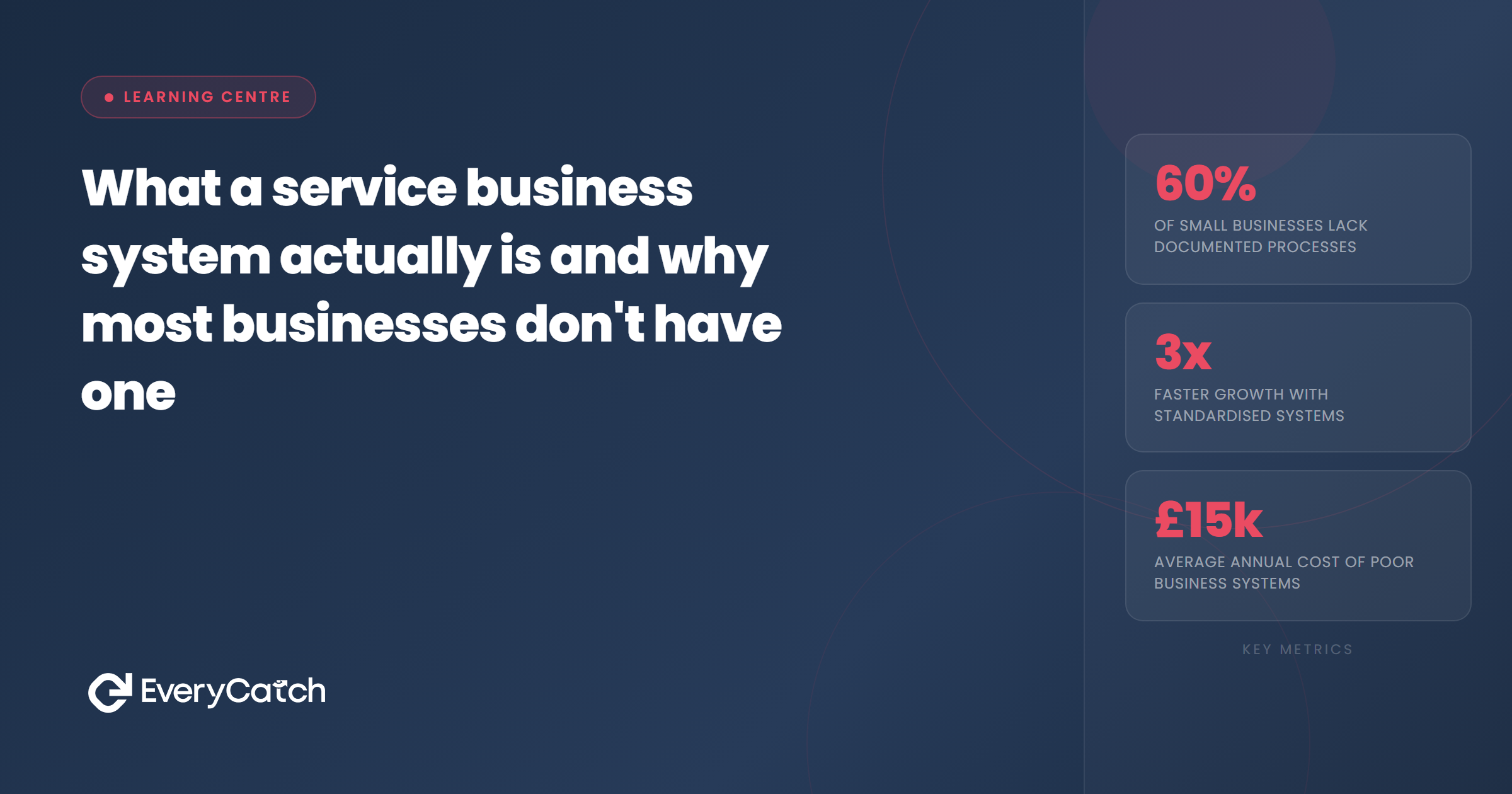
- A business system is a documented, repeatable process that produces consistent outcomes regardless of who is executing it
- Most service businesses operate on habit and personal knowledge rather than defined process — which limits growth and creates fragility
- Systems replace willpower with structure, meaning the right thing happens even on the wrong day
- The highest-priority systems to build are the ones that touch revenue and customer experience directly: enquiry handling, follow-up, review requests, invoice chasing
- Systems compound over time — consistent small actions, automated and repeated, produce disproportionate long-term results
What a Business System Actually Is
A business system is a documented, repeatable process for handling a specific function in the business. It defines what needs to happen, in what order, by whom, and to what standard — consistently, regardless of who is on shift, what mood anyone is in, or how busy the day has become.
For a service business, this might cover how new enquiries are handled, how jobs are scheduled and confirmed, how follow-ups are sent after a job is complete, how reviews are requested, how invoices are raised and chased, or how a customer complaint is managed. In each case, the system replaces the need for someone to decide in the moment what to do next. The right action is already defined, and ideally already triggered automatically.
The key distinction is repeatability. A business without systems produces different results depending on who is involved and what day it is. A business with systems produces consistent results regardless of either. That consistency is the foundation that makes a service business scalable, less dependent on any single person's memory and habits, and ultimately something that can survive the owner stepping away from it.
Why Systems Matter More Than Skills or Effort
Systems matter because the ceiling for a business built on individual effort and personal knowledge is reached very quickly.
A sole trader or small team can only work so many hours. The quality of what they deliver depends partly on how they are feeling on a given day, what they happen to remember to do, and whether they have the energy to follow through on the tasks that are easy to skip when things get busy. The business functions, but it functions on willpower rather than structure, and willpower runs out.
Systems remove that dependency. When the process for handling a new enquiry is defined and automated, it fires at 11pm on a Saturday the same way it fires at 9am on a Tuesday. When the post-job review request is built into the workflow, it goes out to every customer, not just the ones the owner remembered to ask that week. When the invoice follow-up process exists, money gets collected without anyone having to chase it manually every time.
That is the practical value of a business system: reliable outcomes that do not depend on everything going right on a given day, or on the right person being available at the right moment.
Ready to put your key business processes on autopilot?
EveryCatch handles the systems that most service businesses manage manually — enquiry response, follow-up, reviews, and more — set up and running without building from scratch.
Book a free discovery callWhat Most Service Businesses Do Instead
Most service businesses operate on habit and assumption rather than documented process. The owner knows how things are done because they have always done them that way. New staff figure it out by watching, asking, or making mistakes. Customers experience whatever level of consistency happens to emerge from that arrangement on any given day.
The result is that the business is not a business in the full sense. It is a collection of individual behaviours that produce variable outcomes. When the owner is unavailable, things do not happen the same way. When a good member of staff leaves, knowledge walks out with them. When the business tries to grow beyond its current size, the gaps in the non-system become visible and expensive very quickly.
This is not a failure of character or effort. Most service businesses were started by people who are genuinely good at the work — tradespeople, practitioners, specialists — not by people trained in operational design. The systems gap is nearly universal in small service businesses. Which is exactly why closing it creates a genuine competitive advantage. Most competitors have the same gap and are not doing anything about it.
Where to Start Building One
The most effective place to start is with the highest-frequency, highest-stakes processes in the business — the ones that happen every day and where inconsistency is most costly.
For most service businesses that means: new enquiry handling, job confirmation and scheduling, post-job follow-up, review requests, and invoice chasing. These are the processes that directly touch revenue and customer experience. Getting them defined and, where possible, automated produces more value than systematising anything further down the priority list.
Documentation does not need to be elaborate to be effective. A clear written process — here is what happens when an enquiry arrives, here is who does what, here is what gets sent and when — is already a system. It can be refined as the business learns what works. The goal at this stage is not perfection. It is replacing "whoever is available decides what to do" with "the defined process runs, regardless of who is available." That shift alone makes a meaningful difference to consistency and outcomes.
The Compounding Effect of Systematised Operations
Systems compound over time. A process that runs reliably every day for a year produces more consistent outcomes than anything managed manually, and those outcomes accumulate in ways that are hard to see in any single instance but become impossible to ignore over time.
The review requests that go out automatically to every customer accumulate into a Google Business Profile that ranks higher in local search and converts more visitors. The invoice follow-ups that run on schedule reduce debtor days and improve cash flow quarter by quarter. The enquiry responses that fire within minutes improve conversion without any increase in marketing spend. Each of these effects is modest in isolation. Together, sustained over months and years, they separate the businesses that grow steadily from the ones that plateau.
The businesses that eventually reach the point where the owner can take a week off without everything stalling, or hire into senior positions with confidence, or sell for a meaningful multiple, are almost always the ones with systems. Not because the owner was smarter or more disciplined, but because they built something that does not require them to hold every part of it together personally. That is what a system actually is — and it is what most service businesses are still missing.

From the EveryCatch team
EveryCatch is built around the systems that service businesses need most — enquiry handling, follow-up, reputation management, and customer communication — set up and running without the owner having to build everything from scratch.