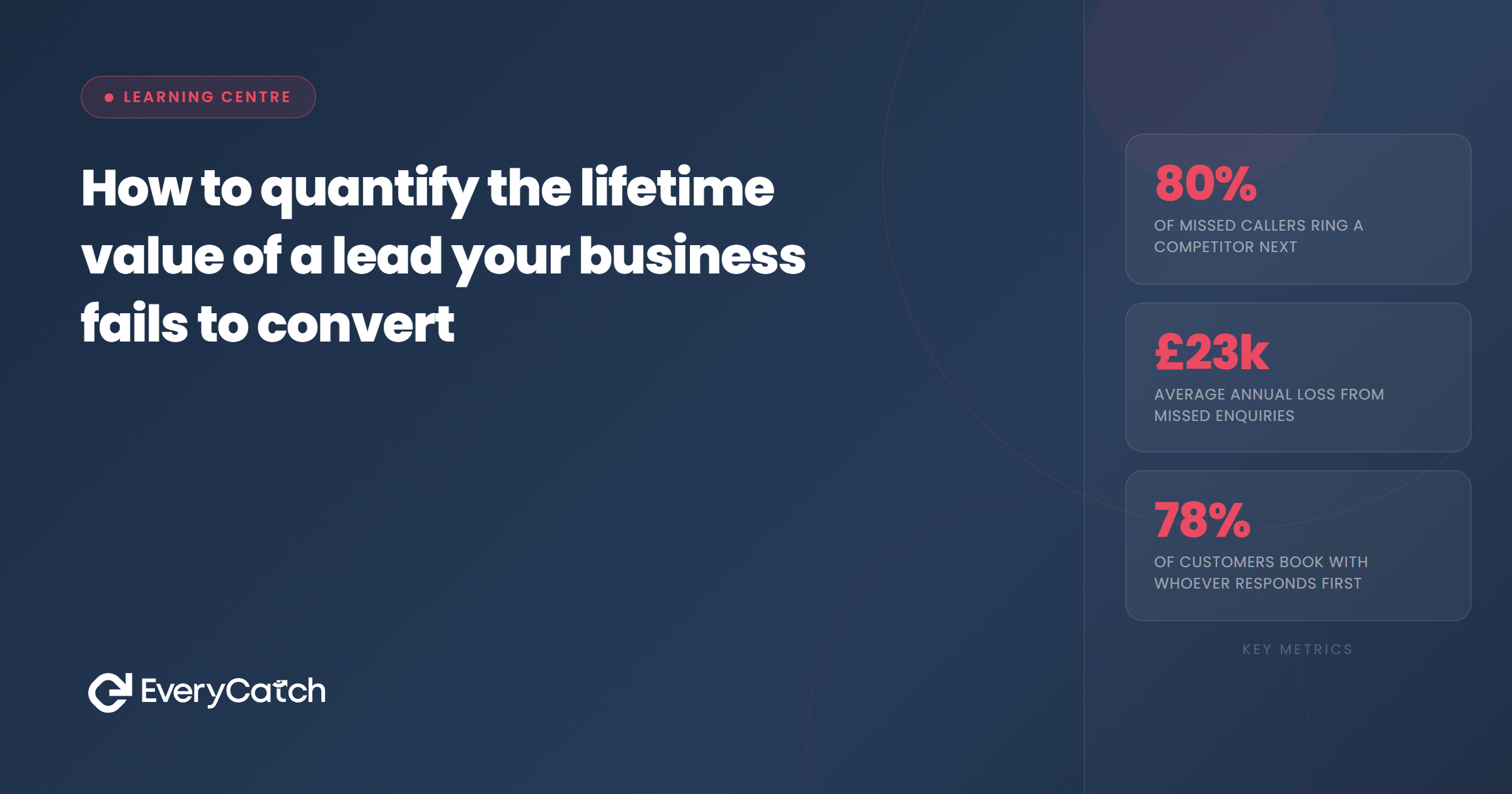

- The true cost of a lost lead is the first job plus repeat business plus the referrals that customer would have generated over time.
- Lifetime value equals average job value, multiplied by how many times a typical customer buys, plus a referral multiplier.
- For most trades and service businesses, a lost lead is worth five to ten times the value of the first invoice.
- You only need three numbers from your own records to run the calculation, and rough figures are fine to start.
- Multiply lifetime value by the number of leads you fail to convert each month to see what slow response and weak follow-up actually cost you.
When a lead goes cold, most business owners write off the value of one job. A plumber who misses a £300 boiler repair enquiry mentally logs a £300 loss and moves on. That figure is wrong, and it is wrong in a way that makes missed leads feel far cheaper than they are. The person behind that enquiry was not looking to buy one repair. They were auditioning a plumber for life.
Quantifying what that lead was really worth takes three numbers you already have, and about ten minutes with a calculator. Here is how to do it properly.
Why the single-job figure undersells the loss
Service businesses run on relationships, not transactions. A customer who has a good first experience rarely shops around again. They save your number, they call you for the next job, and they hand your name to their neighbours. When you fail to convert a lead, you lose every one of those future events in a single moment, not just the job they rang about.
Research on customer behaviour in local services backs this up consistently. Repeat customers spend more per transaction than first-timers, cost nothing to acquire a second time, and refer at higher rates the longer they stay with you. The first invoice is the smallest cheque that customer will ever write you. Losing the lead means losing the whole sequence.
There is a second, quieter cost. You almost certainly paid to generate that lead in the first place, whether through ads, directory listings, SEO or a website. That acquisition cost is spent whether the lead converts or not, which is why understanding what a single missed lead actually costs changes how seriously owners treat response speed.
The three layers of lead lifetime value
To quantify a lost lead, you need to stack three layers of value on top of each other.
Layer one: the first job
Start with your average transaction value. Take your revenue for the last twelve months and divide it by the number of jobs you completed. Do not use your biggest job or your cheapest call-out. The average is what a randomly selected lead is statistically worth on first purchase.
Layer two: repeat business
Next, work out how many times a typical customer buys from you over the life of the relationship. Pull up ten customers you have had for a few years and count their invoices. An electrician might see the same household four or five times over a decade. A cleaning company might invoice the same client fifty times a year. Multiply your average job value by your average number of purchases and you have the direct lifetime revenue of one customer.
Layer three: referrals and reviews
Happy customers recruit new ones. If a typical long-term customer refers even one other person who becomes a customer, the value of the original relationship effectively doubles, because that referred customer carries their own lifetime value. A conservative approach adds fifty per cent to the direct figure. A realistic one for word-of-mouth trades adds one hundred per cent. Reviews compound this further, since a steady flow of five-star reviews lowers the cost of every future lead you generate.
Want to know how many leads you're losing right now?
We will look at your enquiry channels, response times and follow-up gaps, then show you the leak in plain numbers.
Book a free discovery callA worked example you can copy
Take a heating engineer with an average job value of £350. Their records show a typical retained customer books six jobs over the relationship, including an annual service, occasional repairs and one larger installation. The direct lifetime value is £350 multiplied by six, which comes to £2,100.
Now add referrals. The engineer estimates that half of loyal customers send at least one new customer their way, so a fifty per cent multiplier is fair. That takes the total to £3,150 per converted lead.
One adjustment remains. Not every lead becomes a customer even when you respond well, so the value of a lead is the lifetime value discounted by your normal conversion rate. If this engineer converts forty per cent of the leads they actually respond to, each lead is worth £3,150 multiplied by 0.4, which is £1,260. That is the figure a missed call or an ignored web form actually destroys, not £350.
The formula in one line reads like this: lead value equals average job value, times average purchases per customer, times the referral multiplier, times your conversion rate. Swap in your own numbers and you have a defensible figure in minutes.
Count how many leads you actually fail to convert
The per-lead figure only becomes useful when you multiply it by volume, and volume is where most owners underestimate badly. Leads fail to convert for three main reasons: the enquiry was never answered, the response came too late, or nobody followed up after the first contact.
For one week, log every missed call, every after-hours enquiry, every web form and every social message, then track what happened to each. Most service businesses discover they lose between five and fifteen leads a month across those gaps. If you want a structured way to do this, our guide to auditing your business for lead leaks walks through the process channel by channel.
Apply the arithmetic to the heating engineer above. Losing eight leads a month at £1,260 each means £10,080 a month in destroyed lifetime value, or roughly £120,000 a year. Even if you halve every assumption in the model, the number stays large enough to justify fixing the leak this quarter rather than someday.
What to do with the number once you have it
The point of the calculation is not to feel bad about last month. It is to price your decisions correctly. When you know a lead is worth £1,260, spending £100 a month on a system that catches missed calls stops looking like a cost and starts looking like the cheapest employee you will ever hire. It also reframes response speed. Answering an enquiry within five minutes rather than five hours can lift conversion dramatically, and now you can attach a pound figure to that lift.
Fixing the leak usually means two things working together. The first is catching every enquiry the moment it arrives, which tools such as missed call text-back handle automatically by messaging any caller you could not answer. The second is persistent follow-up, because most leads need several touches before they book and most businesses stop after one. EveryCatch customers typically recover a meaningful share of leads that would previously have vanished, simply because every enquiry gets an instant reply and a follow-up sequence that does not forget.
Run the calculation once a year as your prices and customer behaviour change. The businesses that treat lead value as a known number, rather than a vague worry, are the ones that invest in response and follow-up before their competitors do.

From the EveryCatch team
EveryCatch helps service businesses catch and convert every lead with instant responses, automated follow-up and simple pipeline tracking. We write these guides so owners can see exactly where enquiries slip away and what it costs to let them.