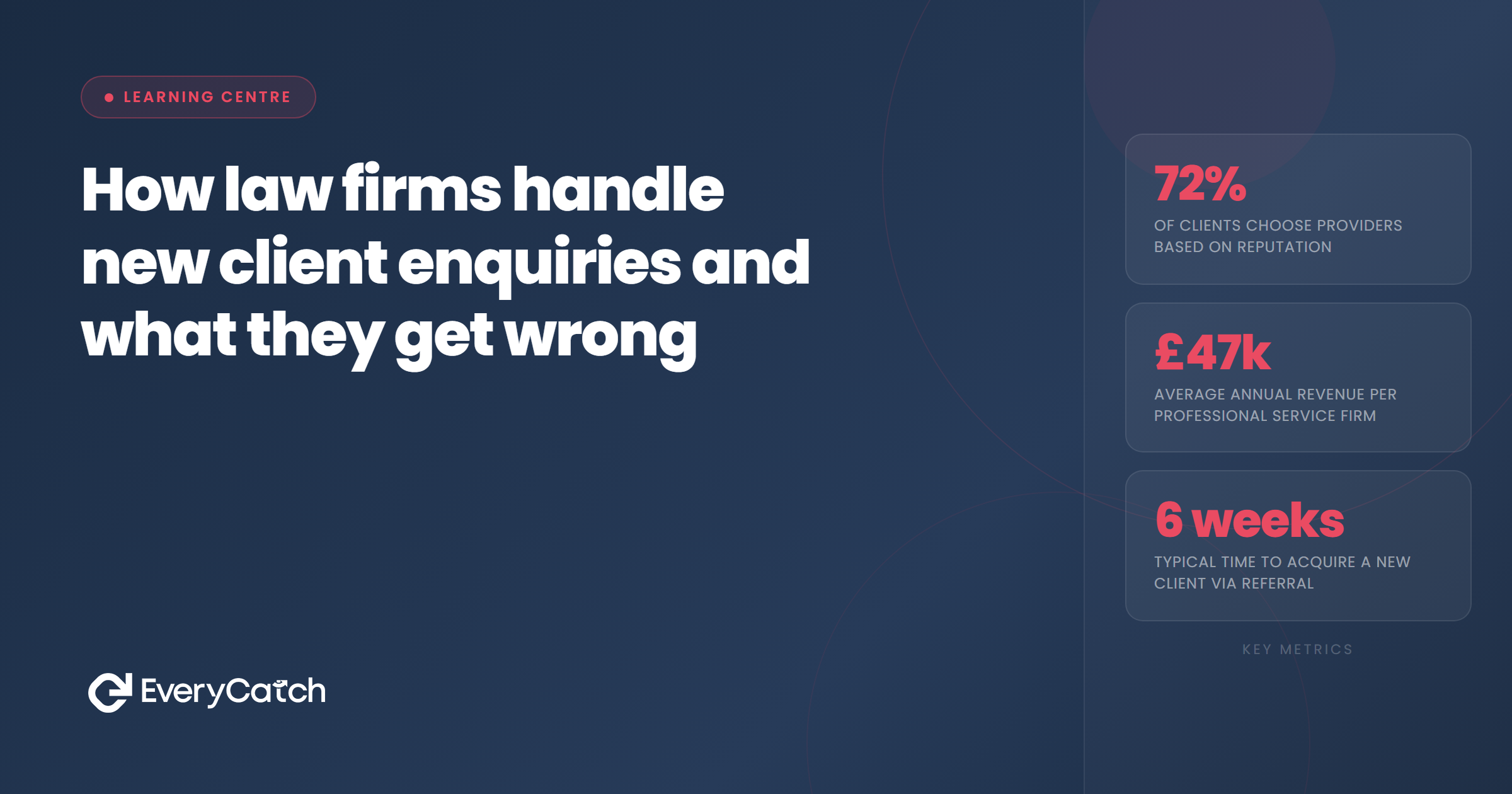

- Most smaller law firms handle new client enquiries reactively, without a structured intake process
- Slow or generic initial responses are the most common reason a prospective client contacts another firm instead
- Prospective clients form a strong impression of the practice from the very first interaction, before any legal work has taken place
- Fixing client intake does not necessarily require additional headcount — it requires a structured process and clear internal standards
- Firms that handle intake well retain more enquiries, generate more referrals, and compete more effectively without increasing their marketing budget
How Most Law Firms Actually Handle New Client Enquiries
Law firms handle new client enquiries in one of two ways: through a dedicated intake team with defined processes, or through whoever happens to be available when the phone rings or the email arrives. For most smaller and mid-sized practices, it is the latter.
The result is an inconsistent experience for prospective clients. A call that arrives during a hearing, a document review, or a client meeting either goes to voicemail or is answered briefly by someone whose attention is elsewhere. The follow-up, if it happens at all, is treated as a low-priority administrative task rather than as a business development priority. Emails to a general inbox queue behind client correspondence and billing queries until someone processes them, sometimes the same day, sometimes days later.
This creates a structural problem. Legal services are high-trust and high-value. A prospective client who has decided they need a solicitor is not making a casual enquiry. They are weighing up their options, comparing practices, and forming an impression from the very first contact. How a firm handles that initial enquiry communicates a great deal about how it will handle the matter itself.
What Goes Wrong and Why Potential Clients Walk Away
Several failure patterns recur across law firms of different sizes and disciplines.
Voicemail dependency is the most common. Many firms rely on practitioners or secretarial staff to pick up and return calls throughout the day, without any systematic process for ensuring that new client calls are captured and returned within a defined window. Calls that are not returned the same day are frequently never converted — the prospective client has moved on.
Unmonitored digital channels compound the problem. Many firms capture enquiries through website contact forms but have no clear process owner for monitoring and responding. Enquiries sit until someone checks the form by chance. For a prospective client who submitted a form expecting a response within a few hours, the delay signals disorganisation.
Generic first responses are another consistent issue. When someone does pick up a new enquiry, they often provide generic information about the firm rather than addressing the specific legal matter the potential client has raised. The caller leaves the interaction without reassurance, which reduces the likelihood they proceed rather than call another firm.
No follow-up system closes the loop on all of the above. If a prospective client does not call back after a first conversation, they are rarely followed up. The firm assumes disinterest. Often the client is still evaluating options and would have proceeded with a prompt, professional second contact.
Losing potential clients before they instruct you?
EveryCatch handles new client enquiries automatically so no first contact goes cold while your fee earners are occupied with existing matters.
Book a free discovery callWhat a Potential Client Actually Expects From You
A prospective client approaching a law firm is typically dealing with something stressful: a dispute, a transaction, a family matter, or a legal concern that has made them anxious enough to seek professional help. The speed and quality of the firm's initial response either builds or undermines the trust they are placing in the firm at its most fragile point.
At a minimum, they expect acknowledgement. They need to know their enquiry has been received and that someone will contact them. Beyond that, they want to speak to someone who understands, broadly, why they are calling and who can give them a clear sense of what the next step looks like. They are not necessarily expecting an immediate substantive legal conversation — but they are forming a strong impression of the firm's professionalism and client focus from the first interaction.
A practice that handles the first contact well signals that it will handle the matter well. A practice that handles it poorly signals the opposite, and that signal is amplified precisely because legal services involve such a high degree of trust. A potential client who feels their enquiry was not taken seriously will not raise the issue — they will simply instruct someone else.
Fixing the Response Problem Without Adding Headcount
The practical fix is not necessarily hiring more people. It is creating a structured process for how new client enquiries are received, acknowledged, routed, and followed up — and making sure that process has clear internal ownership.
At a minimum this means: a way for new client enquiries to be identified as such when they arrive (a separate new client number, a web form with a clear designation, or a handoff protocol during answering); an automated acknowledgement for digital enquiries that sets expectations for when a human will respond; and a defined internal target for first contact — the same business day at minimum, within an hour during business hours for higher-value practice areas.
For practices with the resource, a brief intake triage step handled by a receptionist or paralegal, using a structured question set, dramatically improves both conversion rate and the quality of information the fee earner brings to a first substantive conversation. The prospective client feels properly heard from the first interaction. The fee earner enters the conversation with context rather than starting cold.
The point is not to systemise the legal relationship. It is to ensure the administrative steps between "prospective client enquires" and "first proper conversation" do not damage trust before that relationship has had any chance to form.
The Business Case for Getting This Right
Legal services are not cheap, and new client acquisition costs time and marketing investment. Every prospective client who walks away because an enquiry was handled poorly represents a lost matter, a lost potential long-term relationship, and often a lost referral source. In a profession where reputation and word of mouth still drive the majority of new work for smaller practices, the first impression carries disproportionate weight.
A client who experiences a disorganised intake process will not only be less likely to instruct the firm; they are also less likely to refer others. The inverse is also true. A practice that handles new client contact with speed, clarity, and warmth stands out in a market where many competitors handle it inconsistently. In a sector not traditionally associated with strong client experience at the enquiry stage, improving the intake process alone can be a meaningful competitive differentiator, without changing fees, marketing budget, or how the legal work itself is done.

From the EveryCatch team
EveryCatch helps professional services firms handle new client enquiries faster and more consistently, turning more first contacts into booked consultations without increasing admin headcount.