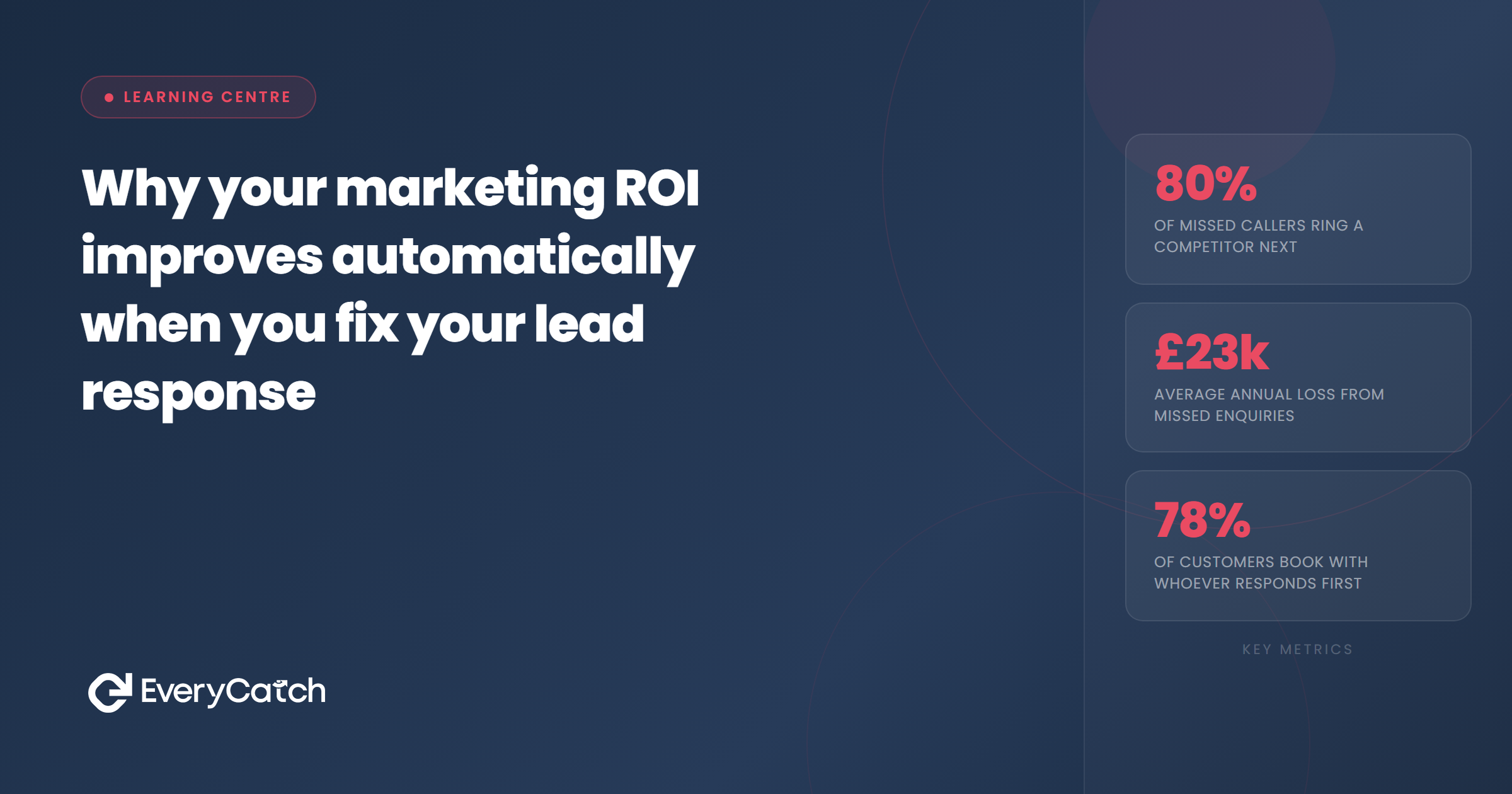

- Marketing ROI has two sides, spend and conversion, and lead response sits entirely on the conversion side.
- If you convert 20% of enquiries instead of 10%, your effective cost per customer halves without changing your budget.
- Slow or missed responses are usually the single largest conversion leak in a service business.
- The improvement is automatic because it applies to every channel at once, ads, SEO, referrals and directories.
- Fixing response speed is almost always cheaper than buying more leads to compensate for the ones you lose.
Most business owners who feel their marketing is underperforming reach for the same lever. They change the ads, switch agencies, or increase the budget. The assumption is that the problem sits in the marketing itself. Often it does not. The marketing is generating enquiries just fine, and the enquiries are dying in the gap between arriving and being answered.
That is why fixing lead response improves marketing ROI automatically. You do not need to change a single ad, keyword or landing page. You simply stop wasting the enquiries you already paid for.
Marketing ROI is a two-sided equation
Return on marketing investment is revenue generated divided by money spent. Every campaign, channel and agency gets judged on that ratio. Yet almost all the attention goes to the denominator. Owners negotiate ad rates, trim budgets and compare cost per click, while the numerator, the revenue those leads actually turn into, is left to chance.
Lead response sits squarely in the numerator. An enquiry only becomes revenue if someone answers it, answers it quickly, and follows up until the job is booked. When any of those steps fails, the money spent to generate the enquiry is still spent. The cost stays fixed while the return drops, and your ROI falls even though your marketing did its job perfectly.
The reverse is also true, and this is the part most owners miss. Improve the conversion side and ROI rises on every pound already committed. There is no new spend to justify, no campaign to test and no waiting for results to accumulate. The improvement lands on day one.
Where the leak usually sits
Research on lead response has been consistent for years. A prospect contacted within five minutes is dramatically more likely to convert than one contacted after an hour, and most businesses take far longer than an hour. In the trades and local services, an unanswered call during a busy afternoon often gets no follow-up at all. We cover the specifics in our article on how fast you should respond to a new lead.
The leak takes three common forms. Calls ring out while the team is on a job. Web form enquiries sit in an inbox until the evening, by which point the prospect has phoned two competitors. And leads that do get an initial reply receive no second touch, so anyone who did not answer the first attempt simply disappears. Each of these failures is invisible in your marketing reports. The ad platform shows a lead delivered. Nobody records that the lead was never spoken to.
This is why the problem persists. When ROI looks weak, the reporting points at the marketing, because the marketing is the only thing being measured. The response gap sits outside the dashboard, quietly deleting a third or more of the return.
A worked example with real numbers
Suppose you spend £1,000 a month on advertising and it generates 40 enquiries, so each lead costs £25. Your team answers promptly during quiet spells but misses calls when busy, and web forms wait hours for a reply. You convert 10% of enquiries, which gives you four jobs. At an average job value of £500, that is £2,000 of revenue from £1,000 of spend, a 2:1 return. Respectable, but thin once you account for materials and labour.
Now fix the response side. Every missed call gets an instant text back, every form gets a reply within a minute, and every lead that goes quiet gets a structured follow-up sequence. Nothing about the marketing changes. If conversion moves from 10% to 20%, which is well within the range businesses see when they close the response gap, the same 40 enquiries produce eight jobs and £4,000 of revenue. Your ROI has doubled to 4:1 and your effective cost per customer has fallen from £250 to £125.
Try producing that result by optimising the ads instead. You would need to halve your cost per lead, which in a competitive local market is close to impossible, or double your budget, which doubles your risk while the leak keeps draining the extra volume at the same rate.
Want to know what your response gap is costing you?
We will walk through your current enquiry handling and show you the revenue sitting in the leak, with no obligation.
Book a free discovery callWhy the effect compounds across every channel
Here is the reason the improvement feels automatic rather than incremental. Lead response is not a channel. It is the layer every channel passes through. Fix it once and the fix applies to your Google Ads, your organic search traffic, your Facebook enquiries, your Checkatrade profile and the referrals that come through word of mouth. A campaign-level improvement helps one campaign. A response-level improvement helps all of them simultaneously.
It also compounds over time. Faster responses win more jobs, more jobs generate more reviews, and more reviews improve the conversion rate of your listings and your website. Prospects who receive an instant, professional reply also refer more readily, because the first impression was sharp. The response fix keeps paying after the initial lift, which is something no ad tweak can claim.
There is a defensive angle too. Every lead you fail to answer is available to a competitor, and in most local markets the fastest responder wins the job regardless of who has the better ads. We explore that dynamic in where missed leads actually go. Closing your response gap does not just raise your own conversion. It stops funding theirs.
Fix response before you spend another pound
The practical order of operations follows directly from the maths. Before increasing any marketing budget, make sure every enquiry gets an answer within minutes, at any hour, through any channel. That usually means an automatic text back on missed calls, instant acknowledgement of web forms, and a follow-up sequence that persists for days rather than one attempt. These are systems rather than habits, because habits break the moment the week gets busy.
This is the problem EveryCatch was built to solve. It catches the enquiry the moment it arrives, replies instantly, and keeps following up until the prospect books or says no. Plenty of businesses assemble something similar from separate tools, and that works too. What matters is that the leak gets closed before more water gets poured in. Once it is, every marketing decision you make afterwards performs better, and the reporting finally reflects what your marketing was capable of all along.

From the EveryCatch team
EveryCatch helps service businesses catch every enquiry with instant responses, automatic follow-up and simple pipeline tracking. We write the Learning Centre to answer the questions owners actually search for, honestly and with real numbers.