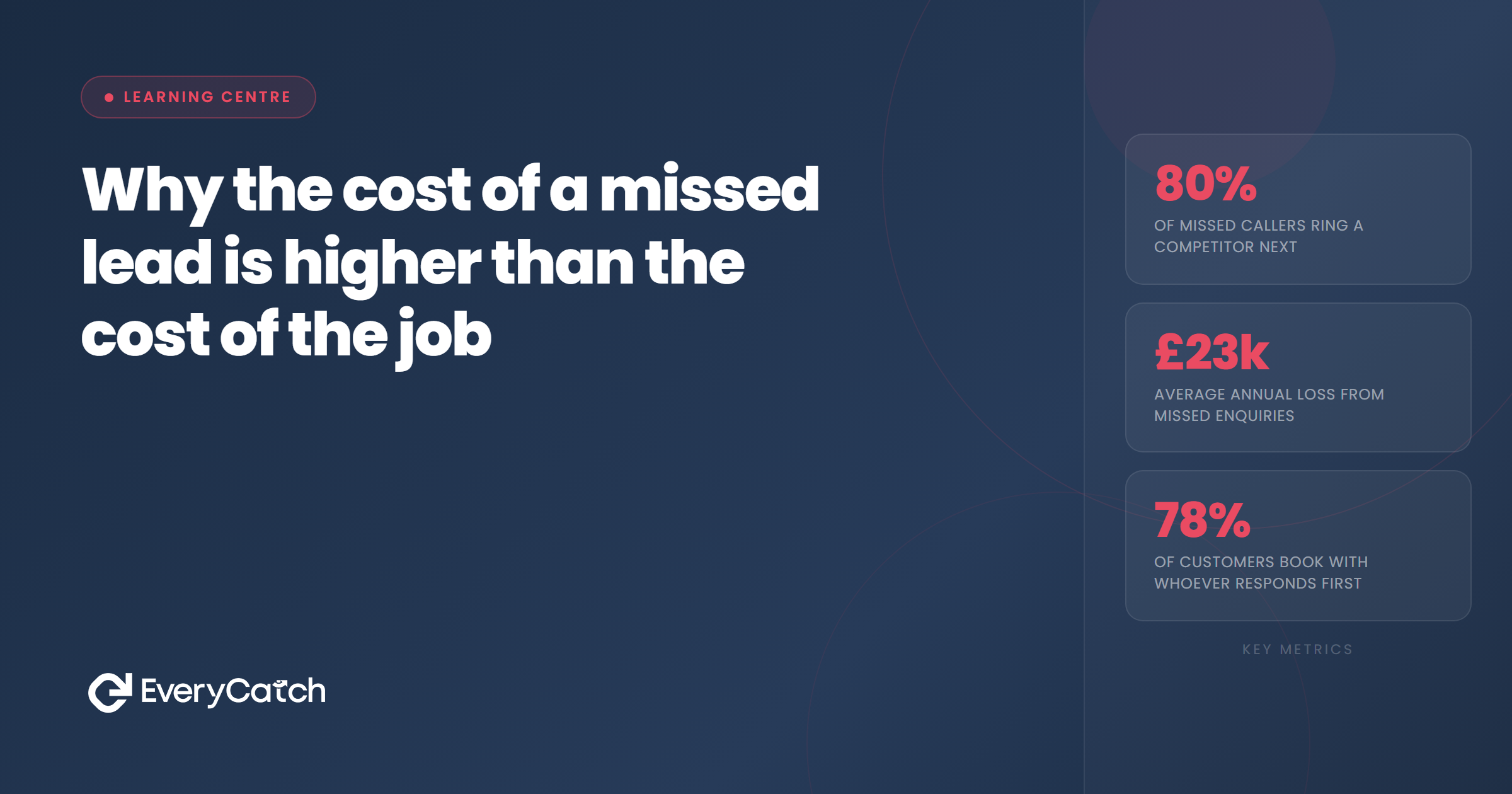
- The invoice value of one job is the smallest part of what a missed lead costs you.
- A single missed enquiry can wipe out years of repeat work, because the customer starts a relationship with someone else instead.
- You have already paid to generate the lead, so missing it means losing the marketing spend as well as the revenue.
- Every missed lead is a review, a referral and a word-of-mouth chain that goes to a competitor.
- Once you calculate the full figure, fixing your response process usually costs a fraction of what missing leads is costing you.
When a lead slips through, most business owners mentally write off the value of the job. A £300 boiler service, a £1,200 fencing job, a £4,000 bathroom refit. It stings, but it feels survivable, so nothing changes.
That mental maths is wrong, and it is wrong in a way that keeps businesses stuck. The invoice value of the job is the floor of what a missed lead costs, not the total. Once you add up everything attached to that one enquiry, the real figure is usually three to ten times larger.
The job value trap
The instinct to price a missed lead at the value of one job comes from how you invoice, not how customers behave. You bill per job, so you think per job. Customers do not work that way. A person who calls a plumber, an electrician or a landscaper is rarely buying a single transaction. They are auditioning a business they hope to use again.
Research on lead response, including the widely cited studies from InsideSales and Harvard Business Review, keeps landing on the same finding. Somewhere between a third and a half of buyers go with the first business that responds properly. When you miss the lead, the customer does not wait for you. They ring the next name on the list, and that next name inherits everything that follows.
So the question is not what the job was worth. The question is what the customer was worth. Those are very different numbers.
You lose the customer, not the job
Think about your best customers. Most of them arrived through one enquiry, years ago. A homeowner who has a good experience with a tradesperson tends to keep using them. The £300 boiler service becomes an annual service contract, a radiator replacement, a bathroom job, then a full boiler swap when the old one finally dies.
A reasonable lifetime value for a loyal domestic customer in most trades sits between £3,000 and £15,000, depending on the trade and how long you retain them. For commercial clients the figure climbs much higher. Miss the first enquiry and you do not lose one invoice. You lose the entire stream, because the customer builds that history with whoever answered.
Worse, that relationship compounds against you. Every job your competitor completes for that customer makes it harder for you to ever win them back. People rarely switch from a tradesperson they trust.
Referrals and reviews go with them
Happy customers talk. In local service businesses, word of mouth is usually the highest-converting lead source you have, and it costs nothing. A satisfied customer typically refers two to three others over the life of the relationship, and those referred leads convert at far higher rates than cold enquiries because the trust arrives pre-built.
The same applies to reviews. That missed enquiry would eventually have become a five-star Google review, which would have nudged the next stranger comparing local businesses towards you instead of away from you. Reviews compound the same way referrals do, and both now belong to the business that picked up.
So a missed lead is not one lost customer. It is a lost node in a network. Cut the node and you cut every connection hanging off it. We covered how this chain works in more detail in our article on how missed leads quietly shrink your referral pipeline.
Want to know what missed leads are actually costing you?
Book a free discovery call and we will walk through your enquiry channels and put a real figure on the leads you are currently losing.
Book a free discovery callYou already paid for the lead
Here is the part that gets ignored most often. That lead did not appear for free. You paid for it through your website, your Google Business Profile effort, your Checkatrade or ads spend, your van livery, your years of building a reputation. Divide your total marketing cost by the number of enquiries you receive and you get your cost per lead. For most local service businesses it lands somewhere between £30 and £150 per enquiry, and considerably more in competitive trades.
When you miss a lead, that money is spent and gone. You bought the enquiry and then dropped it. It is the equivalent of paying for stock and leaving it on the pavement. Many owners respond to slow months by spending more on marketing, when the cheaper fix is almost always to stop losing the leads they already generate. We unpack that trade-off in should you spend more on marketing or fix your lead leaks first.
Every miss is a competitor's gain
A missed lead does not vanish. The customer still needed the work done, so someone did it. That means every figure above should really be doubled in competitive terms. You lost £5,000 of lifetime value, and your nearest competitor gained it. The gap between you widens by both amounts at once.
Over a year, this is how two similar businesses in the same town end up in very different positions. It is rarely about who does better work. It is usually about who catches more of the enquiries both of them are generating.
Putting a real number on it
Run the calculation for your own business. Take one missed lead and stack the layers. Start with the average job value, say £800. Add the repeat work a typical customer brings over five years, perhaps another £2,500. Add one referral at similar lifetime value, £3,000 or more. Add the £75 you spent generating the enquiry. That single missed call now costs over £6,000, and the estimate is conservative because it assumes only one referral and modest repeat business.
Now multiply by how often it happens. Studies of small service businesses consistently find that between a quarter and half of inbound calls go unanswered during working hours, because the owner is on the tools, driving, or with another customer. If you miss even three genuine leads a month, you are looking at a six-figure annual cost hidden inside a business that looks busy.
That is why the fix is worth prioritising over almost anything else. A missed call text-back, a fast response system and a follow-up sequence cost a small fraction of one recovered customer. This is exactly the gap EveryCatch was built to close. When a call goes unanswered, the system texts the caller within seconds, keeps the conversation alive and books the job before they ring your competitor. The lead you already paid for stays yours. If you want to see the mechanics, our guide on how missed call text-back works walks through it step by step.

From the EveryCatch team
EveryCatch helps service businesses catch every enquiry with instant lead response, missed call text-back and automated follow-up. We write the Learning Centre to answer the questions owners actually search for, honestly and with real numbers.