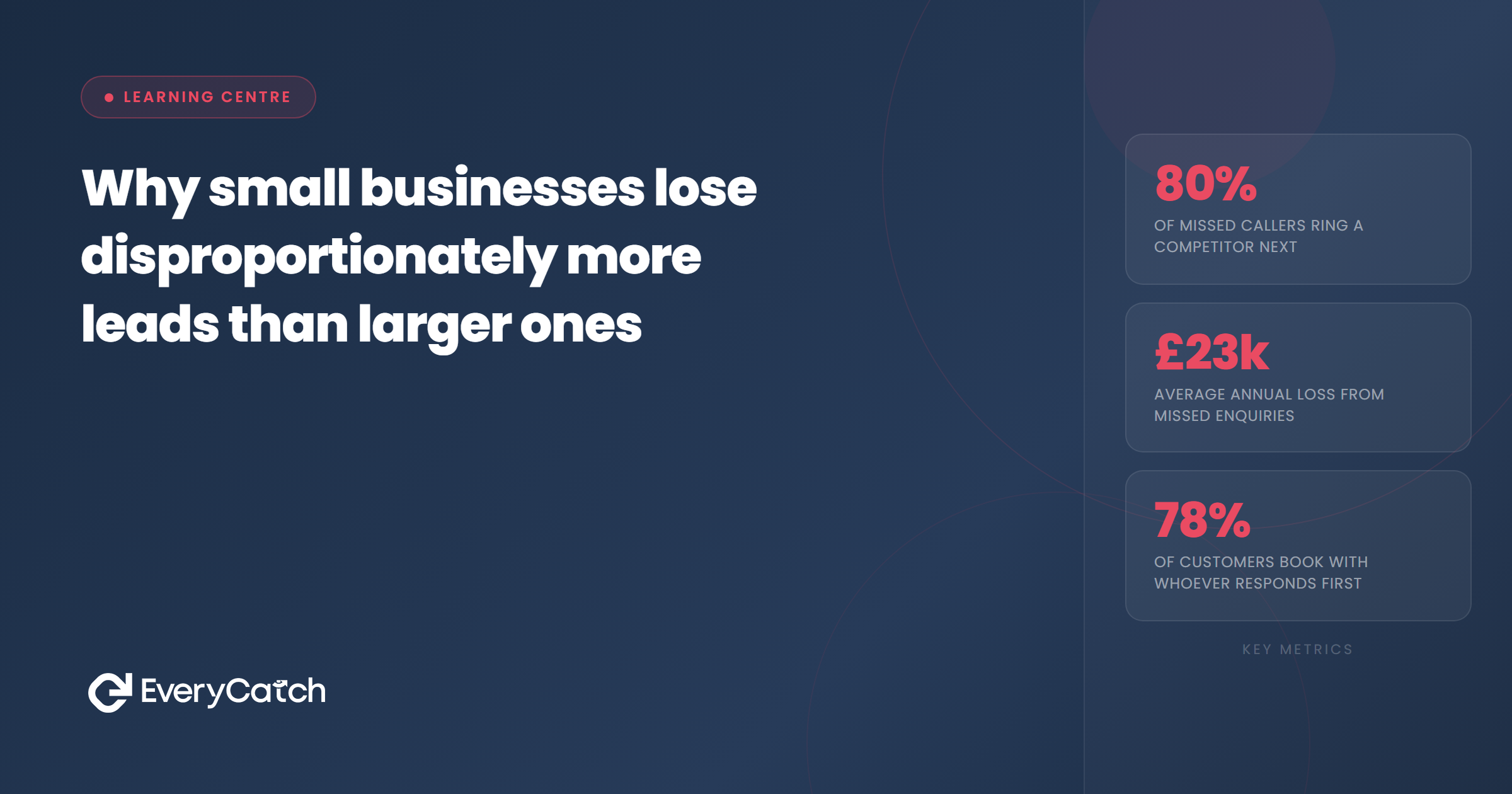

- Small businesses lose a larger percentage of their leads because enquiry handling is a side task rather than someone's job.
- The owner acting as the sales team, the operations team and the workforce creates an unavoidable bottleneck during working hours.
- Each lost lead costs a small business proportionally more, because the lead pool is smaller and each job represents a bigger share of revenue.
- Larger firms win with systems, not talent. Their receptionists, CRMs and follow-up processes catch what small businesses drop.
- Automation now gives small businesses the same catching infrastructure without a single new hire.
The honest answer to the question in the title is uncomfortable. Small businesses do not lose more leads because their work is worse, their prices are higher or their reputation is weaker. They lose more leads because nobody is dedicated to catching them. That single structural fact explains almost everything else.
The structural disadvantage nobody talks about
In a business with twenty staff, someone answers the phone. That is their job. They pick up within three rings, take details, and either book the caller in or promise a callback that actually happens because a system prompts it. The enquiry enters a pipeline and gets worked until it converts or dies.
In a business with one to five people, the phone rings while the owner is up a ladder, mid-consultation or driving between jobs. The call goes to voicemail, and research consistently shows that most callers will not leave a message. They ring the next name on the list instead. The enquiry never existed as far as any record is concerned, which is why so many owners underestimate how many leads they lose.
The difference is not effort. Small business owners typically work longer hours than anyone in a larger firm. The difference is that enquiry handling in a small business competes with billable work, and billable work always wins in the moment. It has to. The job in front of you pays this month's bills. The unanswered call is invisible.
The owner is the bottleneck, and the bottleneck is busy
Small business lead handling has a specific shape. The same person who delivers the work also answers enquiries, sends quotes, chases quotes and books appointments. Every one of those tasks happens in the gaps, usually in the evening when the working day ends.
Evening catch-up creates three predictable failures. First, response times stretch to hours or days, and speed is the single biggest driver of conversion. A lead contacted within five minutes is dramatically more likely to convert than one contacted the next day. Second, follow-up runs on memory. The owner intends to chase Tuesday's quote, then Wednesday brings two emergencies and Tuesday's quote quietly expires. Third, enquiries that arrive outside working hours, which for many trades is when customers actually sit down to sort their to-do list, wait until morning at best.
None of this reflects a lack of care. It reflects the impossible arithmetic of one person doing three jobs. Larger firms solved the same arithmetic years ago by splitting the roles apart.
Why the maths hits small businesses harder
Here is where the word disproportionate earns its place. Suppose a large firm and a small firm both miss 20 per cent of their inbound calls. The large firm generates 500 enquiries a month, so it drops 100 leads from a big pool while its marketing keeps the funnel full. The small firm generates 25 enquiries a month and drops 5. Those 5 might represent a quarter of its potential monthly revenue.
The percentage is identical. The consequence is not. Small businesses also tend to miss a higher percentage in the first place, because there is no receptionist, no rota and no overflow cover. Stack a higher miss rate on a smaller lead pool where each job matters more, and the disproportion compounds at every step.
There is a second multiplier. Small businesses usually pay proportionally more to generate each lead. A Checkatrade subscription, a Google Ads budget or a local sponsorship costs a much bigger slice of a small firm's revenue than the equivalent spend at a national company. When a lead paid for at that price goes unanswered, the small business loses the job and the acquisition cost together.
How many leads is your business dropping each month?
A short call with our team will show you exactly where enquiries are slipping through and what catching them would be worth.
Book a free discovery callWhat larger firms actually do differently
It is tempting to assume big companies convert more leads because of brand recognition or slicker salespeople. Mostly, they do not. They convert more because of unglamorous infrastructure. Every enquiry gets answered by a person or an automated response within minutes. Every enquiry gets logged in a CRM, so nothing depends on anyone's memory. Every quote gets chased on a schedule, automatically, until the customer says yes or no. Every missed call triggers a callback task that someone is measured on.
Strip away the branding and a large firm's advantage is a checklist: answer fast, record everything, follow up relentlessly. There is nothing on that list a small business is incapable of doing. There is simply nothing on that list a small business owner has time to do manually. Which is the entire point. The advantage was never headcount. It was that headcount used to be the only way to run the checklist.
How small businesses close the gap without hiring
That constraint has gone. Automation now runs the whole checklist without a receptionist's salary attached. A missed call can trigger an instant text back, which keeps the customer engaged before they dial a competitor. Web forms and Facebook enquiries can receive a reply within seconds at any hour. Quotes can be chased automatically on day two, day five and day ten. Every enquiry can land in a simple pipeline so the owner sees at a glance who needs what.
This is what EveryCatch was built to do for small service businesses. It answers when you cannot, follows up when you forget, and keeps a record when you are too busy to write one. The owner stays on the tools. The system does the catching. If you want to understand the mechanics before deciding anything, start with how missed call text back works, because for most small businesses that single fix recovers more leads than any other change.
The gap between small and large firms was never about quality or effort. It was about who had systems. Systems used to require staff. They no longer do, and the small businesses adopting them first are quietly taking jobs from competitors who still let the phone ring out.

From the EveryCatch team
We build lead capture and follow-up systems for small service businesses across the UK. Everything we publish comes from watching real enquiries get missed, and then fixing it.