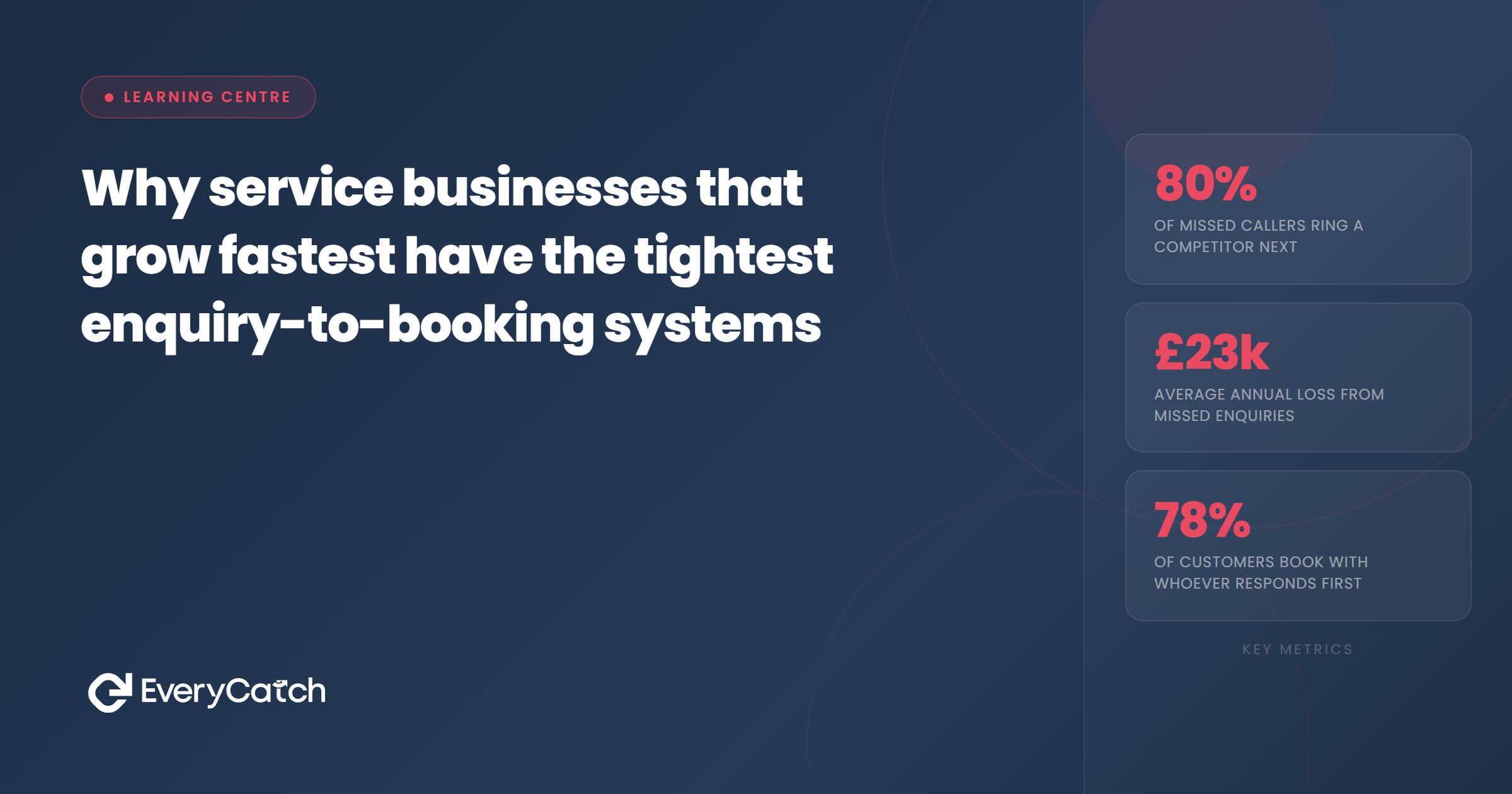

- Fast-growing service businesses win by converting more enquiries, not by generating more of them.
- A tight enquiry-to-booking system removes every point where a lead depends on someone remembering to act.
- Most enquiry loss happens in the gaps: unanswered calls, slow replies, and follow-up that stops after one attempt.
- Tighter conversion compounds, because every booked job feeds reviews, referrals and repeat work.
- You can tighten your own system in a week by measuring response times, closing the missed-call gap, and adding automatic follow-up.
Watch two similar service businesses over three years and you will often see the same pattern. Both do good work. Both spend roughly the same on marketing. One grows steadily while the other plateaus. The instinct is to assume the growing business has better ads, a better website, or a bigger budget. Usually it has none of those things. What it has is a tighter path from enquiry to booking, so a far higher share of the people who make contact end up in the diary.
That difference is invisible from the outside, which is why so few owners look for it. This article explains why the enquiry-to-booking system is the single biggest predictor of growth in service businesses, and how to build one that does not leak.
Growth follows conversion, not enquiry volume
Most owners who want to grow reach for more leads first. They increase ad spend, post more often, or pay for a better position in local search. The maths rarely supports that choice. A business receiving 60 enquiries a month and booking 20 of them does not have a lead problem. It has a conversion problem, and it is paying to pour more water into a leaking bucket.
Consider what happens when that same business improves its booking rate from a third to a half. That is ten extra jobs a month from the same enquiries, the same marketing spend, and the same phone number. To achieve the equivalent through lead generation, it would need a 50 per cent increase in enquiries, which typically means a 50 per cent increase in cost. Tightening conversion is almost always the cheaper lever, and it is the one fast-growing businesses pull first.
Research on lead response backs this up. Studies consistently show that responding within five minutes makes you many times more likely to reach and qualify a lead than responding within an hour. Yet most small service businesses take hours, and some take days. The gap between the fastest responders and everyone else is where market share quietly changes hands. We have covered the cost of that gap in detail in how much missed leads actually cost.
What a tight enquiry-to-booking system actually looks like
A tight system has one defining feature. No enquiry ever depends on a human remembering to do something. Every stage either happens automatically or triggers a clear, immediate prompt for someone to act.
In practice, the strongest systems share five traits:
- Every channel is covered. Calls, web forms, Facebook messages, WhatsApp and emails all land in one place, so nothing sits unseen in an inbox nobody checks.
- The first response is instant. A missed call gets an automatic text within seconds. A form submission gets a reply within minutes, not the next morning.
- Follow-up continues without effort. If the lead does not reply, the system nudges them again over the following days. Persistence is built in rather than left to willpower.
- Booking is frictionless. The lead can pick a time from a live calendar instead of playing phone tennis for three days.
- Everything is visible. The owner can see every open enquiry and its status at a glance, so nothing falls through unnoticed.
None of this requires a receptionist or an office manager. It requires the decision to treat enquiries as a process rather than a series of interruptions.
Where loose systems leak, and why owners rarely notice
Loose systems do not fail dramatically. They leak quietly, one enquiry at a time, and the leaks concentrate in three places.
The first is the unanswered call. Tradespeople and service providers are working when the phone rings, and a large share of callers who hit voicemail simply ring the next business on the list. They leave no message and no trace, so the loss never registers. The second leak is the slow reply. A form enquiry answered eight hours later often finds the customer has already booked elsewhere, because they contacted three firms and hired the first one to respond. The third is abandoned follow-up. Most businesses chase a lead once, then stop. Buyers who were genuinely interested but busy that week are lost to nothing more than silence.
The owner sees none of this. What they see is a reasonable number of jobs coming in and a general sense of being busy. The enquiries that leaked away never appear on any report, which is why we recommend every owner run the exercise in auditing your business for missed lead leaks before spending another pound on marketing.
How many enquiries is your business quietly losing?
A short call with our team will show you exactly where enquiries leak out of your current setup and what it would take to close the gaps.
Book a free discovery callWhy the advantage compounds over time
A tight system does not just win more jobs this month. It compounds. Every extra booked job creates a customer who can leave a review, refer a neighbour, and come back for repeat work. The business with the tighter system converts more enquiries, which generates more reviews, which improves its local search position, which produces more enquiries, which the tight system converts at a higher rate again. The loop feeds itself.
The loose business experiences the same loop in reverse. Fewer conversions mean fewer reviews and referrals, so it must spend more on advertising to stand still. After three years, the two businesses that once looked identical are in different leagues, and the difference traces back to something as unglamorous as how quickly missed calls got a text back.
There is also a quality effect. Fast, organised responses signal professionalism before the customer has seen any work. People assume that a business which replies within two minutes and offers a booking link will also turn up on time and finish the job properly. The system itself becomes a selling point.
How to tighten your own system this week
You do not need to rebuild everything at once. Start with measurement. For one week, record every enquiry that comes in, which channel it arrived through, how long it took to get a first response, and whether it became a booking. Most owners are shocked by their own numbers.
Then close the biggest gap first, which for most service businesses is the missed call. An automatic text back that says you have seen the call and asks what the customer needs keeps the conversation alive during the exact minutes they would otherwise spend ringing a competitor. After that, add automatic follow-up for enquiries that go quiet, and give every lead a direct way to book a time rather than waiting for you to call back. Each step on its own recovers enquiries you are currently losing. Together, they turn your enquiry handling from a leak into an advantage that your competitors cannot see and cannot easily copy.

From the EveryCatch team
EveryCatch helps service businesses catch every enquiry and turn more of them into booked jobs, with automatic responses, follow-up and booking built in. We write the Learning Centre to share what actually works, whether you become a customer or not.