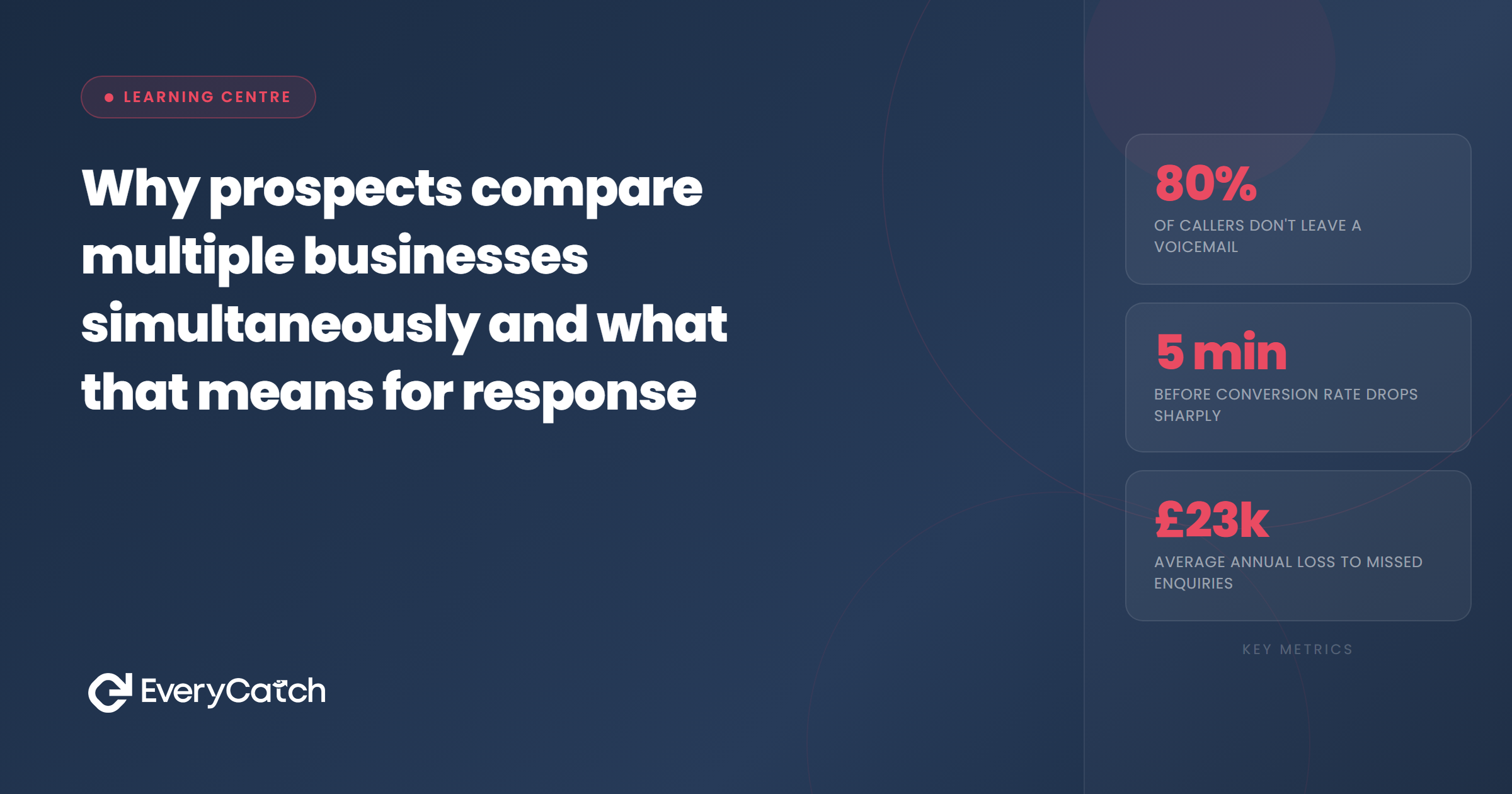

- Prospects submit identical enquiries to multiple businesses at once, typically within a single five-minute session
- The average prospect contacts between three and five businesses for the same job, often using aggregator sites or Google search results
- The first business to respond captures the conversation and sets the frame for what all subsequent responses are measured against
- Second and third responders face dramatically lower conversion rates, even if their quote is better or their service superior
- Response windows have compressed to under five minutes for maximum effectiveness, because prospects move fast once they've decided to shop
Why prospects shop in parallel
People no longer request a quote, wait for it to arrive, then decide whether to get another. That process disappeared the moment smartphones became the default research tool. What happens instead is a single shopping session where prospects open multiple tabs, submit identical enquiries to every business that looks credible, then wait to see who replies first.
This behaviour is driven by two forces. The first is convenience. Modern contact forms take seconds to complete, and most aggregator platforms auto-populate details once you've filled them in the first time. The friction that used to slow down parallel shopping has gone. The second force is uncertainty. Prospects have no reliable way to assess which business is best before they make contact, so they spread their bets across several at once.
The result is a market where enquiry volume looks healthy but conversion rates drop. You're not competing with the business down the road based on service quality or pricing. You're competing on whether you reply before they do, because the first business to respond doesn't just get a head start, they get the entire conversation.
How many businesses get contacted
Research into service industry enquiry behaviour shows that the typical prospect contacts between three and five businesses for the same job. That's the average. For high-value work like bathroom installations or roofing projects, the number can climb to seven or eight. For low-value or urgent jobs, it might drop to two, but seldom one.
Aggregator sites accelerate this behaviour. Platforms that promise to connect you with "trusted local tradespeople" collect a single enquiry and distribute it to multiple businesses simultaneously. The prospect submits one form. Six businesses receive it. The race starts immediately, and the prospect has no idea they've just triggered a sprint.
Even when prospects shop manually through Google, the pattern holds. They'll search "emergency plumber near me" or "fence installer Portsmouth," open the first three or four results in separate tabs, and fill in each form without closing the session. The entire process takes less time than it used to take to dial one phone number and leave a voicemail.
This means every lead that arrives in your inbox is a simultaneous arrival in several other inboxes. The clock isn't ticking on whether you'll respond. It's ticking on whether you'll respond first.
The first-responder advantage
The business that replies first does more than get noticed. They shape the entire transaction. When you're the first voice in someone's ear, you set the terms for what acceptable pricing looks like, what timeline sounds reasonable, and what level of professionalism the prospect should expect from everyone else.
This advantage is psychological, not just temporal. The first response breaks the prospect's uncertainty. They've submitted multiple enquiries because they don't know who to trust. The first business to reply answers that question immediately. You become the known quantity. Every subsequent response is measured against yours, not the other way around.
Research consistently shows that first responders convert at rates two to three times higher than second or third responders, even when pricing is identical. The gap widens further when the first responder is fast. Reply within one minute, and conversion rates jump again. Reply within five, and you're still in the high-conversion window. Reply after 30 minutes, and the advantage has usually evaporated.
Speed doesn't just improve your odds. It changes the nature of the conversation. When you reply instantly, prospects assume competence, availability, and eagerness to help. When you reply slowly, they assume you're busy, disorganised, or not particularly interested. Neither assumption is accurate, but both stick.
How many leads are you losing to faster competitors?
We'll show you exactly where the gaps are and what they're costing you.
Book a free discovery callWhat happens to second and third responders
If you're the second business to reply, you're not competing on the same terms as the first. You're competing with a conversation that's already started. The prospect has moved from uncertainty to engagement. They're no longer waiting to hear from someone. They're talking to someone, and your message arrives as an interruption.
The third and fourth responders face even steeper odds. By the time they reply, the prospect has often booked a site visit or agreed to a quote. Your email sits unopened because the decision has already been made, not because your service isn't good enough, but because you weren't there when the decision was happening.
This dynamic explains why many businesses see a disconnect between lead volume and job volume. You're receiving enquiries at a healthy rate, but conversion remains low. The issue isn't lead quality. The issue is that you're arriving after the race has finished.
Some prospects do eventually reply to second or third responders, usually after a negative experience with the first. But even then, you're not starting fresh. You're recovering a failed transaction, which means lower trust and higher price sensitivity. The prospect is wary, and they're looking for reassurance that you won't disappoint them the same way the last business did.
What this means for your business
If prospects are shopping in parallel, your operational model needs to reflect that reality. Waiting until the end of the day to check your inbox is the equivalent of not showing up at all. The conversation has moved on, the job has gone elsewhere, and the enquiry you received is now a missed opportunity rather than a potential booking.
The fix isn't complicated, but it does require systems. You need a way to know when an enquiry arrives, respond immediately with something useful, and ensure that the first human touchpoint happens within minutes, not hours. This doesn't mean you need to be glued to your phone all day. It means you need automation that buys you the time to reply personally without losing the first-responder advantage.
EveryCatch does this by detecting the enquiry the moment it arrives, sending an instant acknowledgment that feels personal, and alerting you immediately so you can follow up while the prospect is still in shopping mode. The system doesn't replace you. It makes sure you're first in line.
The same logic applies to phone calls. If someone rings and you don't answer, they don't leave a voicemail and wait patiently. They hang up and call the next business on their list. Missed calls need text-back responses within seconds, not hours, because that window is when the prospect is still actively shopping.
Parallel shopping isn't a trend. It's the default behaviour for anyone booking a service trade in 2026. The businesses that win are the ones that respond as though every enquiry is a race, because it is.

From the EveryCatch team
We help service businesses catch leads that would otherwise disappear into competitor pipelines. Our systems respond faster than humanly possible, so your prospects never feel ignored and your inbox never turns into a graveyard of missed opportunities.